
Introduction
A wiring harness is only as reliable as its individual components. Selecting the right wire gauge, terminal plating, connector housing, seal material, and protective covering determines whether a harness survives two years in an air-conditioned office or twenty years on a Pilbara mine site. Yet component selection is frequently treated as an afterthought—something left to the manufacturer's default bill of materials rather than engineered to the application.
This guide breaks down every major wiring harness component, explains the selection variables that matter most, and highlights the pitfalls that lead to field failures. Whether you are designing a harness for underground mining equipment or agricultural machinery, understanding these components at a granular level will help you specify a harness that performs reliably under Australian conditions.
For a broader view of how these components come together on the factory floor, see our wire harness manufacturing process article.
Core Wiring Harness Components
1. Wires and Cables
Wire is the foundational component of any harness. Selecting the correct conductor and insulation involves several interrelated decisions.
Conductor Material
- Copper (bare or tinned): The industry standard. Tinned copper offers superior corrosion resistance, especially in marine and coastal environments common along Australia's coastline. Bare copper is acceptable for enclosed, dry applications.
- Aluminium: Lighter and cheaper per kilogram, but with roughly 61% of copper's conductivity. Requires larger cross-sections to carry the same current. Used in weight-sensitive automotive harnesses where AS/NZS 3008.1.1 derating rules are followed.
- Copper-clad aluminium (CCA): A compromise that appears in cost-sensitive consumer applications. Not recommended for safety-critical or high-vibration harnesses due to potential fatigue at the copper-aluminium interface.
Insulation Types
Insulation choice governs temperature rating, chemical resistance, and mechanical durability:
- PVC (Polyvinyl Chloride): Economical, rated to 85–105 °C. Suitable for general-purpose interior applications. Degrades under prolonged UV exposure—avoid for outdoor Australian deployments without additional sheathing.
- XLPE (Cross-Linked Polyethylene): Rated to 125–150 °C. Excellent moisture and chemical resistance. Preferred for industrial and mining harnesses per AS/NZS 3008.1.1.
- Silicone: Rated to 200 °C+. Extremely flexible but mechanically fragile. Used in high-temperature zones near engines or furnaces.
- PTFE (Teflon): Premium option rated to 260 °C with outstanding chemical resistance. Common in harsh-environment industrial harnesses.
- TPE (Thermoplastic Elastomer): Flexible, halogen-free, and increasingly specified for environmentally conscious designs. See our wire harness sustainability guide for more on halogen-free materials.
Wire Gauge Selection
Wire cross-section must satisfy three constraints simultaneously: current-carrying capacity (ampacity), voltage drop over the harness length, and mechanical strength. AS/NZS 3008.1.1 provides ampacity tables for various installation conditions. For harnesses longer than 3 metres, voltage drop calculations often dictate a larger gauge than ampacity alone.
Our wire gauge selection guide covers the calculation methodology in detail.
2. Terminals and Contacts
Terminals are the metal contacts that create the electrical connection at each end of a wire. Their reliability directly determines harness performance.
Terminal Types
- Ring terminals: Provide a secure, captivated connection under a screw or stud. Resistant to vibration-induced loosening.
- Spade (flag) terminals: Allow quick connect/disconnect without fully removing a fastener. Common in automotive and appliance harnesses.
- Butt splices: Join two wires end-to-end. Available in insulated (heat-shrink or vinyl) and bare variants.
- Pin and socket contacts: Used inside connector housings. Available in stamped-and-formed (economical) and machined (high-reliability) versions.
Plating Options
| Plating Material | Corrosion Resistance | Conductivity | Cost | Typical Application |
|---|---|---|---|---|
| Tin | Moderate | Good | Low | General-purpose automotive, appliance |
| Gold | Excellent | Excellent | High | Medical, high-reliability |
| Silver | Good | Highest | High | High-current, high-frequency |
| Nickel | Good (to 250 °C) | Moderate | Moderate | High-temperature engine bays |
| Tin-lead | Moderate | Good | Low | Legacy designs (restricted by RoHS) |
Gold plating is typically applied over a nickel underplate. A minimum gold thickness of 0.76 µm (30 microinches) is standard for durability; 0.13 µm (5 microinches) "flash" gold is acceptable only for low-cycle mated connections.
"In Australian mining environments, we consistently see tin-plated terminals fail within 18 months when exposed to moisture and sulphide dust. Specifying gold over nickel with a minimum 0.76 µm deposit adds roughly 12% to terminal cost but extends service life by a factor of three." — Custom Wire Assembly
For a deep dive into crimp quality and terminal inspection, refer to our wire harness crimp quality inspection guide.
3. Connectors
Connectors house the terminals and provide the mechanical interface between harness segments or between the harness and a device.
Connector Selection Criteria
- IP Rating: The Ingress Protection rating defines dust and water resistance. For outdoor and mining applications, IP67 is the minimum; IP69K is required for high-pressure washdown. See our IP67 vs IP68 vs IP69K guide for a full comparison.
- Number of positions: From single-pin power connectors to 128-position multi-way housings. Always specify keyed or polarised housings to prevent mismating.
- Current and voltage rating: Must exceed the maximum circuit values with appropriate derating. Connector contacts are typically derated 20–30% from their free-air rating when used in multi-position housings.
- Locking mechanism: Positive locks (latch, screw, or bayonet) prevent accidental disconnection under vibration. Friction-fit connectors are unsuitable for mobile equipment.
- Shell material: Thermoplastic housings suit most applications. Metal shells (aluminium or stainless steel) provide EMI shielding and mechanical robustness for heavy industrial use.
Common Connector Families
For help choosing between major connector brands, our Deutsch vs Amphenol vs Molex and Molex vs TE vs JST comparisons provide side-by-side analysis.
4. Seals and Grommets
Seals prevent the ingress of moisture, dust, and contaminants at connector interfaces and bulkhead pass-throughs.
- Connector seals (cavity plugs and wire seals): Typically silicone or fluorosilicone. Each cavity in a connector must have a wire seal sized to the wire outer diameter, and unused cavities must be plugged. A single missing cavity plug can compromise the entire connector's IP rating.
- Bulkhead grommets: Rubber or silicone grommets that seal where the harness passes through a panel or enclosure wall. Must be sized for both the harness bundle diameter and the panel cutout.
- Heat-shrink seals: Adhesive-lined heat-shrink tubing creates an environmental seal around splices and connector backshells. The adhesive flows when heated, filling voids and bonding to the wire insulation.
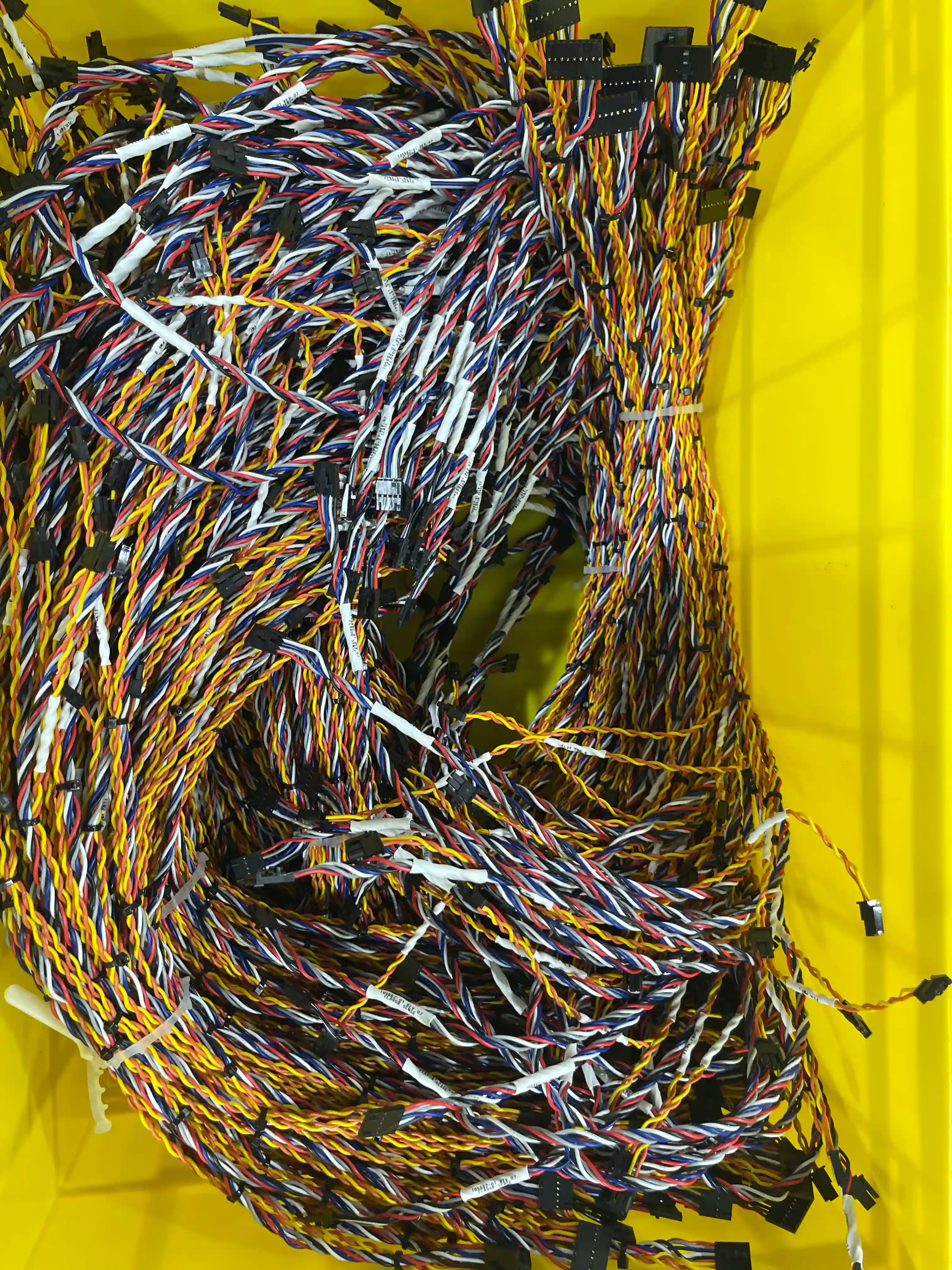
5. Protective Coverings
Protective coverings shield the harness from mechanical damage, chemical exposure, abrasion, and environmental stress.
Conduit and Loom Tubing
- Corrugated conduit (split or unsplit): The most common harness protection. Split conduit allows easy installation and field servicing. Available in polypropylene (general purpose), nylon (higher temperature and chemical resistance), and HDPE (UV-stabilised for outdoor use).
- Braided sleeving: Expands to accommodate varying bundle diameters and allows branch-out points. PET monofilament braiding is standard; Nomex braiding is used for high-temperature applications.
- Heat-shrink tubing: Provides insulation, strain relief, and environmental sealing. See our heat-shrink tubing sleeving guide for material selection guidance.
Tape and Wrapping
Harness tape serves multiple functions: bundling, abrasion resistance, noise dampening, and identification. Tape selection is covered in detail in our wire harness tape types selection guide.
6. Clamps, Clips, and Strain Reliefs
Proper routing and securing prevent harness damage from vibration, chafing, and excessive flexing.
- Cable clamps: Metal or plastic clamps that secure the harness to the chassis or structure at regular intervals. Rubber-lined clamps protect the harness from chafing.
- P-clips: Flat metal clips with a rubber cushion, used for single-wire or small-bundle attachment.
- Strain reliefs: Integrated into connector backshells or added as separate components, strain reliefs prevent mechanical stress from transferring to the terminal-crimp joint—the weakest point in any harness.
- Adhesive-backed clips: Used where drilling mounting holes is impractical. Must be specified with care; adhesive performance degrades at temperatures above 80 °C and in oily environments.
Our wire harness routing and clamping guide provides comprehensive routing best practices.
7. Labels and Markers
Identification is critical for assembly, testing, installation, and field maintenance.
- Heat-shrink markers: Printed or blank markers that shrink onto the wire. Durable and resistant to solvents and abrasion. Compliant with AS/NZS 3000 identification requirements.
- Self-laminating wrap-around labels: A clear tail laminates over the printed area, protecting it from smudging.
- Tag markers: Pre-printed or write-on tags attached with cable ties. Economical but less durable.
- Laser-marked wire: Wire insulation is laser-etched during manufacturing. Permanent and space-efficient, but requires minimum wire lengths to accommodate the marking.
See our wire harness labeling and marking guide for Australian-specific marking standards.
Component Selection Comparison
The table below summarises key selection parameters across the primary harness component categories:
| Component | Key Selection Parameter | Common Failure Mode | Critical Standard | Typical Australian Application |
|---|---|---|---|---|
| Wire insulation | Temperature rating & UV resistance | Cracking from UV/ozone exposure | AS/NZS 3808, UL 758 | Outdoor solar and mining |
| Terminal plating | Corrosion resistance & durability | Contact resistance increase from corrosion | IPC/WHMA-A-620 | Coastal and marine |
| Connector housing | IP rating & locking mechanism | Water ingress, vibration unmating | IEC 60529, AS/NZS 60529 | Heavy industrial |
| Seals | Material compatibility & size fit | Seal extrusion or hardening | SAE AS5202 | Mining washdown equipment |
| Conduit | UV stability & crush resistance | Cracking, splitting under load | AS/NZS 2053 | Agricultural machinery |
| Clamps | Vibration dampening & spacing | Chafing at clamp points | AS/NZS 3000 | Automotive and transport |
| Labels | Solvent resistance & legibility | Fading, smudging, detachment | AS/NZS 3000 Clause 2.3 | All installations |
Best Practices for Component Selection
Match Every Component to the Worst-Case Environment
Design for the most severe condition the harness will encounter, not the average. A harness on a Queensland cattle station may face 45 °C ambient temperatures, 100% humidity, intense UV radiation, and red dust simultaneously. Each component must be rated to survive this combined stressor profile.
Validate Seal Completeness at the Design Stage
A connector rated to IP67 achieves that rating only when every cavity is sealed—occupied or not. During design reviews, verify that the bill of materials includes cavity plugs for every unused position. A single overlooked cavity plug is the most common cause of IP rating failures in the field.
Specify Terminal-Connector Compatibility Explicitly
Not all terminals fit all connectors, even within the same connector family. A TE Superseal 1.5 mm seal will not properly grip a 1.0 mm wire, creating a leak path. Always specify the exact terminal part number, connector part number, wire gauge range, and seal part number together as a validated combination.
Use Strain Relief at Every Transition Point
The crimp joint where a terminal meets the wire is the most mechanically vulnerable point in a harness. Any bending, pulling, or vibration that reaches this joint will cause fatigue failure. Strain reliefs—whether integrated backshells, heat-shrink boots, or cable glands—must be specified at every point where the harness transitions from a fixed to a free state.
"In our failure analysis database, 34% of harness field returns trace back to inadequate strain relief. The crimp joint is designed for electrical conductivity, not mechanical load. If your design allows load transfer to the crimp, you will see failures—usually within the first 12 months of service." — Custom Wire Assembly
Document Every Component with Full Traceability
For harnesses supplied into regulated industries (mining, medical), every component must be traceable to its manufacturer, lot number, and date code. This traceability is a requirement of ISO 13485 (medical) and AS/NZS ISO 9001 (quality management), and it enables targeted recalls if a component defect is discovered.
Common Mistakes in Wiring Harness Component Selection
1. Undersizing Wire Gauge Based on Ampacity Alone
A wire that can carry 20 A in free air may be limited to 12 A when bundled inside a conduit with other current-carrying conductors. AS/NZS 3008.1.1 provides derating factors for grouped cables. Failing to apply these factors leads to overheating, insulation degradation, and potential fire.
2. Mixing Connector Families Without Validating Intermateability
Assuming that connectors with similar keying will mate correctly is dangerous. Mating a genuine TE connector with an aftermarket housing from a different manufacturer can result in contact misalignment, increased insertion force, and poor contact wipe—leading to high resistance or intermittent connections.
3. Ignoring UV Degradation on Outdoor Harnesses
Standard PVC conduit and wire insulation degrade rapidly under Australian UV conditions. Without UV-stabilised materials or protective sheathing, outdoor harnesses can develop insulation cracks within 2–3 years. Always specify UV-resistant materials (HDPE conduit, XLPE insulation, or UV-stabilised PVC) for any harness exposed to direct sunlight.
4. Omitting Cavity Plugs for Unused Connector Positions
As noted above, a single unplugged cavity voids the connector's IP rating. This mistake is especially common when a connector is specified with spare positions for future expansion. If those positions are not plugged, water and dust will enter the connector body and potentially migrate to occupied cavities.
5. Selecting Terminals Based on Price Alone
Tin-plated terminals cost less than gold-plated alternatives, but the total cost of ownership—including field failures, warranty claims, and replacement labour—often favours gold plating in harsh environments. A lifecycle cost analysis that accounts for the harness's expected service life and operating conditions will typically justify the higher-specification component.
"We audited a fleet of 200 underground mining vehicles where tin-plated terminals were specified to save $0.08 per contact. The resulting corrosion failures cost $1.2 million in downtime over 18 months. The gold-plated upgrade would have added $3,200 to the initial harness cost. Component selection is not the place to save pennies." — Custom Wire Assembly
6. Neglecting Thermal Expansion and Contraction
In environments with large temperature swings—such as desert mining sites where temperatures cycle from 5 °C at night to 50 °C during the day—different materials expand and contract at different rates. This can loosen clamps, stress seals, and fatigue crimp joints over thousands of cycles. Specify materials with compatible coefficients of thermal expansion and design in adequate slack to accommodate movement.
Australian-Specific Considerations
UV and Heat
Australia's high UV index and extreme heat demand materials rated well above the nominal operating temperature. A wire rated to 85 °C may see ambient temperatures of 50 °C plus solar gain plus self-heating from current flow, pushing the total well beyond its rating. Specify insulation rated at least 25 °C above the maximum expected conductor temperature.
Dust and Moisture Ingress
Outback dust is finer than typical international test dust and can penetrate seals that pass standard IEC dust tests. For mining and agricultural harnesses, specify IP69K-rated connectors with silicone or fluorosilicone seals, and validate the seal performance with dust exposure testing using fine particulate matter representative of the deployment environment.
AS/NZS Standards Compliance
Key standards governing harness components in Australia include:
- AS/NZS 3000: Wiring Rules—general requirements for electrical installations
- AS/NZS 3008.1.1: Selection of cables—current-carrying capacity and voltage drop
- AS/NZS 3808: Insulated cables for electric heating
- AS/NZS 2053: Conduits and fittings for electrical installations
- AS/NZS 4777: Grid connection of energy systems via inverters (relevant for solar harnesses)
For compliance guidance specific to cable assemblies, see our AS/NZS cable assembly compliance guide.
Conclusion
Wiring harness reliability is determined at the component level. Every wire gauge, terminal plating, connector IP rating, seal material, and protective covering must be selected to withstand the worst-case conditions the harness will face over its entire service life. In the Australian context—where UV intensity, temperature extremes, fine dust, and coastal salinity create uniquely demanding environments—this rigour is not optional; it is essential.
By following the selection criteria and best practices outlined in this guide, engineers can avoid the most common failure modes and specify harnesses that deliver long-term reliability. If you need expert guidance on component selection for your next project, contact our engineering team or explore the resources in our learning centre.
FAQ
What are the main components of a wiring harness?
The main components of a wiring harness are: wires and cables (conductor + insulation), terminals and contacts, connector housings, seals and grommets, protective coverings (conduit, sleeving, tape), clamps and strain reliefs, and labels or markers. Each component must be selected to match the electrical, mechanical, and environmental requirements of the application.
How do I select the correct wire gauge for a wiring harness?
Wire gauge selection requires evaluating three factors simultaneously: current-carrying capacity (ampacity) per AS/NZS 3008.1.1, voltage drop over the total harness length, and mechanical strength. For bundled conductors, apply the derating factors specified in AS/NZS 3008.1.1. In most harnesses longer than 3 metres, voltage drop—not ampacity—determines the minimum gauge.
What is the difference between tin-plated and gold-plated terminals?
Tin-plated terminals are economical and suitable for dry, low-corrosion environments. Gold-plated terminals offer superior corrosion resistance and lower contact resistance, making them essential for harsh environments (mining, marine) and low-voltage signal circuits where contact resistance is critical. Gold plating typically requires a nickel underplate and a minimum thickness of 0.76 µm for durability.
Why do unused connector cavities need to be plugged?
Unused cavities in a sealed connector must be plugged to maintain the connector's IP (Ingress Protection) rating. An unplugged cavity creates a direct path for water, dust, and contaminants to enter the connector body, potentially migrating to occupied cavities and causing corrosion or short circuits. Cavity plugs are low-cost components that are frequently overlooked, but their omission is one of the most common causes of IP rating failure in the field.
What protective covering is best for outdoor wiring harnesses in Australia?
For outdoor Australian conditions, UV-stabilised HDPE corrugated conduit or UV-resistant braided PET sleeving is recommended. Standard PVC conduit degrades rapidly under Australia's high UV index. For additional protection, XLPE-insulated wire with an outer UV-stabilised sheath provides the best combination of temperature resistance, moisture resistance, and UV durability.
How often should wiring harness clamps be spaced?
Clamp spacing depends on the harness diameter, weight, and vibration environment. As a general guideline, clamps should be spaced no more than 300 mm apart for harnesses up to 20 mm in diameter, and no more than 450 mm apart for larger bundles. In high-vibration applications such as off-road mining equipment, reduce spacing by 25–30% and use rubber-lined clamps to prevent chafing. Always include a clamp within 50 mm of every connector or splice.
What standards apply to wiring harness components in Australia?
Key Australian standards include AS/NZS 3000 (Wiring Rules), AS/NZS 3008.1.1 (cable selection), AS/NZS 2053 (conduits), and AS/NZS 3808 (insulated cables). For quality and workmanship, IPC/WHMA-A-620 is the international standard most commonly referenced by Australian harness manufacturers.