
Medical Connector Manufacturers for Custom Cable Assemblies
Compare the right medical connector families, integrate them into a production-ready cable assembly, validate the first article, and release a traceable build for Australian medical device programs.

Short answer: who is responsible for what?
Connector OEM (the connector manufacturer): owns the connector part design, mating-cycle rating, sealing/IP rating, sterilisation-compatibility statement for the connector itself, material declarations and datasheets.
Assembler: owns the cable, termination, strain relief and overmold build, wire schedule, BOM/revision control, test scope specified on the drawing and assembly lot traceability records. We are an Australian contract assembler, with cable assemblies built in partner factories.
Customer/device maker: owns the sterilisation method and cycle count the device actually sees, device validation, risk file, regulatory submission and acceptance of any connector substitution.
We do not certify a connector for a sterilisation method; the OEM datasheet and the device maker's validation do.
When buyers search medical connector manufacturers, the real need is usually bigger
Device teams rarely need an isolated connector. They need a connector family that fits the device, survives cleaning or sterilisation, supports the intended cable stack-up, and can be released into repeatable production with the right documentation.
Built Around Medical Device Risk
Medical connector decisions are driven by patient-contact risk, sterilisation exposure, mating-cycle life, ingress needs, and regulatory documentation instead of price alone.
Connector Family Review Before Quote
We compare circular push-pull, miniature board-to-cable, sealed sensor, hybrid power-signal, and disposable interface options before locking the cable design.
Traceable Cable Integration
Approved connector selections move into a controlled cable assembly package with BOM control, revision history, test scope, and lot traceability for later audits.
Prototype Validation Before Release
First articles can be checked for mating fit, pinout, retention, continuity, insulation resistance, and handling behaviour before the assembly is released to production.
Suitable for Regulated Programs
This capability fits medical device teams that need support around IEC 60601 electrical safety, ISO 10993 material questions, and documentation for TGA or FDA submissions.
From Connector Choice to Repeat Supply
Australian buyers can move from connector-family evaluation into prototype and recurring cable assembly supply without handing the project to a second vendor after approval.
What we evaluate before proposing a medical connector family
The connector decision has to align with the medical cable, not just the mating face. That is where many projects lose time.
| Decision area | Medical connector specialist path | Generic sourcing path | Catalog-only path |
|---|---|---|---|
| Regulatory support | Selection considers traceability, material declarations, and submission-ready documentation | Often focused on fit and price with less attention to medical documentation depth | Buyer must validate compatibility and paperwork independently |
| Cable integration | Connector choice is reviewed together with cable OD, shield termination, strain relief, and assembly method | Connector is chosen first and cable integration problems are solved later | Fixed part with limited control over cable build details |
| Prototype path | One supplier can evaluate, build, test, and revise the first article | Engineering, sourcing, and assembly may sit with different vendors | No custom prototype process beyond ordering samples |
| Production repeatability | Approved samples move into revision-controlled builds and repeat production | Repeat supply may drift if cable instructions are incomplete | Works for standard leads, weaker fit for custom device programs |
Technical scope for medical connector integration
Service Scope
Medical connector family selection, cable-end integration, prototype builds, first-article approval, and repeat cable assembly supply
Typical Connector Types
Push-pull circular, sealed circular, micro-miniature, hybrid power-signal, disposable patient leads, RF, and compact board-to-cable systems
Supported Materials
Cable jackets, overmolds, shielded constructions and strain relief can be specified against supplier material declarations and the device validation requirements
Validation Options
Continuity, pinout, insulation resistance, hi-pot, retention, dimensional and customer-defined functional checks can be specified; scope and acceptance criteria are agreed at quotation and recorded on the drawing
First Articles and Prototypes
First-article and prototype quantities can be discussed at quotation for design verification, validation builds or regulatory support samples
Typical Review Inputs
Connector part numbers, mating device details, drawings, sterilisation method, wire schedule, cable OD, shield requirement, and quantity plan
Commercial Fit
Best for OEM medical devices, diagnostics, patient monitoring, therapy systems, laboratory equipment, and service-spare programs
Out of Scope
Standalone connector brokerage, PCB redesign or unvalidated component substitutions; any connector substitute requires device-maker acceptance and the specified validation
Useful public references
Medical cable and connector selection is shaped by electrical safety, risk management, and quality-system expectations. Public references that buyers often review include the FDA medical device overview and background on IEC 60601.
For quality-system planning, teams commonly reference ISO 13485 and then map those expectations into their own design controls, supplier approval, and traceability process.
We use those frameworks to shape cable assembly documentation, but we do not replace your regulatory consultant, notified body, or in-house quality team.
Responsibility matrix
The connector OEM supplies component claims, the assembler controls the agreed build, and the device maker owns validation for the intended use. Set these responsibilities at quotation.
| Topic | Connector OEM | Assembler | Device maker |
|---|---|---|---|
| Connector rating claims | Owns the connector design, mating-cycle and sealing/IP ratings, connector sterilisation-compatibility statement, material declarations and datasheets. | Uses the approved part number in the assembly BOM and builds the specified cable termination and strain relief. | Selects the requirements for the intended use and accepts any connector substitution after the required validation. |
| Cable and overmold materials | Declares connector materials and the conditions relevant to the connector interface. | Controls the specified cable, termination, strain relief and overmold build, wire schedule and BOM revision; supplier declarations can be included in the agreed scope. | Approves the material selection and validates it for the device’s actual exposure. |
| Sterilisation validation | Provides compatibility evidence and cycle limits for the exact connector part number and method. | Builds to the approved specification; assembly checks can be specified. Does not certify connector sterilisation compatibility. | Owns the actual sterilisation method, maximum lifetime cycle count and device validation. |
| Mating-cycle life of the finished assembly | Rates the connector under its own published test conditions. | Controls the build and the test scope specified on the drawing; finished-assembly cycle testing can be agreed at quotation. | Defines the required mating cycles, test conditions and acceptance criteria and validates the finished assembly in use. |
| Traceability records | Provides connector lot/date identification and associated records within its supply scope. | Owns assembly lot traceability records, drawing/BOM revision control and the test records agreed at quotation. | Defines the required fields and links the agreed assembly records to the device records. |
| Documentation to submit | Supplies connector datasheets, rating statements and material declarations. | Supplies the agreed assembly build, revision, traceability and test documentation. | Owns the risk file, regulatory submission and acceptance of supporting evidence. |
Published connector ratings vs what they mean
A family page is a starting point. Use the OEM datasheet for the exact part number and validate the complete cable assembly against the device requirements.
Published example: Fischer Connectors Core Series Plastic
The manufacturer states compatibility with autoclave, Cidex, EtO, gamma radiation, Steris and Sterrad processes. It lists up to 5,000 mating cycles, 2 to 27 contacts and push-pull locking.
The page does not state an autoclave cycle limit. The autoclave cycle count must be taken from the OEM datasheet for the exact part number, not from a family page; confirm method compatibility for that part number too.
Source: Fischer Connectors, Core Series Plastic product focus (read 2026-10-12).
Wikipedia describes mating cycles as an indirect measure of connector lifespan, with contact plating type and thickness among the major factors. It also names push-pull, bayonet, screw-in shells, jackscrews and levers as locking styles. See Wikipedia, Electrical connector.
For assembly specification, the connector rating applies to the connector under the OEM's test conditions. The cable, strain relief and overmold can fail earlier, so the drawing should state the required mating cycles and the test used for the finished assembly.
Sterilisation exposure: what to ask suppliers
General sterilisation background, not a device rating. The conditions below describe processes; they do not establish compatibility or a cycle limit for a connector, cable or overmold.
| Method | Published condition | What to ask |
|---|---|---|
| Steam autoclave | Typical cycles: 3 to 30 minutes at 121–134 °C at 100 kPa. | Ask the connector OEM for the cycle count for this method and the exact part number. Ask the cable jacket and overmold suppliers for the same for the specified materials. |
| Ethylene oxide (EtO) | Generally 30–60 °C, relative humidity above 30%, gas concentration 200–800 mg/L, for several hours. | Ask the connector OEM for the cycle count for this method and the exact part number. Ask the cable jacket and overmold suppliers for the same for the specified materials. |
| Gamma radiation | Uses gamma radiation from cobalt-60 or caesium-137. | Ask the connector OEM for the cycle count for this method and the exact part number. Ask the cable jacket and overmold suppliers for the same for the specified materials. |
| Hydrogen peroxide plasma | Some hydrogen peroxide systems have cycle times as short as 28 minutes; nylon may become brittle. | Ask the connector OEM for the cycle count for this method and the exact part number. Ask the cable jacket and overmold suppliers for the same for the specified materials. |
Published conditions: Wikipedia, Sterilization (microbiology). Supplier questions are specification prompts, not published component ratings.
Traceability records to agree at quotation
Specify the assembly records needed by the device team on the drawing or quote. The scope is agreed at quotation.
As UDI background, UDI-DI identifies the manufacturer and product; UDI-PI is the production identifier and includes lot/batch and/or expiry information. See Wikipedia, Unique Device Identification. The assembly records below can support the device maker's traceability file; they do not themselves establish device UDI compliance.
Assembly-level records that can be specified
- Connector lot/date code
- Cable lot
- Overmold material lot
- Build date
- Operator/test record reference
- Drawing revision
- Test result per serial or lot, as specified
Illustrative worked example
Assumed numbers, for illustration only
Assume a device will be autoclaved N times over its life and its selected connector has a mating-cycle rating M. Keep N as the device maker's required autoclave count; it cannot be inferred from M.
For the arithmetic only, assume M = 5,000 mating cycles and 8 complete plug/unplug cycles per working day. The mating-cycle rating is used after 5,000 / 8 = 625 working days. At an assumed 260 working days per year, 625 / 260 ≈ 2.40 years, or about 2.4 years.
These are assumed inputs, not Fischer or customer figures, and the calculation is not a service-life guarantee. Separately confirm that the exact connector, cable jacket and overmold support the required N autoclave cycles, and validate the finished assembly for the combined use conditions.
Specify on the drawing
Agree these requirements at quotation so the build and acceptance checks follow the device specification.
- Exact connector OEM part number, recorded in the assembly BOM.
- Sterilisation method(s) and maximum cycles required over the device life.
- Required mating cycles for the finished assembly.
- IP/ingress requirement and the conditions in which it must be met.
- Cable jacket and overmold material, with their declared sterilisation compatibility.
- Required traceability fields and whether records are per serial or lot.
- Test scope, method and acceptance criteria, including the mating-cycle test used.
- Whether substitutes are allowed; no unvalidated substitution, and device-maker acceptance is required.
Use our testing capability to define the agreed checks and our overmolding capability to document material and strain-relief requirements.
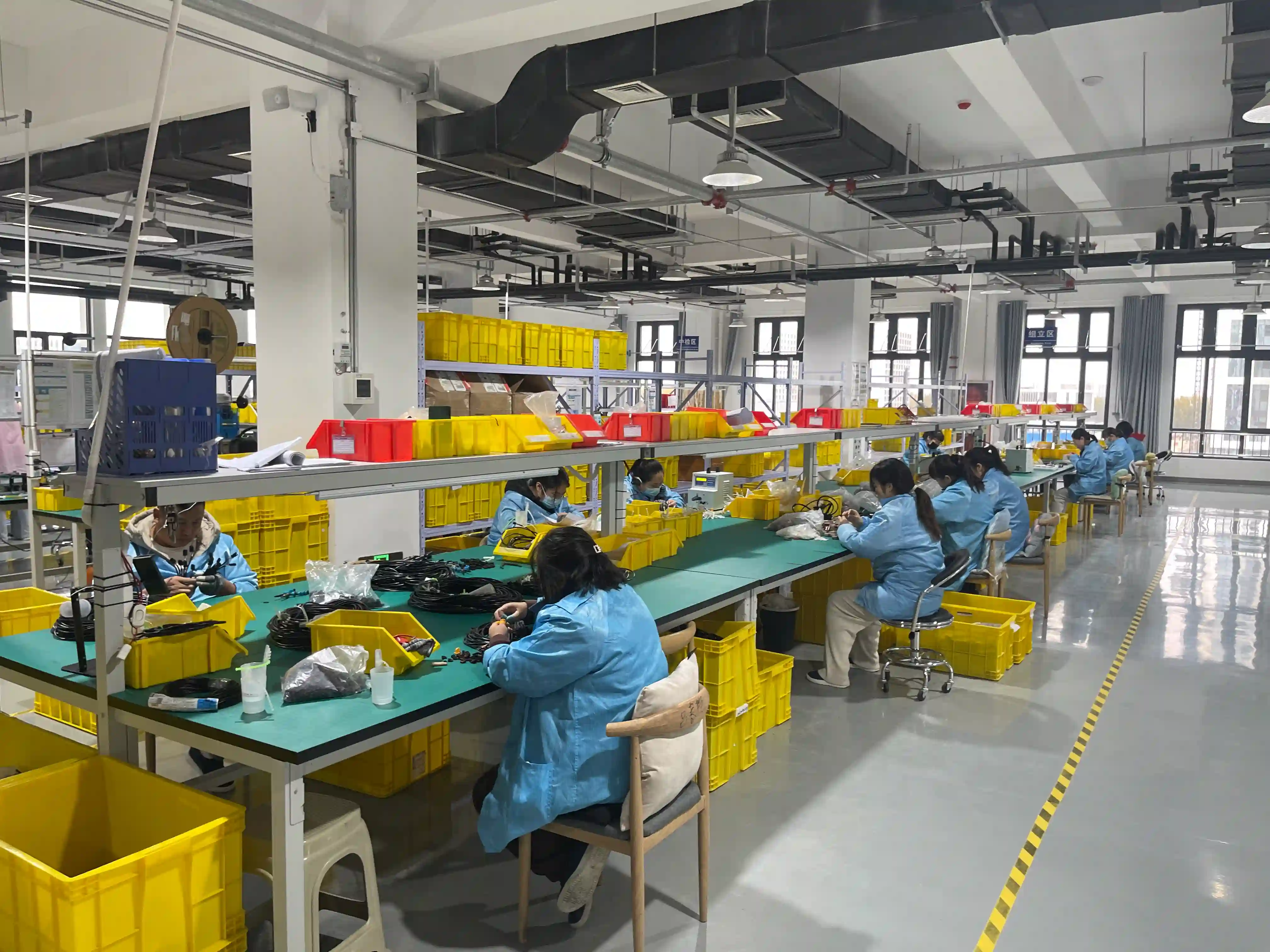
How the process works
Review the Device Interface
We start with the device function, mating method, cleaning or sterilisation exposure, cable route, and any user handling requirements so the connector choice is tied to the real clinical or laboratory use case.
Compare Suitable Medical Connector Manufacturers
Connector families are screened for shell size, contact layout, mating-cycle rating, sealing, shielding, sterilisation compatibility, and documentation availability before a shortlist is proposed.
Define Cable, Overmold, and Test Requirements
Once the connector family is approved, we align cable construction, conductor count, shield handling, strain relief, labels, and required validation checks into one build definition.
Build and Validate the First Article
Fit, handling, retention and electrical checks can be specified for prototype assemblies, with scope and acceptance criteria agreed at quotation so the device team can review the first article before production release.
Release Controlled Production
Approved medical cable assemblies move into repeat supply with documented BOMs, revision notes, test criteria, and lot traceability for future orders.
Typical medical programs this page fits
This is a commercial fit for buyers who need connector-family guidance tied directly to a medical cable assembly release.
Patient Monitoring Leads
Low-noise connectors and cable constructions for ECG, SpO2, temperature, and bedside monitoring equipment where mating reliability and handling comfort matter.
Diagnostic and Imaging Equipment
Cable assemblies for ultrasound, laboratory analysis, and imaging support systems that need compact connectors, shielding, and repeatable service replacement.
Therapy and Surgical Equipment
High-reliability interconnects for electrosurgical, respiratory, and therapy devices where strain relief, retention, and cleaning exposure are part of the design risk.
Portable and Wearable Devices
Miniaturised connector families for handheld and body-worn equipment where size, flex life, and user connection cycles are critical buying criteria.
Laboratory and IVD Platforms
Traceable cable builds for analytical instruments and automated lab systems that need stable connector sourcing over multiple product revisions.
Legacy Medical Equipment Support
Controlled connector replacement and cable rebuilds for ageing installed equipment where service teams need a validated spare rather than a guessed substitute.
How a typical medical connector manufacturers program runs with us
This is an illustrative description of a representative project type, not a specific customer engagement. As a contract assembler we do not publish customer-identifiable data.
Common questions from medical buyers
These questions usually appear before a connector family is released into a medical cable BOM.
How do I choose between different medical connector manufacturers?
Start with the application risk rather than brand familiarity. The correct medical connector family depends on mating cycles, sterilisation method, cable OD, signal sensitivity, ingress exposure, user handling, and documentation needs. We compare those factors before locking the connector into the cable BOM so the approved sample is commercially repeatable.
Can you help if our team only knows the mating device and not the connector family?
Yes. Many projects start with a device sample, rough drawing, or an existing cable that needs improvement. We can review the interface, identify realistic connector families, define cable integration constraints, and build a first article for approval before production.
Do you sell standalone medical connectors?
No. This capability is focused on finished medical cable assemblies and harnesses, not independent connector resale. That boundary matters because buyers usually need validated cable integration, strain relief, shielding, and test evidence rather than loose components.
What documentation should a medical connector supplier support?
At minimum, buyers usually need clear part identification, material declarations, test scope, revision control, and traceability records that can feed into device quality files. Depending on the program, sterilisation compatibility data, biocompatibility evidence, and electrical safety support may also be required.
Can medical connector changes be validated in low quantities first?
First-article and prototype quantities can be discussed at quotation. Mating, cable handling and electrical checks can be specified for design verification, validation testing or service-spare reviews before larger purchasing commitments are made.
What are the common mistakes when selecting medical cable connectors?
The most common mistakes are choosing by catalogue appearance, underestimating cable exit strain relief, ignoring cleaning or sterilisation exposure, and approving a connector before the cable stack-up is defined. In medical programs, those gaps often surface later as field failures or documentation delays.
Who is responsible for sterilisation compatibility?
The connector OEM provides the compatibility statement and datasheet for the exact connector part number. The device maker defines the actual sterilisation method and maximum cycle count and validates the device. We do not certify a connector for a sterilisation method: compatibility rests on the OEM datasheet and the device maker’s validation, not an assembler’s statement. Cable and overmold compatibility also needs supplier declarations and device validation.
Does a 5,000 mating-cycle rating apply to the finished assembly?
No. It is the connector’s rating under the OEM’s test conditions. The cable, strain relief or overmold can fail earlier. Specify the required mating cycles, test method and acceptance criteria for the finished assembly on the drawing; a mating-cycle rating does not establish a sterilisation cycle limit.
What traceability can be agreed for a medical cable assembly?
Connector lot/date codes, cable and overmold material lots, build date, operator/test record reference, drawing revision and test results per serial or lot can be specified. The record fields, revision and test record scope are agreed at quotation and written on the drawing or quote.
Related medical cable resources
Use these pages if you are moving from connector selection into validation, testing, or full medical cable assembly production.
Medical Wire Harness
Medical harness manufacturing for diagnostics, therapy devices, and patient-adjacent equipment.
Overmolding
Add sealed exits, strain relief, and medical-friendly protection around selected connector systems.
Testing & Quality Control
Add the electrical and workmanship checks needed before regulated assemblies are released.
Obsolete Connector Replacement
Replace unavailable medical connectors with validated alternates and updated cable builds.
Medical Cable Assembly Compliance Guide
Background on TGA, FDA, ISO 13485, and documentation requirements for medical cable programs.
Cable Assembly Connector Selection Guide
Connector selection fundamentals for mixed-end cable assemblies and risk-based sourcing decisions.
Need connector-family guidance and a buildable medical cable definition?
Send your drawing, device photos, current part number, or sample cable. We can review the connector options, define the cable integration details, and quote a validated first article.