
Power Tool Wire Harnesses Built Around the Housing, Not Just the Schematic
Custom wire harness and cable assembly manufacturing for cordless tools, corded tools, chargers, battery interfaces, trigger switches, motors, LEDs, and safety interlocks.
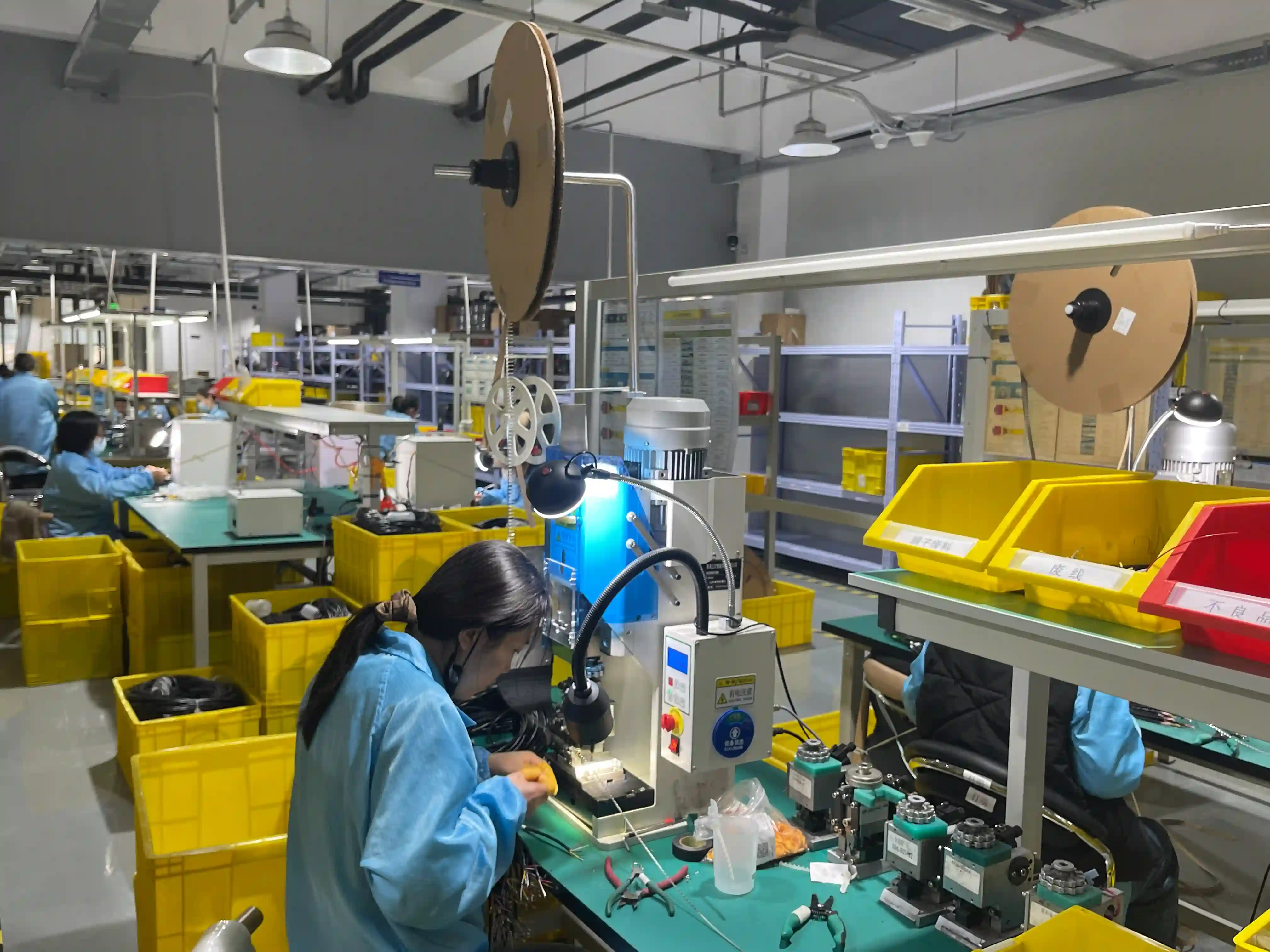
Short answer
- A power tool harness is specified by motor current, housing route and drop or vibration exposure, not by the schematic alone.
- Conductor loss is simple arithmetic: for example 0.6 m of 12 AWG copper at an assumed 60 A drops about 0.19 V and dissipates about 11.3 W (table below).
- Crimp resistance, routing and strain relief are checked separately, because the table covers the bulk conductor only.
- Test scope, quantities and limits are agreed on the drawing; none of the example figures on this page are customer or factory measurements.
Harness Design for Tight, Hot, High-Current Tool Interiors
Power tool wire harness manufacturing is a packaging problem as much as an electrical problem. A cordless drill, grinder, saw, or charger can place battery contacts, trigger switches, motor leads, LEDs, and sensors inside a housing where a small routing mistake can create pinch damage, heat exposure, or an intermittent fault after drop testing.
Our production approach starts with the tool architecture, then works back to wire gauge, terminal style, insulation, strain relief, and test fixture design. For broader harness workmanship context, buyers often reference cable harness construction principles and IPC workmanship expectations through the public IPC electronics overview.
The practical differentiator is first-article discipline: branch length, connector orientation, terminal retention, label location, and bend radius are checked against the housing before repeat supply. That reduces the common power tool failure mode where a harness passes bench continuity but later rubs against a motor, switch body, battery slide, or screw boss.
Capability Boundary
- We build harnesses, leads, cable assemblies, and electromechanical subassemblies for tool OEMs.
- We support samples, drawings, connector tables, and reverse-engineering inputs.
- We do not design or manufacture control electronics, battery cells, motors, or plastic tool housings.
What We Control in a Power Tool Harness
Power tool programs need more than generic jumper wires. The harness must survive assembly, current load, thermal cycling, vibration, and repeated handling by end users.
Battery Interface Leads
Battery bay harnesses need low-resistance contacts, secure terminal retention, and routing that survives pack insertion cycles without chafing.
Motor and Switch Circuits
Trigger, speed control, brushless motor, brushed motor, and brake circuits are built with the correct gauge, insulation, and strain relief for current and heat.
Compact Housing Fit
Handheld tools leave little room for excess wire. First articles check branch length, bend radius, connector orientation, and pinch-point clearance.
Vibration and Drop Resistance
Terminal locks, adhesive heat shrink, sleeving, and controlled bend zones help prevent intermittent faults after repeated impacts and tool vibration.
Fixture-Based Testing
Continuity, pinout, insulation resistance, and optional hi-pot checks catch swapped cavities, weak crimps, and assembly errors before incoming inspection.
Repeatable OEM Release
Controlled BOMs, cavity maps, cut lists, labels, and revision history make repeat production more predictable than sample-only sourcing.
Technical Specification Framework
The right specification depends on battery voltage, stall current, housing temperature, insulation class, available bend radius, and whether the harness is handled during service. Standards such as the public IP Code help define ingress targets, but the drawing still needs concrete release criteria for every wire, connector, and test point.
| Supported tool types | Cordless drills, grinders, saws, sanders, outdoor tools, chargers, test tools, and corded handheld equipment |
|---|---|
| Circuit types | Battery leads, motor leads, trigger switch harnesses, LED leads, charger contacts, sensors, interlocks, and earth leads |
| Wire and cable options | PVC, XLPE, silicone, TPE, high-strand flexible wire, multi-core cable, shielded signal cable, and customer-specified wire |
| Termination methods | Open-barrel crimping, closed-barrel crimping, ferrules, soldered leads by review, splices, heat shrink, and strain relief |
| Production profile | Prototypes, pilot runs, first articles, and repeat OEM production with controlled revision release; quantity confirmed per drawing at quotation |
| Testing | Continuity and pinout checks, with insulation resistance, hi-pot, pull-force sampling, and fixture checks when specified on the drawing |
| Quality basis | Factory certificates are held by the Hebei Cloom factory; scope and validity are confirmed per quotation. Product release follows the control plan agreed on the drawing. |
These ranges define quoting and manufacturability review. Final voltage, current, temperature, and safety requirements must be confirmed from your tool design and target market.
Representative Failure Scenario
A handheld tool harness can pass continuity at the supplier and still fail after assembly. In this illustrative case a battery lead is cut slightly long, folds under the pack slide, rubs during pack insertion, and exposes copper after repeated cycles.
The fix is not simply "better wire." The fix is a controlled harness package: shorter branch tolerance, a defined bend route, adhesive heat shrink at the transition, terminal pull-force sampling, and a housing fit check before production release.
In compact tools, excess wire is not harmless: every extra loop is a possible pinch point, heat trap or assembly-time variation, which is why the first article is checked in the real housing.
Lead Voltage Drop and Heat: Five Gauges Recomputed
Assumed example: annealed copper at 20 °C, a lead 0.3 m long each way (0.6 m loop), an 18 V nominal pack, and assumed motor currents of 30 A and 60 A. Resistance per metre comes from the AWG diameter formula, d = 0.127 mm × 92(36 − n)/39, and a resistivity of 1.7241 × 10⁻⁸ ohm metre.
| AWG | mohm per m | Loop mohm (0.6 m) | At 30 A | At 60 A | ||||
|---|---|---|---|---|---|---|---|---|
| Drop V | % of 18 V | Heat W | Drop V | % of 18 V | Heat W | |||
| 18 | 20.95 | 12.6 | 0.38 | 2.1 | 11.3 | 0.75 | 4.2 | 45.2 |
| 16 | 13.17 | 7.9 | 0.24 | 1.3 | 7.1 | 0.47 | 2.6 | 28.5 |
| 14 | 8.29 | 5.0 | 0.15 | 0.8 | 4.5 | 0.30 | 1.7 | 17.9 |
| 12 | 5.21 | 3.1 | 0.09 | 0.5 | 2.8 | 0.19 | 1.0 | 11.3 |
| 10 | 3.28 | 2.0 | 0.06 | 0.3 | 1.8 | 0.12 | 0.7 | 7.1 |
Check one row by hand: 12 AWG has a cross-section of 3.31 mm², so the 0.6 m loop is 1.7241 × 10−8 × 0.6 / 3.309 × 10−6 = 3.13 mohm. At 60 A that is 60 × 0.00313 = 0.19 V (1.0 percent of 18 V) and 60² × 0.00313 = 11.3 W. Copper resistance rises with temperature; at a conductor temperature of 80 °C it is about x 1.236 the 20 °C value (1 + 0.00393 × 60).
Limits of this table: bulk conductor only. It excludes crimp, connector and switch resistance, intermittent duty cycles and the heat path out of the housing. Stall and peak current come from your motor and controller design, so confirm them before choosing a gauge.
Five Route Checks at First Article
A schematic cannot show where a lead rubs. These five locations are reviewed against the real housing before repeat supply.
- 1Battery slide. Lead clears the pack slide and contacts through repeated insertion without folding or rubbing.
- 2Trigger flex zone. Bend radius and branch length allow the trigger to travel without pulling on terminals.
- 3Motor terminals. Strain relief or a defined bend sits before the terminal so vibration does not load the crimp.
- 4Clamp points. Clips, ties or sleeving fix the harness away from screw bosses, edges and moving parts.
- 5Heat source. Insulation type and clearance suit the nearest motor, switch or controller heat source.
Drop and Vibration Retest: Record Format
A harness that passes continuity can still change after a drop or vibration test, so compare contact resistance and terminal condition before and after. This table is a record format only: the values and limits come from your drawing or test plan, and this page does not publish results.
| Field | What to record | Where the limit comes from |
|---|---|---|
| Harness revision and sample ID | Revision, lot and a unique sample number | Drawing and cut list |
| Test condition | Drop orientation and count, or vibration profile and duration | Customer test plan |
| Contact resistance, before and after | Reading at each power terminal with the method named (for example a four-wire measurement) | Drawing or customer limit |
| Terminal seating and pull-force sample | Seated or not, pull-force result against the drawing minimum | Drawing |
| Visual at clamp and transition points | Insulation damage, chafe, sleeve or heat-shrink movement | Workmanship standard agreed with the customer |
| Disposition | Accept, rework or hold, with the reason | Control plan |
Related reading: crimp quality inspection for the crimp side of the record, and testing and quality control for how the agreed scope is applied. Factory certificates are held by the Hebei Cloom factory; see the quality page.
Applications We Support
Process From Prototype to Repeat Lot
Tool Architecture Review
Confirm battery voltage, motor current, switch layout, housing space, heat zones, service access, and expected movement before choosing wire and terminal details.
Harness Stack Definition
Select wire gauge, insulation, terminals, connector locks, sleeves, labels, heat shrink, and optional overmolded or strain-relieved exits.
Prototype and Housing Fit
Build first articles for bend radius, branch location, connector orientation, trigger clearance, battery bay routing, and assembly-line handling review.
Controlled Production Release
Release cut lists, crimp settings, cavity maps, visual standards, test limits, and revision-controlled work instructions for repeat lots.
Electrical and Mechanical Test
Verify pinout, continuity, insulation resistance where specified, pull-force samples, terminal seating, labels, and final workmanship before shipment.
How a typical power tool wire harness manufacturer program runs with us
This is an illustrative description of a representative project type, not a specific customer engagement. As a contract assembler we do not publish customer-identifiable data.
Power Tool Harness FAQ
Can I start with a small pilot lot of power tool wire harnesses?
Prototype, first-article and pilot quantities are discussed per drawing, and the quantity is confirmed at quotation. Before a pilot is built, lock the connector family, wire gauge, switch leads, motor leads, strain relief, labelling and test method, because changing any of them after the first article restarts the housing fit check.
What should I send for a power tool wire harness quote?
Send a drawing, sample, photos, connector part numbers, wire gauges, circuit count, housing space limits, battery voltage, motor current, expected flex points, annual volume, and required tests. Also mark whether the harness sits near a brushed motor, a heat source, a battery slide or a screw boss, because those locations change the insulation, sleeving and routing review.
Can you build harnesses for cordless battery tools and corded tools?
Yes. We build harnesses and leads for cordless tool internals, trigger assemblies, motor connections, charger docks, LED modules, safety interlocks and corded tool mains leads. We do not make battery cells, battery packs, motors or control electronics. Cordless designs often need compact routing and higher-current terminals, while corded designs usually put more weight on strain relief and earth continuity.
How much voltage does a short tool lead lose at high current?
It depends on gauge, length and current. As an assumed example, a 0.3 m lead each way (0.6 m loop) in 12 AWG copper has about 3.1 mohm of conductor resistance. At an assumed 60 A that is about 0.19 V, or 1.0 percent of an 18 V pack, and about 11.3 W of heat in the conductors. The same loop in 18 AWG would drop about 0.75 V (4.2 percent) and dissipate about 45.2 W. These are bulk-conductor figures only; crimp, connector and switch resistance are additional.
How do you reduce vibration and flex failures inside handheld tools?
We match conductor strand count, insulation type, terminal retention, bend radius and branch support to the tool housing. For moving or high-vibration zones we usually review silicone, XLPE or TPE insulation, adhesive-lined heat shrink, sleeving, clamp points and terminal locks, then check the first article in the real housing rather than on the bench.
What should be recorded after a drop or vibration test?
Record the harness revision and sample identity, the test condition from the customer test plan, contact resistance before and after, terminal seating and pull-force sample results against the drawing minimum, and any insulation damage at clamp points. The limits come from your drawing or test plan. The record format further down this page shows the fields.
Do power tool harnesses need electrical testing on every unit?
Continuity and pinout checks on each harness are the usual baseline for a harness this size, with insulation resistance, hi-pot, pull-force sampling, visual crimp inspection and fit checks added when the voltage, current or safety risk justifies them. The test scope is agreed on the drawing, and repeat builds normally keep the same fixture and limits.
Should I choose crimped, soldered, or welded terminations for a power tool?
Crimped terminals are usually the best default for power tool wire harnesses because they are repeatable, serviceable and compatible with inspection. Solder can work for specific switch or motor connections, but solder wicking creates a stiff transition that can crack under vibration. Welded joints are specialised and are reviewed against the design. The right choice depends on current, vibration and service access.
Related Capabilities
Terminal Crimping Service
Controlled crimps for open-barrel contacts, ferrules, lugs, and sealed terminals used in compact harnesses.
Prototype Cable Assemblies
First articles and pilot lots for housing fit, trigger routing, battery contact review, and design validation.
Overmolded Cable Assembly
Use overmolding where tool leads need permanent strain relief, sealing, or a cleaner user-facing cable exit.
Testing & Quality Control
Electrical, mechanical, and visual checks that support repeat production and incoming inspection.
Related Engineering Guides
Crimp vs Solder Terminations
Compare termination choices before locking a switch, motor, or battery-lead design.
Wire Harness Crimp Quality Guide
Review crimp inspection points that matter for vibration-prone handheld equipment.
Wire Harness RFQ Best Practices
Send the data that shortens quote time and reduces first-article revisions.
Need a Power Tool Harness That Fits the Tool Housing First Time?
Send your drawing, sample, or photos and we will review the routing, connector selection, crimp plan, and test requirements before quoting.