
Wire harness service
Cable Lacing Service for Wire Harnesses
Cable lacing at Hebei Cloom, with lacing material chosen to your requirements. Send your drawing to review the requested method, tie interval and acceptance requirements before quotation.
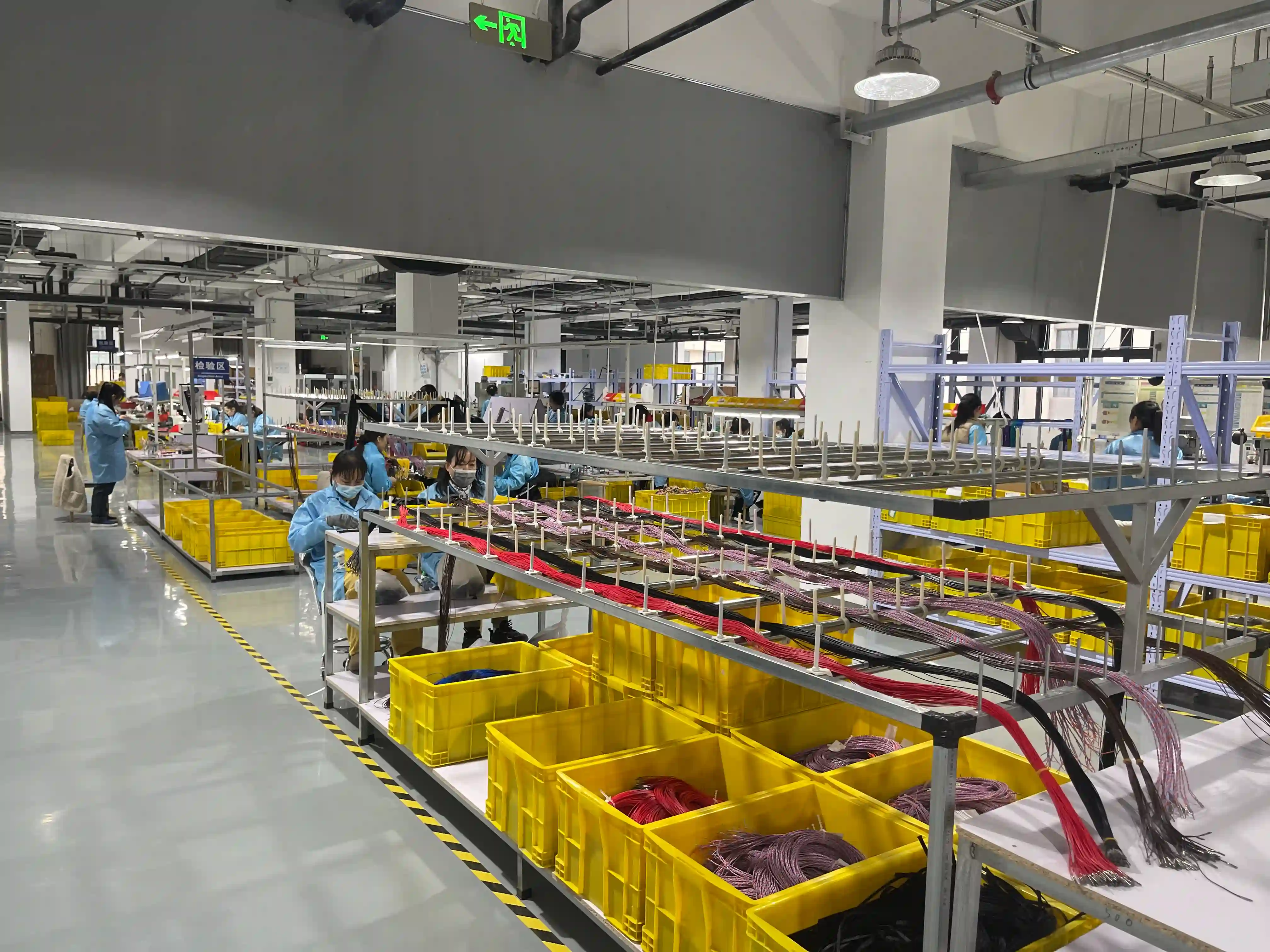
Cable lacing at Hebei Cloom
Yes, we lace wire harnesses. Send a drawing or photos that show the laced sections; the method, tie interval, lacing material and acceptance requirements are reviewed and confirmed at quotation. No MOQ; lead time depends on harness complexity and is confirmed in your quote. Manufacturing: Hebei Cloom, Luquan, Shijiazhuang. Contracting party: Shijiazhuang Cloom Tech., Ltd.
Specify the lacing method for review
Include the method you need in your RFQ; feasibility is confirmed at quotation.
| Method | What it is | Typical use |
|---|---|---|
| Spot ties (single ties) | Individual lacing ties at set intervals along the trunk and at each breakout. | For drawings that specify separate ties; rework access depends on the harness design. |
| Continuous lacing (running lock stitch) | One length of lacing cord or tape run along the bundle with a lock stitch at each interval. | Long trunks that must hold a formed shape, such as cabinet or rack wiring. |
| Breakout and terminal ties | Ties securing branch points and lacing ends where specified by the drawing or agreed workmanship requirements. | End and breakout securing details depend on the drawing and applicable workmanship requirements. |
Cable lacing vs cable ties
Many harnesses use both: ties on general runs and lacing where the drawing calls for it. The full comparison, including spiral wrap and clips, is in our bundling methods guide.
| Factor | Cable ties | Lacing cord or tape |
|---|---|---|
| Removal and rework | Cut off, no residue | Cut; replacement and retie requirements depend on the pattern |
| Tail and edge risk | Cut tails must be flush, no sharp edges | No rigid tail; knot ends trimmed |
| Hold on formed shape | Good at points, can slip on smooth jackets | Grip and shape retention depend on tie pattern, material and spacing |
| Pressure on insulation | Over-tightening can deform insulation | Flat tape can spread contact pressure; tension and width still matter |
| Labour per harness | Low, tool-assisted | Higher, manual |
| Example specification contexts | General production harnesses | Drawings that call out lacing, cabinet and rack looms, legacy rebuilds |
Lacing materials: chosen to your specification
Lacing material is chosen to your requirement. The clearest way to state it on a drawing is a material specification or part number. Many drawings name a US federal commercial item description (CID) for flat braided lacing and tying tape:
Method: we selected the four material-specific CIDs in the A-A-5208x "Tape, lacing and tying" family from the EverySpec and GlobalSpec listings (retrieved November 1, 2026); the list is not exhaustive and is not a stock list. These CIDs supersede MIL-T-43435B, which older drawings may still cite. Revisions and validation notices change, so state the revision you require and check it in the official ASSIST database. If no material is defined, selection and availability are agreed at quotation.
How many spot ties? A planning example
Assumed example, not a standard: ties along a straight trunk at a fixed interval, one at each end. Real intervals come from your drawing; any additional end or breakout securing follows the agreed drawing and workmanship requirements.
| Trunk length | 50 mm interval | 100 mm interval | 150 mm interval |
|---|---|---|---|
| 600 mm | 13 ties | 7 ties | 5 ties |
| 1200 mm | 25 ties | 13 ties | 9 ties |
| 2400 mm | 49 ties | 25 ties | 17 ties |
Ties = ⌈length ÷ interval⌉ + 1. Calculated November 1, 2026.
How a laced harness order runs
- 1Drawing review. We identify the requested laced sections, method, interval and material for quotation; unresolved requirements need agreement before an order is accepted.
- 2Material. Lacing material is chosen to your requirement. If it is not defined, material selection and availability are agreed at quotation.
- 3Lacing at Hebei Cloom. Cable lacing is carried out at Hebei Cloom; the build method and required tooling are agreed for the order.
- 4Inspection. The acceptance standard, edition, class and inspection records you require are confirmed at quotation.
- 5First article and repeat orders. If first-article approval is required, the approval and revision-control process is agreed before production; repeat orders reference the agreed revision.
What to send for a quote
- Drawing or marked-up photo showing which sections are laced and which use ties, sleeving or tubing.
- Lacing method: spot ties, continuous lacing, or your own standard.
- Lacing material specification or part number and colour, or the environment (temperature, fluids, UV) for material review at quotation.
- Tie interval and breakout tie rules, if your drawing specifies them.
- Requested acceptance standard, edition and class, plus inspection and documentation requirements, for feasibility review.
- Quantity, harness revision, and whether a first article needs your sign-off before production.
Cable lacing FAQ
Which lacing material do you use?
Lacing material is chosen to your requirement. Include the material specification or part number in your RFQ (the federal lacing-tape specifications in the table above are a common way to name it). If it is not defined, selection and availability are agreed at quotation.
Can you lace a harness built to my existing drawing or sample?
Send the drawing, or photos and a sample description, for review. Feasibility, dimensions and acceptance requirements are agreed before the order is accepted.
Is cable lacing better than cable ties?
Neither suits every design. Lacing avoids a rigid plastic tie tail; labour, shape retention and rework depend on the selected material, pattern and application. Many harnesses use both in different zones; follow the agreed drawing.
Which acceptance standard do you inspect lacing to?
State your required standard, edition and class in the RFQ. IPC/WHMA-A-620 defines Class 1, 2 and 3 workmanship for cable and harness assemblies; the inspection criteria and records for your order are reviewed and agreed at quotation.
Who builds the laced harnesses?
Laced harnesses are built by Hebei Cloom, our wholly owned subsidiary in Luquan, Shijiazhuang. Contracts are issued by Shijiazhuang Cloom Tech., Ltd.
Related harness capabilities
Get a Laced Harness Quote
Send your drawing, wire list or BOM for an engineering review.
First reply within 12 hours, quotation within 24 hours; quotes are valid for 30 days.