
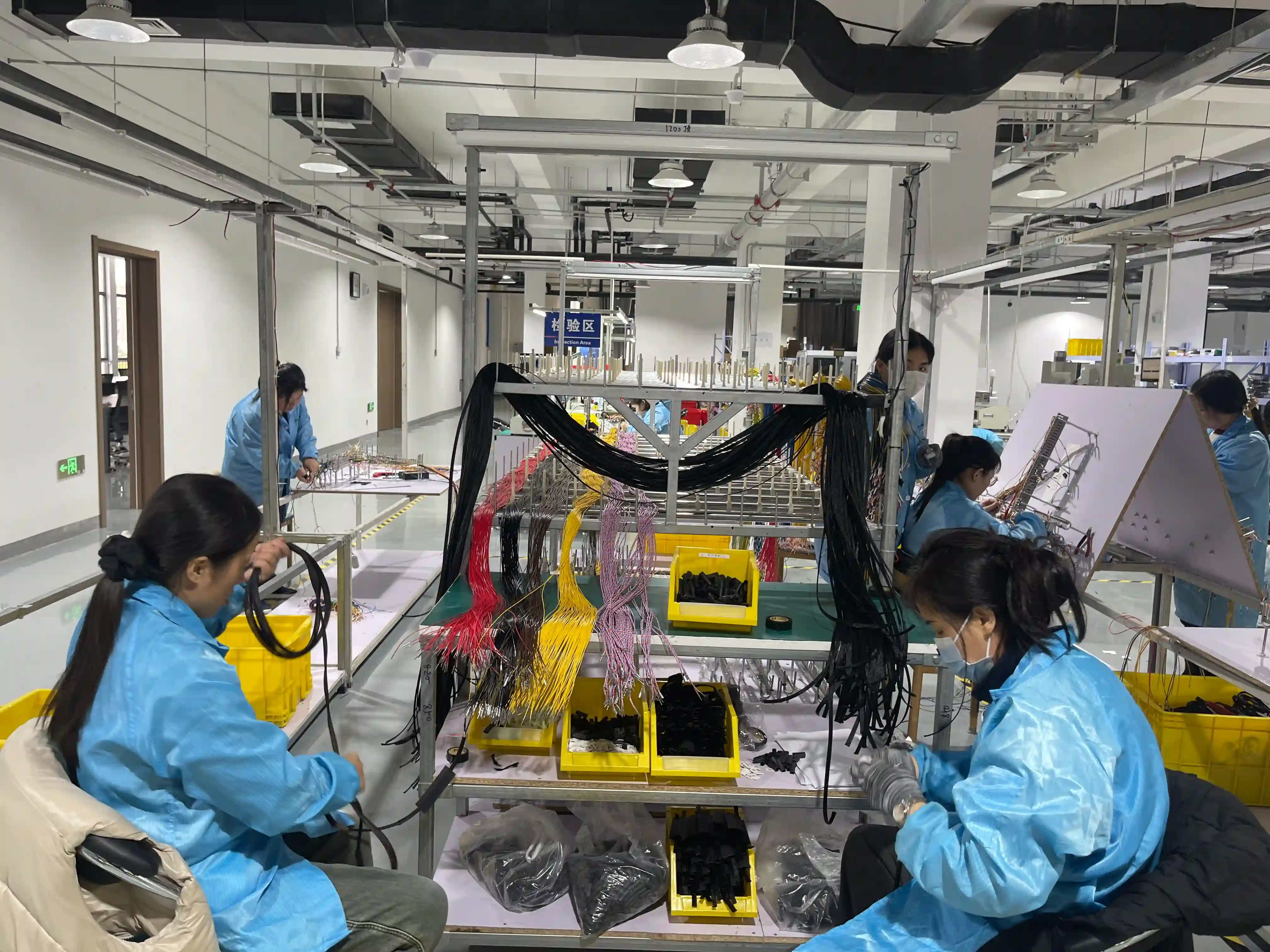
A Conduit Mismatch Found After Field Testing
A typical scenario: a customer completes a testing phase of custom wire harness samples and comes back with dimensional feedback — the conduit size on a harness model does not meet the assembly envelope, even though the harness functions correctly. The right response is to review the feedback with the customer's engineers, prepare the next sample revision, and requote the updated design before any production batch moves forward.
The harness function is sound, but the conduit OD and fit do not match the assembly envelope.
Review conduit size, bundle diameter, clamp fit, and sample revision before requoting.
The project moves from rejection risk into a controlled design iteration for the next sample and batch scope.
This is an illustrative description of a representative project type, not a specific customer engagement. As a contract assembler we do not publish customer-identifiable data.
TL;DR
- Size conduit from the finished bundle, not from wire OD alone.
- Keep practical fill near 60-70% for static runs and lower for moving equipment.
- Validate conduit with sample installation, clamp fit, bend radius, and pull-through checks.
- Record IPC-A-620, UL-758, and customer drawing evidence before batch release.
What Conduit Sizing Means in a Wire Harness
Wire harness conduit is a protective tube, loom, or sleeve that surrounds a finished wire bundle to control abrasion, crush, splash, UV exposure, and routing damage. It is part of the harness design, not packaging material, because it changes outside diameter, bend stiffness, clamp choice, and connector exit geometry.
Conduit fill ratio is the amount of usable internal conduit area occupied by the insulated wires, taped bundle, splices, labels, or secondary sleeving. A fill ratio that looks efficient on a spreadsheet can become a production defect when a branch must bend, pass through a gland, or sit under a clip.
Harness routing envelope is the real installation space around the conduit, including clamp openings, panel holes, edge guards, service covers, mating connector backshells, and maintenance access. For the engineer or buyer already at prototype or supplier-transfer stage, this is the buying question: will the factory build match the equipment, or will conduit size force a late mechanical change?
The workmanship baseline normally references IPC-A-620 for cable and wire harness acceptance. Wire material control may reference UL-758, while automotive programs may add ISO 6722 wire requirements and IATF 16949 change-control expectations. The customer drawing still wins when it is stricter.
"Conduit sizing fails when teams measure the loose wires and forget the built harness. Tape overlap, splice bulges, labels, and branch heat shrink can add 2mm to 6mm at the exact point that must pass through a clamp."
A Factory Method for Choosing Conduit Diameter
Start with the routing drawing, not the conduit catalogue. Mark every zone where the harness is exposed to abrasion, stone impact, oil, coolant, washdown, sunlight, heat, moving joints, or service handling. A protected cabinet branch may only need braided sleeve or tape. A mobile equipment chassis run may need corrugated conduit plus clips at controlled intervals.
Next, calculate the theoretical bundle. List each wire OD, cable OD, splice sleeve, drain wire, shield termination, marker sleeve, and branch transition. The sum of circular areas gives a starting point, but do not release from that number alone. Build the largest cross-section on the sample harness and measure it with light caliper pressure at straight sections, taped sections, and breakout transitions.
For a static equipment run, a practical fill target around 60% to 70% usually leaves enough assembly clearance without making the conduit look oversized. For dynamic routing, service loops, vibrating brackets, or harnesses that must be pulled through a frame, move closer to 50%. That extra air is not waste; it protects insulation from compression and preserves bend radius.
Measure these points
- Finished bundle OD at the largest branch
- Conduit ID, OD, wall thickness, and split width
- Clamp closed diameter with the conduit installed
- Minimum bend radius after connectors are fitted
- Clearance through panel holes, glands, and covers
Record these controls
- Conduit material, colour, slit type, and temperature range
- Start and stop dimensions from connector datum points
- End-retention method: tape, clip, heat shrink, or boot
- Approved sample photos and inspection notes
- Revision-controlled BOM line and supplier part number
This factory-side method fits the BROKE objective for the article: a senior engineer with 15 years of harness production experience is solving a specific design and sourcing question, using standards, measured numbers, and release criteria rather than a generic protection claim.
Conduit and Sleeve Selection Table
| Protection option | Best use | Fill target | Good fit | Watchout |
|---|---|---|---|---|
| Split corrugated conduit | Abrasion, crush, fast installation | 60-70% static, about 50% dynamic | Vehicle chassis, industrial equipment, exposed branches | Oversized OD can miss clips or foul covers |
| Closed corrugated conduit | Higher containment, cleaner routing | 50-65% | Long straight runs before connector termination | Harder rework and branch access |
| Expandable braided sleeve | Flexible abrasion protection | 70-80% before expansion limit | Robotics, panels, low-profile cable assemblies | Frays if cut ends are not heat sealed |
| Spiral wrap | Field access and late branch exits | Loose wrap, not a fill-controlled tube | Maintenance-friendly equipment looms | Lower crush protection than conduit |
| Heat shrink over conduit end | End retention and edge control | Sized by recovered diameter | Breakouts, connector exits, clamp points | Wrong shrink ratio can pinch insulation |
| Tape wrap plus clips | Low profile and quiet routing | Bundle controlled by wrap overlap | Interior harnesses, cabinets, protected runs | Limited protection against stone impact or sharp brackets |
Use the table as a first filter, then cross-check the detailed wire harness routing and clamping guide, the heat shrink and sleeving guide, and the waterproof wire harness capability if the design faces washdown or outdoor exposure.
"A conduit change is an engineering change. If a 15mm conduit becomes 18mm, the BOM, clip, drawing callout, test sample photos, and first article notes all need the same revision trail."
How to Validate Conduit During Samples and First Article
The weakest section in many conduit specifications is the drawing note. "Use protective loom" does not tell purchasing which material to buy, does not tell production where the conduit starts, and does not tell quality how to reject a loose or oversized fit. Replace that note with a controlled callout: "PA6 split corrugated conduit, nominal 15mm OD, black, -40 to 125 degrees C, start 35mm from C1 rear face, finish 20mm before branch B heat shrink, retain with two turns of specified harness tape."
During prototype review, install the harness in the real fixture, machine, enclosure, or a dimensionally accurate mock-up. Confirm that connectors mate without forcing the conduit sideways. Check whether the conduit presses on a latch, blocks a fastener, or creates a bend tighter than the cable supplier's limit. The 2025 industrial equipment case was not a crimp or continuity problem; it was a physical fit problem found after field testing.
During first article inspection, capture photos of each conduit start-stop point, measure the finished OD at at least three locations, and record the actual clip closure. For production lots, keep the conduit part number under the same receiving and kitting discipline used for terminals and connector housings. If a buyer substitutes a cheaper loom with the same nominal size but different wall thickness, the installed harness may no longer fit.
Release Checklist
Conduit Mistakes That Create Late Harness Rework
Specifying nominal size without usable ID
Two 15mm conduits can have different wall thickness, corrugation height, split recovery, and usable fill. Use a supplier drawing or measured sample, especially before a 200-piece or larger run.
Forgetting the assembly sequence
Closed conduit may need to be loaded before large connectors are crimped. Split conduit may be faster, but the seam orientation must avoid water traps and rubbing points.
Treating conduit as a substitute for routing control
Conduit reduces abrasion risk, but it does not cancel bend radius, clamping, edge protection, or strain relief. For connector exits, pair this guide with the strain relief design guide.
"The cheapest conduit decision is made at sample stage. Once connectors, clips, labels, and test fixtures are released, a 3mm diameter correction can touch purchasing, production, quality, and installation at the same time."
FAQ: Wire Harness Conduit Sizing
What conduit size should I choose for a wire harness?
Start by measuring the finished bundle at the largest taped or sleeved section, then select conduit that leaves 10% to 25% working clearance. For moving equipment, validate the actual sample because a 15mm conduit that looks acceptable on paper can still fail the customer assembly space.
What is a safe fill ratio for corrugated conduit?
For static harness runs, keep practical fill near 60% to 70% of usable internal area. For service loops, moving arms, or harsh vibration, reduce fill toward 50% to preserve bend radius, reduce wire compression, and keep pull-through damage under control.
Which standards apply to wire harness conduit and loom protection?
Use IPC-A-620 for workmanship evidence, abrasion and protection acceptance, UL-758 where recognized wire styles or appliance wiring material apply, and ISO 6722 when automotive wire insulation temperature or abrasion classes are specified.
Should conduit size be checked during prototype samples?
Yes. Check conduit size on every prototype and first article because conduit changes connector exit angle, clamp fit, branch length, and service clearance. In one 2025 Australian project, 3 sample units exposed a 15mm conduit mismatch before a 200-piece batch was released.
How much clearance is needed around a harness inside equipment?
For static industrial equipment, leave at least 5mm clearance from sharp structure and clamp the harness before unsupported spans become long enough to rub. Near heat, moving joints, or hydraulic lines, increase clearance and add sleeve, conduit, or standoff clips.
When is braided sleeving better than corrugated conduit?
Braided sleeving is better when flexibility, low profile, and connector exit smoothness matter. Corrugated conduit is better for crush, stone impact, and abrasion. A 10mm to 25mm branch often uses both: braid near the connector, conduit along exposed chassis routing.
Need Conduit Size Checked Before Production?
Send the drawing, photos of the routing path, target batch quantity, and any sample feedback. We can review conduit diameter, material, clamp fit, and validation records before your next wire harness build.
Request Harness Review