
Custom RF Cable Assemblies Manufacturer
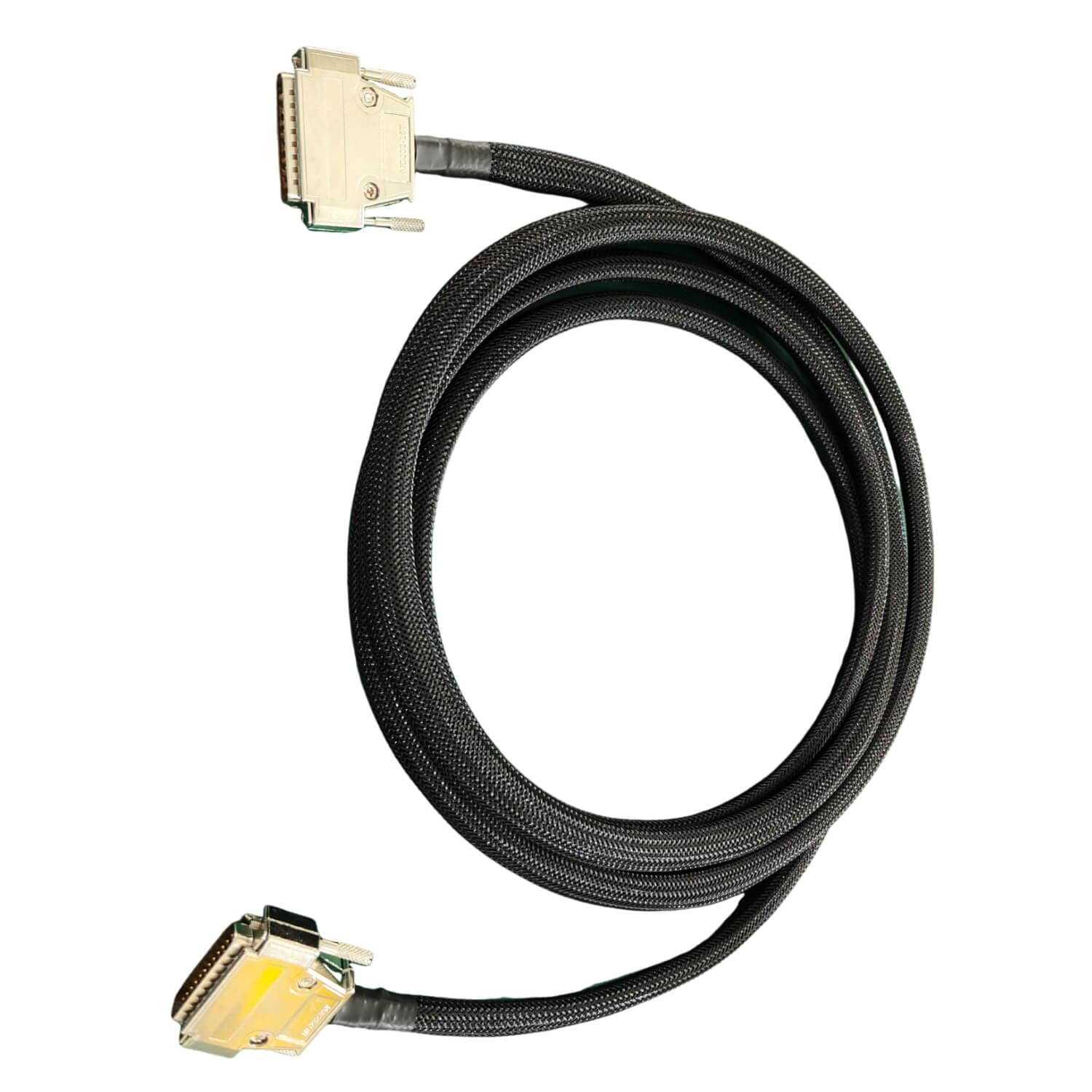
As a contract assembler, we coordinate builds with partner factories for finished RF coax leads, antenna jumpers, pigtails and mixed-end interconnects. The drawing, sample and BOM define the scope agreed at quotation.
Quick answer
A finished RF assembly is only as specified as its test conditions. A VSWR or insertion-loss figure without a frequency range, cable length, calibration reference plane and fixture/adapter definition is not a specification. Continuity cannot detect impedance problems. Limits come from the drawing, connector datasheet and cable datasheet, and are agreed at quotation before the first article.
What buyers usually need from an RF cable assembly manufacturer
RF cable assemblies are built around signal behaviour, not just electrical continuity. Once the interconnect becomes a coaxial transmission line , the cable, connector, route length, and transition geometry all affect the result.
In practice, buyers need a supplier that can look beyond connector names. The right build depends on impedance, shielding, cable loss, bend space, service access, and whether the assembly uses a field interface such as an RF connector , a vehicle-grade keyed system, or a compact internal transition.
If the assembly is performance-sensitive, the handoff should also define what success looks like. That can mean continuity only for a protected short jumper, or it can mean deeper checks around VSWR , return loss, and installation fit for a more demanding RF path.
Technical scope
| Typical RF Scope | 50 ohm RF coaxial assemblies for signal, antenna, telemetry, and test applications; 75 ohm coaxial builds for specified system interfaces, including video |
|---|---|
| Supported Interfaces | SMA, BNC, TNC, N-type, MMCX, FAKRA, micro-coax formats, and approved mixed-end assemblies |
| Cable Types | RG families, low-loss coax, double-shielded coax, compact micro-coax, and customer-specified shielded constructions |
| Validation Options | Continuity, pinout, workmanship, length, orientation, insulation checks, insertion loss, return loss, VSWR, and shielding-related checks when specified |
| Build Quantities | Prototype, pilot and repeat-order quantities are discussed at quotation |
| Application examples | RF coax leads are generally used for antenna links, instrumentation, embedded wireless and specified video interfaces; these are application examples, not customer claims |
| Quote Inputs | Finished length, connector at each end, impedance, frequency range, bend space, mounting style, labels, and test criteria |
Frequency, loss, and VSWR limits must be defined for the exact cable, connectors, and measurement method. This table does not imply a universal RF performance rating.
Capability scope and boundaries
- Custom coaxial cable assemblies, RF jumpers, antenna leads, panel-mount transitions, mixed-end leads, replacement builds, prototypes, pilot lots, and repeat OEM supply are in scope.
- 50 ohm and 75 ohm builds require a cable family, connector interface, and test plan defined by the drawing or confirmed during sample review.
- The service covers assembled, inspected, labelled, repeatable interconnects. Commodity-only raw cable distribution is outside this scope.
- For microwave cable assemblies, supply frequency, loss, VSWR, phase, and test limits for review. Performance claims require an agreed RF acceptance plan.
IPC/WHMA-A-620 is the common workmanship standard, with class chosen per drawing.
Practical selection rule: 50 ohm vs 75 ohm
Use 50 ohm coax for most RF, antenna, telemetry, wireless, and test equipment paths. Use 75 ohm where the equipment specifies a 75 ohm interface, including video, broadcast, and clock links explicitly specified as 75 ohm. Confirm the system requirement before selecting either family.
Match the cable and connector impedance to the equipment at both ends. A connector family name or a successful continuity check does not establish impedance compatibility; a mismatched transition can cause reflections and degrade return-loss performance.
A low-frequency shielded signal in a cabinet or vehicle may be better specified as standard shielded cable work. For RF, video, telemetry, antenna, or test signals, define impedance and frequency range before choosing connectors.
Specify repeated movement, outdoor exposure, washdown, and tight bend space before the first article. Changing the cable family after connector tooling is selected can require a redesign.
| Assembly requirement | Cable and connector compatibility | Release inputs |
|---|---|---|
| 50 ohm RF path | Confirm 50 ohm cable and connector variants against the equipment interfaces and selected cable construction. | Operating frequency, route length, cable loss target, and agreed RF acceptance limits. |
| 75 ohm system path | Confirm 75 ohm cable and connector variants for the specified video, broadcast, or other 75 ohm interface. | System impedance, route length, frequency range, and test criteria. |
| Mixed-end or bulkhead assembly | Check each end for impedance, cable diameter, gender, keying, mating hardware, and panel depth. Different connector families do not establish compatibility on their own. | Connector part numbers, mounting style, orientation, bend space, strain relief, and first-article fit checks. |
What a traceable S-parameter record must state
Agree at quotation which fields your RFQ needs. This is a record template, not a promise that every field is always delivered. Identify the assembly and its test conditions together so another reviewer can interpret the traces and compare them with the same acceptance plan.
| Field | What to record | Why it changes the number |
|---|---|---|
| Frequency range and points | [start / stop frequency, units, number of points, spacing or segmented sweep] | The span defines the band evaluated; spacing can miss narrow peaks between points. |
| Sweep, IF bandwidth and source power | [sweep type / time, IF bandwidth, averaging and source power as set] | Bandwidth and averaging affect noise and sweep time; power settings affect measurement conditions and calibration validity. |
| Calibration method and reference plane | [method, reference impedance and plane at each end: assembly connector faces or instrument ports; any de-embedding] | The plane determines whether intervening test cables, fixtures and adapters are included in the result. |
| Calibration kit / standards and date | [kit / standards identity, calibration date and setup-calibration date as recorded by whoever measures] | Standards definitions and calibration validity affect error correction; preserve the link to the measurement setup. |
| Test cables, fixtures and adapters | [identity, connection order and whether each is included or removed by calibration / de-embedding] | Adapters add their own loss and reflection. A changed connection chain can invalidate a comparison. |
| Assembly identification and length | [part number, drawing revision, serial or lot, length datum to datum and measuring condition] | A result must belong to the delivered configuration; length changes attenuation and electrical phase. |
| Cable state during test | [straight, specified bend, or flexed under a defined procedure; bend geometry] | Bending or movement can change geometry and electrical behaviour; a static test does not establish flex performance. |
| Connector mating torque or method | [connector-specified torque or mating method, contact inspection and mating condition] | Seating and repeatability affect the RF transition; a connector family name alone does not define the method. |
| Parameters captured | [S11 and S21; S22 / S12 if required; port direction, reference impedance, units and trace file ID] | S11 gives input reflection for return loss and VSWR; S21 gives forward transmission for insertion loss under matched reference conditions. S22 and S12 describe reverse-side reflection and transmission. |
| Pass / fail limit and source | [frequency-dependent limit, drawing / connector datasheet / cable datasheet revision or agreed RF acceptance plan; result and decision rule] | Compare like conditions. State how uncertainty is handled near a limit; a component rating alone is not a finished-assembly test result. |
| Operator, date and instrument ID | [operator, measurement date, instrument ID and calibration-status reference from the measuring party] | These fields trace the result to a setup and responsible record owner; they do not imply that this business owns the instrument. |
Resolve missing datums through engineering drawing review and agree coverage through the testing scope. Connect first-article evidence to the release decision using the first-article inspection guide.
Return loss, VSWR and insertion loss: the conversions, computed
Return loss and VSWR describe reflection; insertion loss describes forward transmission. For S-parameters referenced to real impedances with the other port matched, use the magnitudes below. Return loss is positive for a passive mismatch even though the S11 log-magnitude trace is negative. See Keysight: Reflection Measurements for the relationship between reflection, return loss and VSWR.
|Gamma| = |S11| = (VSWR − 1) / (VSWR + 1)
VSWR = (1 + |Gamma|) / (1 − |Gamma|)
RL = −20 log10(|Gamma|) dB
ML = −10 log10(1 − |Gamma|²) dB
Reflected power = |Gamma|² × 100%
IL = −20 log10(|S21|) dB
Assumed VSWR examples only, not measured results or achievable limits. Calculations use unrounded inputs. Display precision: VSWR and return loss to 2 decimals, |Gamma| to 4, mismatch loss to 3, and reflected power percentage to 2. Mismatch loss is the reduction in accepted power due to a single mismatch, expressed in dB; it is not the total cable insertion loss.
| Assumed VSWR | |Gamma| | Return loss (dB) | Mismatch loss (dB) | Reflected power (%) |
|---|---|---|---|---|
| 1.20 | 0.0909 | 20.83 | 0.036 | 0.83 |
| 1.30 | 0.1304 | 17.69 | 0.075 | 1.70 |
| 1.50 | 0.2000 | 13.98 | 0.177 | 4.00 |
| 2.00 | 0.3333 | 9.54 | 0.512 | 11.11 |
Derived example: an abrupt 50 ohm to 75 ohm junction
Gamma = (75 - 50) / (75 + 50) = 0.2000
| VSWR | |Gamma| | Return loss (dB) | Mismatch loss (dB) | Reflected power (%) |
|---|---|---|---|---|
| 1.50 | 0.2000 | 13.98 | 0.177 | 4.00 |
Derived result: RL 13.98 dB, VSWR 1.50, mismatch loss 0.177 dB and 4.00% reflected power. This ideal junction has real impedances and no additional discontinuities. It explains why a 75 ohm lead on a 50 ohm port can pass continuity while reflecting RF energy. A finite mismatched lead has another transition and length-dependent multiple reflections, so this is not a prediction of its full frequency response. Review coaxial impedance control when defining the complete path.
Insertion loss scales with length and frequency: an assumed worked example
Assumed example, not a datasheet value or a performance commitment. This simple matched loss budget omits multiple-reflection interactions and fixture loss. Use the datasheet attenuation for the chosen cable at the actual frequency; this example only shows the arithmetic.
Assumed frequency 1.00 GHz; assumed cable attenuation 0.50 dB/m; assumed connector loss 0.10 dB each; 2 connectors.
IL (dB) = length (m) × attenuation (dB/m) + 2 × connector loss (dB)
Delivered power / incident power (%) = 10^(−IL / 10) × 100
| Length (m) | Cable loss (dB) | Connector total (dB) | Total IL (dB) | Delivered power (%) |
|---|---|---|---|---|
| 0.50 | 0.25 | 0.20 | 0.45 | 90.16 |
| 1.00 | 0.50 | 0.20 | 0.70 | 85.11 |
| 3.00 | 1.50 | 0.20 | 1.70 | 67.61 |
All inputs and results in this example display to 2 decimals, except the connector count. Doubling the first listed length to the second doubles the cable contribution; the connector contribution stays fixed. The total therefore does not double. Attenuation depends on frequency, so repeat the budget using the selected cable and connector data at each required frequency; this single-frequency example cannot clear another band.
Compare coaxial cable types and RG214 assembly considerations before choosing construction. A cable family name alone is not an attenuation specification.
Metrics: what can be committed and what cannot
These are conditions for agreeing a requirement, not a catalogue of guaranteed results. The drawing and connector / cable datasheets inform limits; the finished-assembly acceptance plan, feasibility and record package must be agreed at quotation.
| Metric | Can be committed when | Cannot be committed when |
|---|---|---|
| Length tolerance | Datum points, routing / support and measuring condition are written on the drawing and accepted at quotation. | Only an approximate overall length or a photograph is supplied. |
| Connector part number and orientation | Exact parts, mating references and orientation / view direction are on the BOM and drawing. | Only a family name is specified, or a substitution has not been reviewed. |
| Continuity and shield continuity | Connections, shield termination, method and acceptance criteria are on the agreed test plan. | Continuity is being used to stand in for impedance or RF performance. |
| VSWR, return loss and insertion-loss limits | Named cable and connector parts, length, frequency range, calibration reference plane and fixture / adapter definition are fixed; limits from the drawing and datasheets or an RF acceptance plan are agreed at quotation. | Parts, band, length or measurement conditions are unspecified, or a generic connector rating is treated as an assembly guarantee. |
| Phase matching | The pairing procedure, reference planes, band, cable state and tolerance are explicitly agreed. | Only equal physical lengths are requested; these do not define a phase-matching acceptance test. |
| 100% versus sampled RF testing | Coverage, sample selection, checks and record package are agreed as a quotation decision. | Full RF testing of every assembly is assumed to be the default, or continuity coverage is taken as RF coverage. |
For phase-sensitive requirements, define the pairing and acceptance method through the microwave assembly scope. Check any replacement part using the connector substitution validation guide; a mating fit alone does not validate RF equivalence.
Measurement conditions that move the result
- Reference plane: fixture and adapter loss and reflection remain in the result if they sit beyond the calibrated plane and have not been de-embedded. Record what is included and the correction method so comparisons refer to the same assembly boundary.
- Cable movement during a sweep: flexing can change geometry and phase while different frequency points are being acquired. Semi-flexible and flexible constructions have different bending constraints; follow the selected cable datasheet, hold the specified state and define any flex procedure separately.
- Connector mating cycles and repeatability: contact condition and seating can vary when a connector is remated. Inspect the interfaces and record relevant mating history or any re-mating procedure; do not treat successive connections as automatically identical.
- Torque or mating method: use the connector-specific method, not an assumed universal torque. Uneven seating can alter the discontinuity at the interface.
- Frequency span versus the application band: loss and reflection vary with frequency, and sparse points can miss a peak. A test at one frequency does not clear a different band; cover the required band with agreed point spacing and limits.
- Temperature: state it when relevant to acceptance. Changes in conductor loss, dielectric properties and physical length can affect attenuation and phase; an ambient test does not establish performance at other temperatures.
Keysight: Accurate Measurement Calibrations explains how the standards connection defines the reference plane and how test cables, fixtures and adapters affect calibration. Use that distinction when agreeing what belongs in the reported assembly result.
Coaxial assembly decisions we lock down early
Before the first cable is cut, we define the signal path, connector interface, and acceptance test for the RF or coaxial assembly.
Connector Families That Match the RF Job
We build assemblies around the actual interface and frequency requirement, including SMA, BNC, TNC, N-type, MMCX, U.FL-style micro-coax, FAKRA, and mixed-end transitions where the design supports them. We check mating hardware, panel depth, connector gender, keying, and strain relief before selection is final.
Impedance and Cable Selection Reviewed Up Front
RF builds are not generic wires with special connectors. For coaxial cable assemblies, we confirm 50 ohm or 75 ohm impedance alongside cable diameter, dielectric, shielding, insertion loss, and bend space before the BOM is frozen. Similar-looking leads can have incompatible impedance transitions that continuity testing will not detect.
Prototype-to-Production Control
We help convert a sample lead, imported assembly, or bench prototype into a documented part number with controlled length, connector orientation, labels, revision, and inspection criteria. First-article confirmation, production notes, packing requirements, and traceable test records can be agreed at quotation.
Inspection Scope Matched to Signal Risk
Continuity alone is not enough for many RF builds. We align the release plan to the application, with options that can include orientation checks, insulation checks, insertion loss, return loss, VSWR, shielding, and fit validation. Customer-defined network analyser criteria and acceptance limits are agreed before the first article.
Mechanical Reliability at the Termination
Cable exits, stripping, strain management and connector handling affect the termination. We review jacket preparation, dielectric cutback, braid handling and boot or heat-shrink selection. IPC/WHMA-A-620 is the common workmanship standard, with class chosen per drawing.
Built for Real Equipment Environments
RF coax leads are generally used in telecom cabinets, embedded wireless products, vehicle electronics, instrumentation benches and industrial enclosures. Specify environmental exposure and service access in the drawing review.
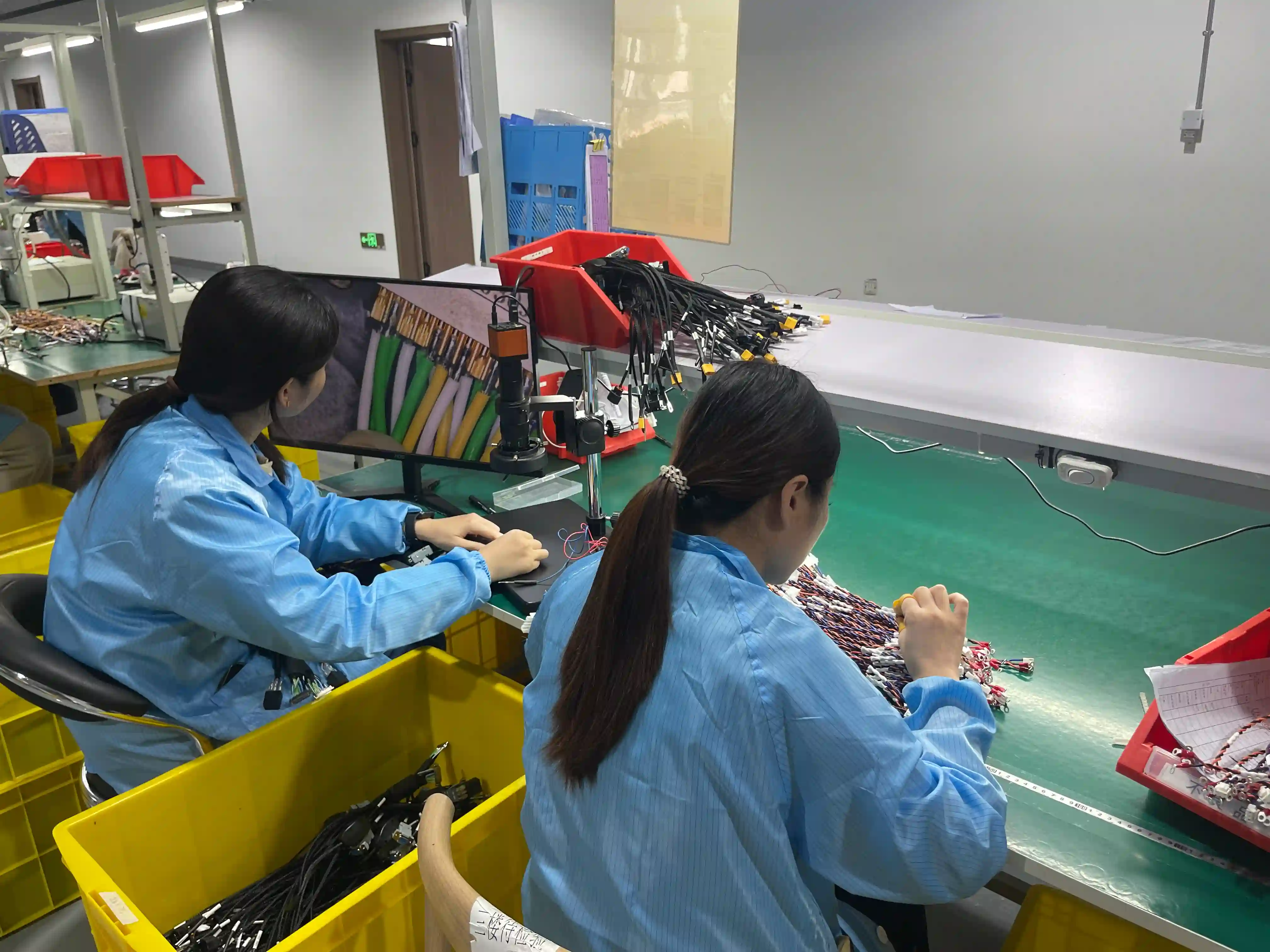
Common RF and coaxial cable assembly applications
These are general application examples for RF coax leads, not a list of customers or completed projects.
Telecom and Wireless Infrastructure
RF jumpers, base-station leads, and antenna interconnects for radios, repeaters, remote monitoring hardware, cabinets, and distributed communications equipment.
Instrumentation and Test Systems
Bench and rack assemblies for analysers, calibration setups, laboratory equipment, and validation rigs where repeatable connector orientation and cable length matter.
Embedded and Industrial RF Hardware
Internal and external antenna links for IoT devices, telemetry products, gateway hardware, rugged electronics, and control systems that need stable coax routing.
Automotive and Transport RF Assemblies
Vehicle antenna and module connections using formats such as FAKRA and other controlled RF interfaces for connectivity, GNSS, cameras, and platform electronics.
Compact Coax and Board-Level Transitions
Smaller-format assemblies for medical devices, imaging, compact electronics, and space-limited products that need micro-coax or fine-pitch RF transitions rather than larger field connectors.
Video and Broadcast Interconnects
75 ohm coaxial cable assemblies for video and broadcast-style equipment where connector impedance and route length are controlled.
Replacement and Retrofit Supply
Sample-based replacement leads are an application example for equipment service and legacy installations. Confirm the missing part definition and acceptance requirements before quoting a replacement.
RF and coaxial manufacturing process
RF Requirement Review
We review connector interfaces, cable family, target impedance, operating frequency range, route length, bend radius, target quantity, and environmental exposure before quoting. Cable diameter and mating hardware are confirmed before a connector family is selected.
Cable and Connector Definition
Our team defines connector gender and body style, cable construction, shielding, mounting details, crimp or solder approach, strain relief, sealing features, boots or heat-shrink, label placement, and packing constraints. Missing sample-based specifications are documented before repeat production is quoted.
Prototype or First-Article Build
Initial assemblies are evaluated against the agreed fit, routing, connector orientation and electrical acceptance requirements. Prototype quantities and build scope are discussed at quotation; first-article acceptance requires review of the agreed record package.
Controlled Assembly and Verification
Assemblies follow controlled cutting, stripping, shield preparation, termination, marking, and inspection instructions. The cable-to-connector transition affects impedance and mechanical reliability. Define the checks and agreed record package at quotation.
Release for Ongoing Supply
Finished assemblies are checked against the agreed release plan and packed to protect connector faces and cable exits. The approved BOM and inspection plan define repeat-order requirements. Revision-controlled build notes, part labels and test evidence form the agreed record package; confirm its contents at quotation.
Useful related resources
Buyers comparing connector styles can start with our RF connector types guide.
If your application is sensitive to geometry changes, shielding, or routing transitions, review high-speed cable assembly signal integrity.
For more traditional RF interfaces, our BNC connector types page is a useful reference before connector selection is frozen.
We also support related production needs such as cable testing, overmolding, and RF-adjacent assemblies used in telecom, automotive, and industrial equipment.
Related RF capabilities
If the assembly is already narrowed to a connector family or cable type, these pages give the more specific manufacturing view.
Coaxial Cable Assembly
Use this when the RFQ still needs impedance, cable family, connector selection, and RF release criteria defined.
SMA Cable Assembly
Compact 50 ohm coax assemblies for antennas, RF modules, and instrumentation.
Rosenberger Connector Cable Assembly
Use this when the RFQ specifies Rosenberger RF, HSD, HFM, or FAKRA-style connector interfaces.
RG214 Cable Assembly
Double-shielded coax assemblies for heavier-duty RF routing and antenna infrastructure.
FAKRA Connector Cable Assembly
Automotive-focused RF cable assemblies for GNSS, telematics, and vehicle electronics.
Micro Coaxial Cable Assembly
Miniature coax builds for compact electronics, imaging, and dense internal routing.
Australian RFQ scenario
Illustrative RFQ only; not a customer case study.
Consider a BNC-to-SMA sample for a telemetry enclosure (see SMA cable assemblies for that connector family). Requested prototype and production quantities would be discussed at quotation. Before the pilot lot, the quote review should establish impedance, cable loss target, panel space, connector orientation, label format, and whether VSWR or insertion-loss records are required.
An illustrative RF assembly review and release sequence
This illustrative sequence describes a review method, not a completed project or measured result. Builds are coordinated with partner factories under the agreed scope.
RF cable assembly FAQ
Common questions from engineering, sourcing, and quality teams evaluating a new RF cable assembly supplier.
What does an RF cable assembly manufacturer actually supply?+
An RF cable assembly manufacturer supplies custom coaxial interconnects built around the required connector interface, impedance, cable construction, and environment. That can include antenna jumpers, module pigtails, panel-mount transitions, test leads, retrofit replacements, and production assemblies with controlled documentation.
How is an RF cable assembly different from a standard cable assembly?+
RF assemblies must preserve signal performance, not just electrical continuity. Cable geometry, shielding, connector compatibility, impedance, return loss, and length control matter far more than they do on general-purpose low-frequency harnesses.
Which connector types do you support for RF builds?+
We support common RF connector families such as SMA, BNC, TNC, N-type, MMCX, FAKRA, and compact micro-coax interfaces, plus mixed-end configurations where the cable and application support that combination.
Can you help if we only have a sample cable or imported assembly?+
A sample lead, installed-cable photo or incomplete BOM can be an input to review. Resolve connector part numbers, cable family, length datums and inspection requirements in a controlled drawing before release.
Do you offer RF testing beyond continuity checks?+
RF testing scope and feasibility are reviewed at quotation. Name the cable and connectors, frequency range, reference plane, acceptance limits and required record package. Continuity does not establish RF impedance performance; RF coverage is an agreed test-plan decision.
Do you support prototypes as well as recurring production?+
Prototype, first-article, pilot and repeat-order quantities are discussed at quotation. Agree the drawing, BOM, test plan and record package before the first article; sample approval does not itself authorise production.
What should an S-parameter report state to be usable?+
Agree the required fields at quotation: assembly ID and revision, datum-to-datum length, frequency range and points, sweep / IF bandwidth and source power, calibration method and reference planes, standards identity and date, fixtures / adapters, cable state, mating method, parameters and port direction, acceptance-limit source, operator, date and instrument ID. Link traces to the same assembly; the template is not an automatic delivery promise.
Why can VSWR numbers from two labs differ?+
Compare the same part and revision at the same frequencies, reference impedance and calibration planes. Different adapters, calibration standards, cable position, connector seating, torque, temperature and sweep settings can change the result. Check the conditions and measurement uncertainty before deciding that the assembly changed.
How does a 50 ohm to 75 ohm mismatch show up in return loss?+
For an ideal abrupt junction between real impedances, Gamma = (75 - 50) / (75 + 50) = 0.2000: RL 13.98 dB, VSWR 1.50, mismatch loss 0.177 dB and 4.00% reflected power. This is a derived fact, not a measurement or acceptance limit. A 75 ohm lead on a 50 ohm port can pass continuity while reflecting RF energy. A finite lead has another transition and length-dependent multiple reflections, so its measured response need not equal the single-junction result.
How does insertion loss change with cable length?+
At a fixed frequency, the simple matched loss budget is length times cable attenuation per metre plus the losses of the connectors. Doubling length doubles the cable contribution, while the connector contribution stays fixed. Use the chosen cable datasheet at the actual frequency; the page example uses assumed inputs only and omits mismatch interactions.
Can you commit a VSWR limit?+
Only after the named cable and connector parts, length, operating band, calibration reference planes and fixture / adapter definition are agreed. Limits come from the drawing, connector and cable datasheets, or a documented RF acceptance plan, and are agreed at quotation before the first article. There is no universal assembly limit or default RF test coverage.
Get an RF Cable Assembly Quote
Send your drawing, wire list or BOM — an engineer replies with a quote and lead time within 24 hours.
Need a quote for an RF cable assembly program?
Send the connector part numbers, cable type, finished length, impedance, frequency range, environment, and any RF acceptance criteria you already have. If the drawing is incomplete, we can help define the missing details before production release.