
FAKRA Connector Cable Assembly Manufacturing
Custom FAKRA cable assemblies with 100% VSWR and hi-pot testing, crimping checked against the terminal manufacturer's height and pull-force specification, and IP67 overmolded options. DC to 6 GHz performance for automotive, telematics, and RF applications.
Why FAKRA Connectors Demand Precision Assembly
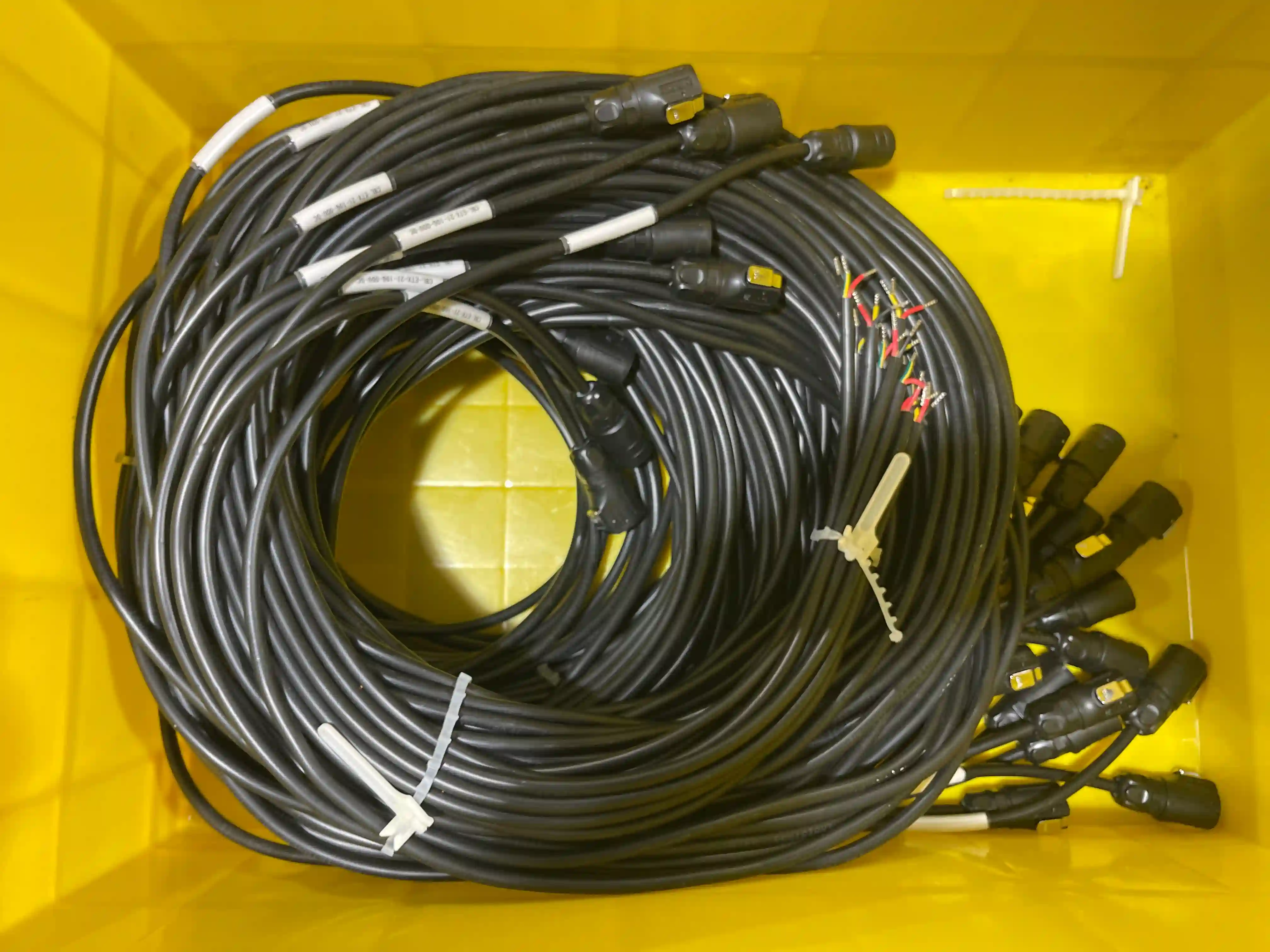
FAKRA (Fachkreis Automobil, a German automotive standards body) connectors are the de facto RF interface in vehicles worldwide. Every GPS antenna, LTE modem, satellite radio, and V2X communication module in a modern car routes through FAKRA. The problem: a poorly crimped or misassembled FAKRA connection doesn't fail obviously — it degrades. A 0.5 dB insertion loss increase at the connector translates to reduced signal-to-noise ratio, dropped connections, and warranty claims that surface months after installation. That's why assembly precision and 100% RF testing aren't optional — they're the difference between a harness that works on the bench and one that works for 15 years in the field.
The USCAR-17 specification defines 14 mechanical keying codes (color-coded) to prevent mismating in dense harness environments. A single vehicle can have 8-12 FAKRA connections, each carrying a different RF service. Getting the color code wrong isn't just a rework issue — it can mean a GPS feed connected to an LTE port, with no way to detect the error without functional testing. Our assembly process includes both visual color verification and electrical validation at every station.
FAKRA Assembly Capabilities
RF Performance Validation
100% VSWR and insertion loss testing on every assembly using calibrated vector network analyzers. We test to your frequency spec, not just a generic pass/fail. The VSWR and insertion-loss limits come from your drawing and from the cable and connector datasheets; the reference below shows how VSWR converts to return loss.
Precision Crimping
Crimps are checked against the terminal manufacturer's application specification: crimp height is measured with a micrometer (in millimetres) and pull force is verified by pull test (in newtons). The acceptance class under IPC/WHMA-A-620 and the sampling plan are set on your drawing.
IP67 Overmolding
Polyurethane or PVC overmold encapsulation sealing the connector-cable junction against water, dust, and vibration. Meets ISO 20653 IP6K9K for automotive underhood and exterior mounting. Tooling NRE: $1,500–$3,000.
All 14 FAKRA Keying Codes
Complete support for USCAR-17 color codes A through Z. We stock Rosenberger, TE Connectivity, and Amphenol FAKRA bodies. Dual FAKRA (HSD) and FAKRA-to-SMA/FAKRA-to-N-type transitions also available.
Cable Selection Engineering
We help you select the right cable for your frequency and routing constraints: RG-174 for short flexible runs, RG-316 for lower loss, RG-58 for long antenna feeds, or custom low-loss corrugated cables. Bend radius, attenuation, and jacket compatibility all factor in.
Full Traceability & Documentation
Each assembly ships with test data (VSWR plot, insertion loss, hi-pot result), material certificates, and certificate of conformance. Serial-level traceability from raw cable lot to finished assembly per IATF 16949 requirements.
FAKRA Assembly Specifications
What a FAKRA drawing needs to state, where each requirement normally comes from, and what we need from you to build and test to it.
| Parameter | Where the requirement comes from | What to state on the drawing |
|---|---|---|
| Keying code | The vehicle or system maker, using the standardised FAKRA codes | Code letter at each connector end (see the code reference below) |
| Impedance and cable | The RF design; FAKRA/SMB links are normally 50 Ω | Cable type and manufacturer part number, length and tolerance |
| VSWR / return loss | Your RF specification and the connector and cable datasheets | Limit, frequency band, test points and calibration plane |
| Insertion loss | Cable datasheet attenuation at your frequency, plus connector loss | Limit for the finished assembly at the stated frequencies |
| Crimp height | The terminal or connector manufacturer's application specification | Connector part numbers; we measure height in mm against that specification |
| Pull force | The connector manufacturer's specification and your acceptance standard | Minimum force in newtons and the sampling plan |
| Hi-pot / insulation resistance | Your electrical specification | Voltage, duration and leakage limit |
| Sealing | IP codes under IEC 60529, as required by your application | Required IP code and whether the assembly is overmolded |
| Workmanship acceptance | IPC/WHMA-A-620 | Class and standard revision |
This table lists where each requirement is defined; it does not state limits. Limits come from your specification and the component datasheets, and we confirm them against your drawing before the first build.
FAKRA Assembly Process
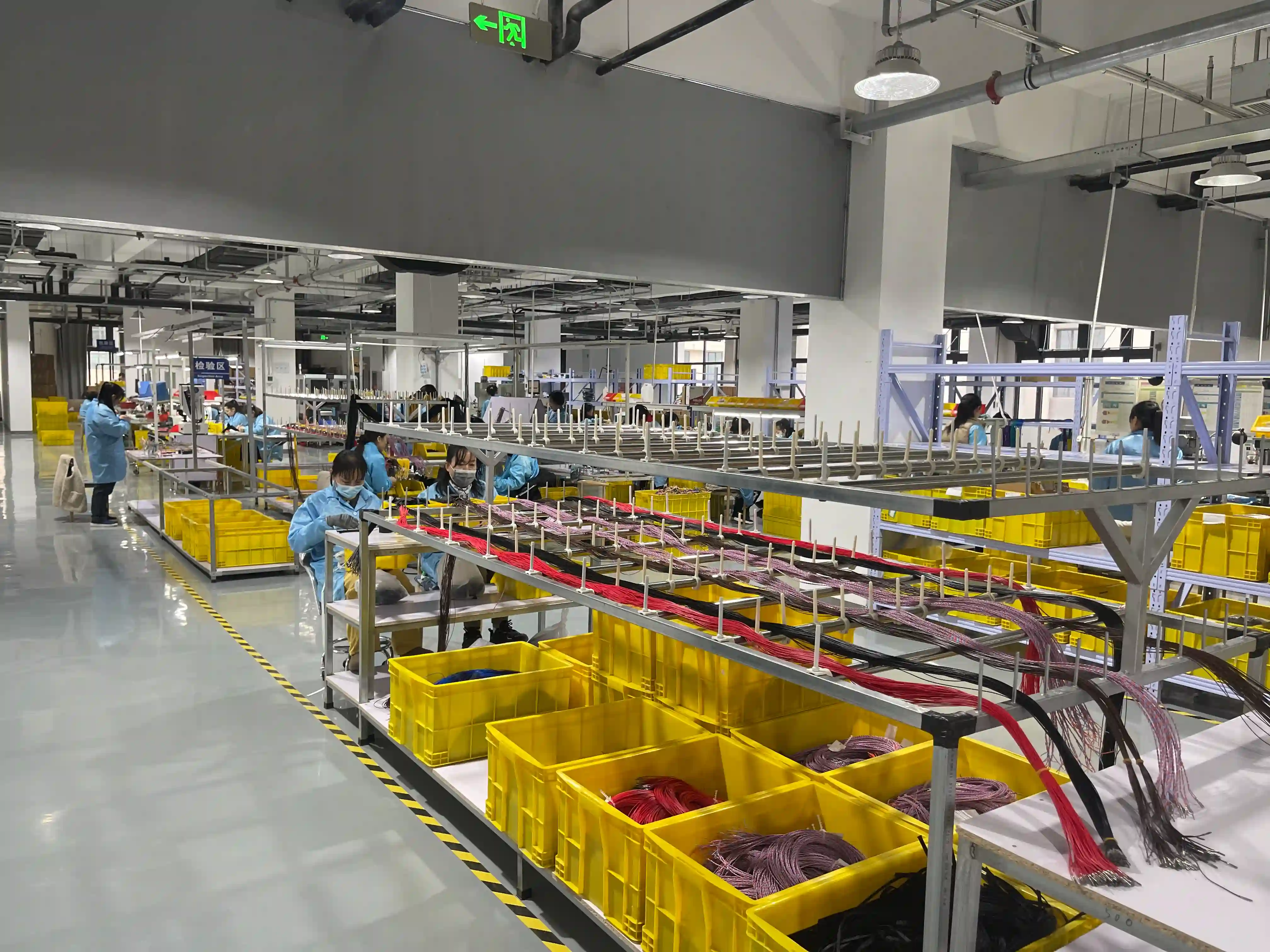
Every FAKRA cable assembly follows a controlled process designed to catch RF defects that visual inspection alone cannot detect. Here's what happens from order to shipment.
Design Review & Cable Selection
We review your assembly drawing, confirm FAKRA color code and keying, validate cable type against frequency and bend-radius requirements, and flag any DFM issues. If you're unsure between RG-174 and RG-316, we'll calculate the insertion loss budget for your specific run length.
Incoming Material Verification
FAKRA connectors are verified against manufacturer lot codes and dimensional specs. Cable is checked for OD tolerance, shield coverage percentage, and attenuation at spot frequencies. Non-conforming material is quarantined before it reaches the production floor.
Automated Cable Preparation
Cable is cut to length (±1.0mm tolerance), stripped, and shield prepared using programmable cutting and stripping machines. For coaxial cables, the strip dimensions for dielectric and center conductor are set to the connector manufacturer's specification — typically 4.0mm dielectric exposure and 1.5mm center conductor for standard FAKRA.
Connector Crimping & Assembly
Center contact crimped with force-monitored tooling, then FAKRA body assembled and outer crimp applied. Pull-force testing on the first article and periodic samples confirms crimp integrity. For solder-type FAKRA connectors, we use temperature-controlled soldering with flux residue cleaning per IPC J-STD-001.
100% RF & Electrical Testing
Every assembly is tested on a VNA for VSWR and insertion loss across your specified frequency band. Hi-pot testing at 500–3000 VDC verifies dielectric integrity. Continuity and insulation resistance tests confirm wiring correctness. No assembly ships without a passing test record.
Overmolding (If Required) & Final Inspection
For IP67 assemblies, the connector-cable junction is overmolded with polyurethane or PVC compound, then re-tested for RF performance and subjected to IP verification (water spray per ISO 20653). Final visual inspection, labeling, and packaging per your shipping requirements.
FAKRA vs HSD: Choosing the Right Connector System
This is one of the most common questions we get from automotive harness designers. The decision isn't about which is "better" — it's about signal type and data rate.
| Factor | FAKRA (Single-Ended RF) | HSD (High-Speed Data) |
|---|---|---|
| Signal Type | Single-ended RF | Differential pair |
| Typical Applications | GPS, LTE/5G, V2X, SDARS, DAB | USB, Ethernet, LVDS camera, MOST |
| Frequency / Data Rate | DC to 6 GHz | Up to ~15 Gbps |
| Impedance | 50 ohm single-ended | 100 ohm differential |
| Cable Type | Coaxial (RG-174, RG-316, RG-58) | Shielded twisted pair (STP/UTP) |
| Keying System | 14 color codes (USCAR-17) | Mechanical keying (4 variants) |
| Cost per Assembly | Lower (simpler cable) | Higher (STP cable + 4 contacts) |
Practical guidance: If your signal is an antenna feed — anything that talks to the outside world through RF — use FAKRA. If your signal is data moving between modules inside the vehicle (camera to ECU, USB to head unit), use HSD. Many modern vehicles use both connector systems in the same harness, and we assemble both. The key is not mixing them up in the BOM, which is why our process enforces color-code and connector-type verification at the build station.
Representative Project: Automotive Telematics FAKRA Harness
Illustrative example of how a typical project of this type runs — not a specific customer engagement. As a contract assembler we do not publish customer-identifiable data.
Typical Challenge
A telematics OEM needs FAKRA harness assemblies for a fleet-management module combining GPS, 4G LTE, and V2X antennas in a single roof-mounted unit. A common pain point is intermittent FAKRA connections from inconsistent crimp force and no RF validation on production units. The harness also has to meet IP67 sealing for exterior roof mounting across a wide -40°C to +85°C operating range.
Typical Solution
A 3-branch FAKRA harness using RG-316 cable for the lower-loss GPS run, with FAKRA codes D (blue, LTE), A (brown, GPS), and K (orange, V2X). Automated crimping with force-displacement monitoring on each crimp, 100% VSWR testing across the GPS, LTE, and V2X bands, and a polyurethane overmold at the branch point and each FAKRA connector for sealing.
Typical Outcome
Field failures from intermittent FAKRA connections are largely eliminated through controlled crimping and 100% RF validation, with VSWR comfortably under the specification limit. Selecting the right cable type for each run and consolidating overmold tooling typically reduces per-unit cost, and bringing RF testing in-house shortens production lead times versus a supplier that does not RF-validate.
Common FAKRA Assembly Applications
Automotive
- ✓GPS/GNSS antenna feeds (FAKRA A, brown)
- ✓Cellular/LTE/5G telematics (FAKRA D, blue)
- ✓V2X DSRC/C-V2X communication (FAKRA K, orange)
- ✓Satellite digital audio (SDARS, FAKRA E, beige)
- ✓Digital audio broadcast (DAB, FAKRA C, black)
- ✓Keyless entry and tire pressure monitoring
Industrial & Telecom
- ✓Base station RF interconnects
- ✓Distributed antenna systems (DAS)
- ✓IoT gateway antenna connections
- ✓Fleet tracking and asset management modules
- ✓Agricultural and mining vehicle telematics
- ✓Rail and transit communication systems
Testing That Catches What Visual Inspection Misses
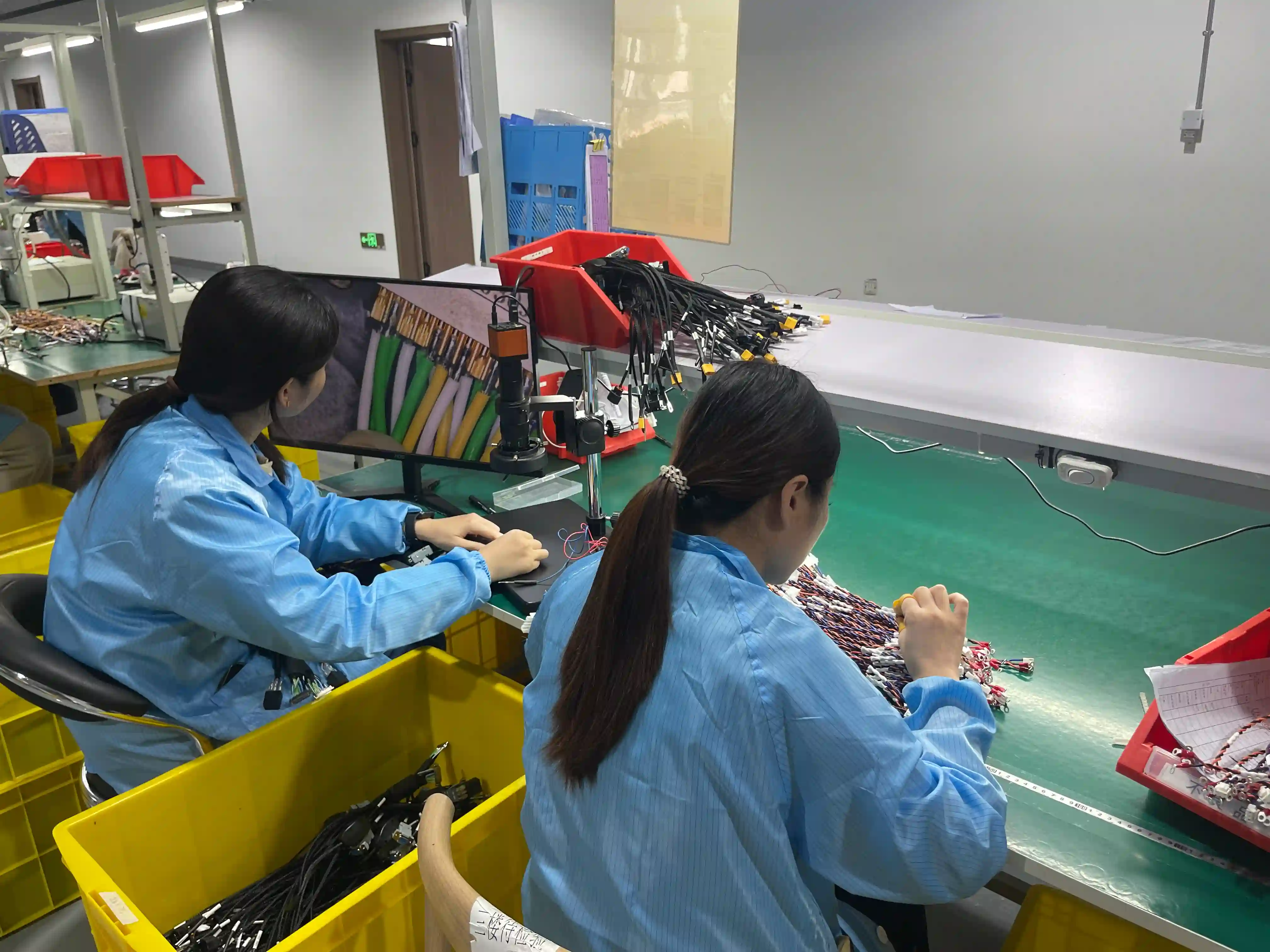
A FAKRA connector can look perfectly assembled — correct color code, proper crimp, no visible damage — and still have a shield connection that's marginal enough to degrade VSWR at 5.9 GHz. That's the fundamental challenge with RF assemblies: the defects that matter most are invisible without the right test equipment.
Our test protocol runs every assembly through three electrical gates: continuity and insulation resistance (catches opens and shorts), hi-pot at your specified voltage (catches dielectric defects), and full VNA sweep (catches RF performance issues). The VNA data is stored per serial number, so if a field issue surfaces, we can pull the original test plot and compare it against the failure mode.
For automotive programs, we also offer environmental stress screening (ESS) including thermal cycling (-40°C to +85°C, 10 cycles) and vibration per ISO 16750-3 on first articles and periodic production samples.
FAKRA Reference: Codes, VSWR and Records
This is a public-specification reference for purchasing and engineering teams. It is not a measured result from a customer project; your drawing and the component datasheets set the final limits.
FAKRA keying codes and housing colours
The 14 standard codes below are listed as in the Rosenberger FAKRA code table. Which code goes with which antenna or signal path is decided by the vehicle manufacturer, so do not infer the function from the colour. The Z code is commonly described as a universal key; confirm that in the connector datasheet.
| Code | Housing colour |
|---|---|
| A | Black |
| B | White |
| C | Blue |
| D | Bordeaux violet |
| E | Green |
| F | Brown |
| G | Grey |
| H | Violet |
| I | Beige |
| K | Curry |
| L | Carmine red |
| M | Pastel orange |
| N | Pastel green |
| Z | Water blue |
VSWR, return loss and reflected power (50 Ω system)
VSWR and return loss describe the same reflection. The reflection coefficient is Γ = (VSWR − 1) / (VSWR + 1); return loss in dB is −20 · log10(Γ); reflected power is Γ²; mismatch loss is −10 · log10(1 − Γ²). The values below are calculated from those formulas.
| VSWR | Γ | Return loss | Reflected power | Mismatch loss |
|---|---|---|---|---|
| 1.2:1 | 0.091 | 20.8 dB | 0.8% | 0.036 dB |
| 1.5:1 | 0.200 | 14.0 dB | 4.0% | 0.177 dB |
| 2.0:1 | 0.333 | 9.5 dB | 11.1% | 0.512 dB |
| 3.0:1 | 0.500 | 6.0 dB | 25.0% | 1.249 dB |
Cable attenuation: read the datasheet at your frequency
Insertion loss of an assembly is mostly the cable's attenuation, and attenuation rises with frequency. As a worked example only, the Fairview Microwave RG174 datasheet lists a typical attenuation of 12.5 dB/100 ft, which is 41.01 dB/100 m, at 100 MHz. For that cable at 100 MHz the cable loss alone is:
| Cable length | Cable loss at 100 MHz (from 41.01 dB/100 m) |
|---|---|
| 0.5 m | 0.21 dB |
| 1.0 m | 0.41 dB |
| 2.0 m | 0.82 dB |
Do not reuse this figure at other frequencies or for other cables. Take the attenuation for your cable and band from its own datasheet, and add the connector contribution stated by the connector maker.
Crimp and pull-test record (template)
A crimp record is only useful if each number has a unit and a source. Height is a length in millimetres; pull force is a force in newtons, so a tolerance on one cannot be expressed in the unit of the other. The template shows the fields we record against your drawing; the limits come from the connector manufacturer's application specification and your acceptance standard.
| Field | Unit | Source of the limit |
|---|---|---|
| Connector part number, tool or applicator ID | — | Drawing |
| Cable type and part number | — | Drawing |
| Crimp height (centre and outer crimps) | mm | Connector manufacturer's application specification |
| Pull force and failure mode (pull-out, cable break) | N | Connector manufacturer's specification and your acceptance standard |
| Sample point (first article, in-process, final) | — | Control plan agreed with you |
| Verdict, inspector and date | — | — |
Frequently Asked Questions
What is the minimum order quantity for FAKRA cable assemblies?▼
Prototype MOQ starts at 25 units for initial validation builds. Production MOQ is 200 units per part number. Lead time is 2-3 weeks for prototypes using standard FAKRA connectors (Rosenberger, TE, Amphenol) and 4-6 weeks for production runs with full testing documentation.
What FAKRA color codes do you support?▼
FAKRA defines 14 standard keying codes, each with its own housing colour and mechanical key so that mismatched connectors cannot mate: A black, B white, C blue, D bordeaux violet, E green, F brown, G grey, H violet, I beige, K curry, L carmine red, M pastel orange, N pastel green and Z water blue (colours as listed in the Rosenberger FAKRA code table; confirm against your connector datasheet). Which code is used for which function is set by the vehicle manufacturer. We build to the code letters on your drawing.
What RF performance specifications do your FAKRA assemblies meet?▼
RF limits are set per drawing, because VSWR and insertion loss depend on the cable, the connectors, the length and the frequency band. We test the finished assembly on a vector network analyzer against the limits and test points you specify, and we agree the calibration plane with you first. Cable attenuation comes from the cable datasheet and rises with frequency, so check the value at your band rather than a single figure.
FAKRA vs HSD connector — when should I use each?▼
Use FAKRA for single-ended RF signals (GPS, LTE, V2X antennas) operating up to 6 GHz. Use HSD (High-Speed Data) for differential signals like USB, Ethernet, or LVDS camera links where impedance matching at 100 ohms differential matters. FAKRA handles up to ~6 GHz single-ended; HSD handles up to ~15 Gbps differential. Many vehicles use both: FAKRA for antenna feeds, HSD for camera and infotainment data.
Can you overmold FAKRA connectors for IP67 waterproofing?▼
Yes. We offer IP67 and IP6K9K overmolded FAKRA assemblies using polyurethane or PVC overmold compounds. The overmold encapsulates the crimp junction and cable entry, sealing against water ingress per ISO 20653. Overmold tooling adds 2-3 weeks to initial lead time and approximately $1,500-$3,000 in NRE depending on connector body style.
What cable types are compatible with FAKRA connectors?▼
Common cable types include RG-174 (1.8mm OD, flexible, short runs), RG-316 (2.5mm OD, better loss), RG-58 (4.9mm OD, low loss, longer runs), and low-loss corrugated cables for base station applications. We also assemble FAKRA on custom shielded twisted pairs for combined RF/power applications. Cable selection depends on frequency, run length, and bend radius requirements.
What files do you need to quote a FAKRA cable assembly?▼
We need: (1) assembly drawing showing connector types, cable spec, and length with tolerances, (2) FAKRA color code and keying requirement, (3) electrical test specifications (VSWR, insertion loss limits, hi-pot voltage), (4) annual volume estimate and target pricing. 3D CAD (STEP) of any overmold is helpful but not required for initial quote — we can design the overmold from your connector and cable selections.
How do VSWR and return loss relate?▼
They describe the same reflection. The reflection coefficient is (VSWR - 1) / (VSWR + 1), and return loss in dB is -20 x log10 of that value. For example, a VSWR of 1.5:1 equals about 14.0 dB return loss, and 2.0:1 equals about 9.5 dB. A lower VSWR, or a higher return loss, means less signal is reflected.
Which FAKRA code do I need?▼
The code is chosen by the system designer so that each antenna or signal path can only mate with its intended connector. It is not derived from the connector colour alone, so use the code letters on your drawing or the vehicle manufacturer's harness specification. The Z code is commonly described as a universal key, but confirm that in the connector datasheet before relying on it.
Need a FAKRA assembly quoted for your project?
Request a QuoteRelated Services
Overmolding
IP67/IP6K9K overmold encapsulation for waterproof FAKRA assemblies and environmental protection.
Automotive Wire Harnesses
Full vehicle harness manufacturing including FAKRA, HSD, and power distribution assemblies.
Cable Assembly Testing
100% electrical and RF testing including VSWR, insertion loss, hi-pot, and environmental validation.
Custom Cable Assembly
Full-service custom cable assembly from prototype through production with engineering support.
Get Your FAKRA Assembly Quoted Today
Send us your assembly drawing and we'll return a detailed quote with cable selection recommendations, test specifications, and lead time within 24 hours. No minimum order too small for prototype builds.