
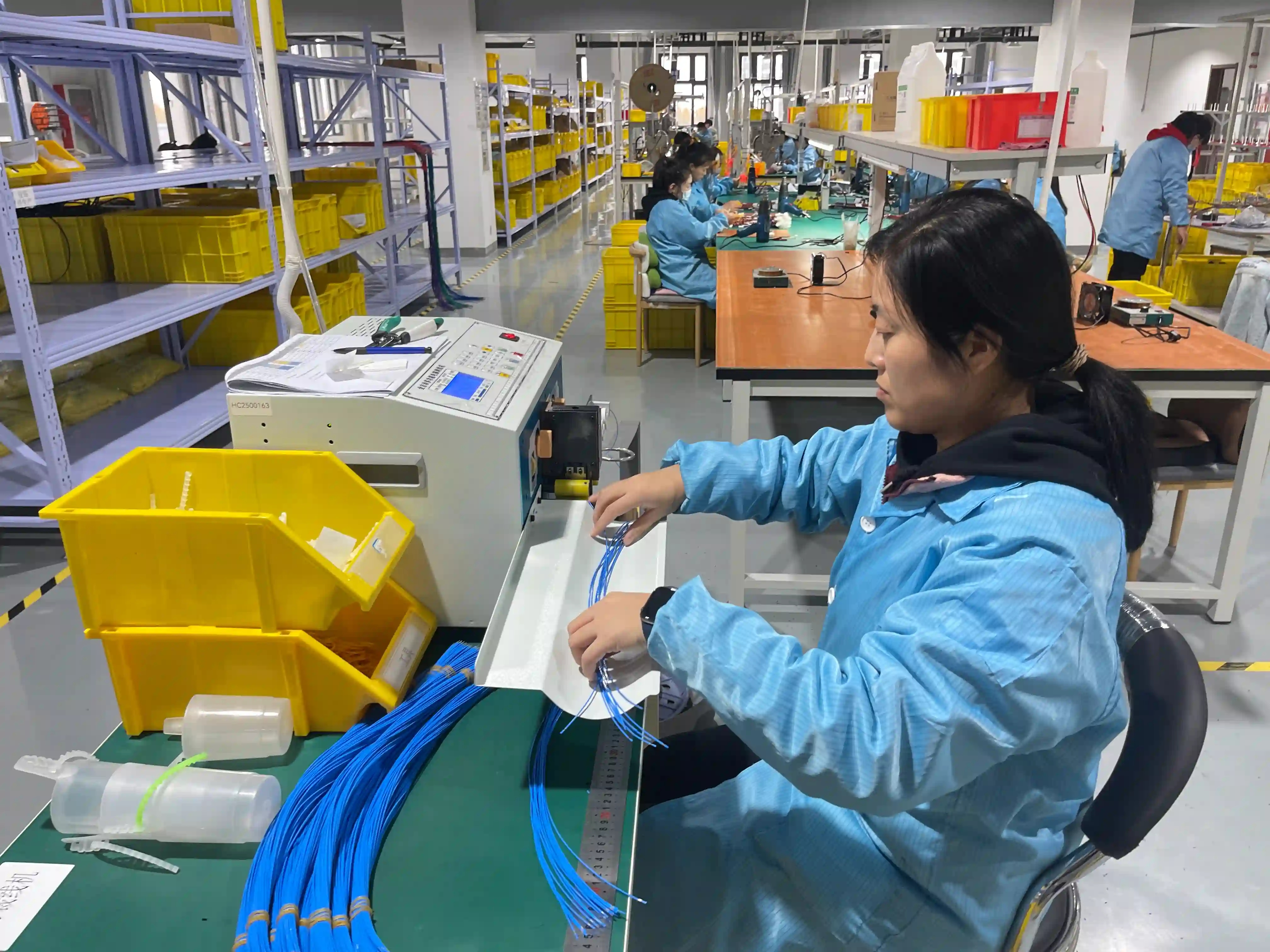
Engineers often treat conductor choice as a minor line item: pick the AWG, check the insulation, move on. That works only until the harness goes into vibration, the operator needs a tighter bend radius, or a crimped terminal starts failing pull tests because the conductor construction was wrong from the start.
Solid and stranded wire can carry the same nominal gauge marking, but they do not behave the same in manufacturing or in service. The difference shows up in flex performance, termination control, conductor fatigue, routing stability, and the probability of field failures. On a custom cable assembly, that difference matters more than the copper cost delta.
This is especially relevant on a site like ours because most OEM harness work is not building wiring. It involves connectors, branch points, strain relief, inspection, and movement. If you are also evaluating conductor size, pair this article with our wire gauge selection guide, our flex life and bend radius guide, and our terminal selection guide.
Engineering Support
Unsure whether your harness should use solid or stranded conductors?
Send us your drawing, current load, bend radius, and connector part numbers. We will review conductor construction, AWG, and termination risk before you release the build.
What AWG Means for Solid and Stranded Wire
AWG, or American Wire Gauge , defines conductor size by diameter and equivalent cross-sectional area. A true 18 AWG solid wire and a true 18 AWG stranded wire are intended to represent roughly the same copper area, so from a basic DC resistance standpoint they are in the same class. The mistake is assuming that this means they are functionally interchangeable in a cable assembly.
The conductor geometry changes everything around that copper area. A solid wire is one continuous core, so it holds shape well, strips cleanly, and is simple to insert in static screw-clamp or push-in terminations designed for solid conductors. A stranded wire divides the copper into many smaller elements, which reduces stiffness and improves fatigue resistance during bending or vibration.
Standards help frame the difference. IEC 60228 distinguishes conductor classes including solid, stranded, flexible, and extra-flexible constructions. In production harness work, those classes are not academic. They influence stripping settings, crimp tool qualification, bundle routing, strain relief design, and acceptance criteria under IPC/WHMA-A-620.
“If the harness sees vibration, connectors, or rework, stranded wire is usually the safer choice even when the AWG is identical. Same copper area does not mean same process capability.”
Solid vs Stranded Comparison Table
| Factor | Solid Wire | Stranded Wire | Practical Takeaway |
|---|---|---|---|
| AWG equivalence | Same nominal AWG area when correctly specified | Same nominal AWG area when correctly specified | Gauge alone does not decide application fit |
| Flexibility | Low, especially above 20 AWG to 16 AWG | High, improves further with finer strand counts | Use stranded for routed harnesses and service loops |
| Vibration life | Poor in moving or shock-loaded assemblies | Much better when properly strain relieved | Automotive, robotics, and mining almost always favor stranded |
| Crimp compatibility | Limited to terminals explicitly qualified for solid conductors | Preferred for most harness crimps and ferrules | Check terminal datasheet before using solid wire |
| Form stability | Excellent, holds shape well in static routing | Moderate, tends to relax unless restrained | Solid can be useful in tidy fixed cabinet wiring |
| Stripping sensitivity | Simple to strip but easier to nick the full conductor | Requires strand-safe settings to avoid cut strands | Both need process control, but the failure modes differ |
| Rework tolerance | Can work-harden after repeated bends | Handles service manipulation more gracefully | Stranded is more forgiving during assembly and repair |
| Typical harness fit | Low | High | Most custom cable assemblies should default to stranded |
Table: Direct comparison of solid and stranded conductor construction for wire harness and cable assembly applications.
When Solid Wire Is the Better Choice
Solid wire still has a place. It is not obsolete; it is simply specialized. Where the route is static, protected, and unlikely to be serviced often, solid conductors can be efficient and neat. Inside fixed control cabinets, terminal blocks, and low-movement enclosure wiring, solid wire gives a straight, clean path and tends to stay exactly where the installer forms it.
For some panel wiring, that shape retention is useful. Technicians can route jumpers with precise geometry, maintain visual separation, and avoid the spring memory that some flexible conductors create. When the termination system is designed for solid conductors, insertion can also be fast and repeatable.
Use solid wire when: the run is short, static, protected, and terminated in hardware approved for solid conductors; the assembly will not see repeated bending; and maintenance access does not require frequent movement.
Even here, the limits matter. Solid wire becomes risky once the route leaves a protected enclosure, crosses a hinge, interfaces with a connectorized harness, or enters equipment exposed to shock. A fixed cabinet is one thing. A mobile machine, trailer, medical device, or robot is another.
When Stranded Wire Is the Better Choice
Stranded wire is the standard answer for most harnesses because real harnesses move, vibrate, get tied down, pass through clamps, and terminate in crimps. In those conditions, flexibility is not just a convenience. It is a reliability requirement.
Automotive harnesses, industrial automation cables, medical leads, mining equipment looms, and robotic dress packs all benefit from stranded conductors. The individual strands share strain during bending and reduce the risk of a single high-stress fracture point. That does not make stranded wire immune to failure, but it makes good strain relief and bend management possible.
Stranded construction also aligns with the way most custom harnesses are manufactured. Open-barrel and closed-barrel crimps, ferrules, backshells, overmolds, and branch transitions are typically engineered around stranded conductors. If you are deciding between termination methods, our crimp vs solder guide explains why properly controlled crimps dominate production harness work.
In higher-flex applications, standard stranded wire may still be insufficient. Robotics, retractile cords, drag chains, and moving sensor cables often need fine-stranded or extra-flex constructions rather than general-purpose stranded building wire. That distinction is why “stranded” alone is not enough in a drawing. The strand count and flex target need to be explicit.
“The right comparison is not solid versus stranded in theory. It is whether the chosen conductor survives the actual bend radius, clamp spacing, and vibration profile of the finished harness.”
Termination, Crimping, and Inspection
This is where conductor choice starts affecting manufacturing yield. A solid conductor behaves as one piece of copper. That can simplify insertion into some terminals, but it also means any nick from stripping removes a meaningful share of the conductor section at one point. On stranded wire, the more common defect is cut or folded-back strands, which reduce pull force and electrical capacity.
Crimping changes the equation further. Most harness terminals are validated on specific wire types and insulation diameter ranges. If the terminal is approved for 22 to 18 AWG stranded wire, substituting 20 AWG solid wire is not a harmless simplification. Barrel compression, bellmouth formation, insulation support, and pull-force performance can all move out of range.
Inspection teams also see different defect patterns. Solid wire failures often show up as conductor cracking at the rear of the terminal after vibration or rework. Stranded wire failures show up as bird-caging, missing strands, under-crimping, over-crimping, or poor ferrule application. If you need a deeper quality reference, see our crimp quality inspection guide.
Common engineering mistake: specifying wire gauge only, without conductor construction, then expecting purchasing or production to choose the correct termination method. Gauge, strand class, and terminal approval must be locked together.
For Australian OEM work, this matters even more where harnesses may pass through qualification testing, PPAP documentation, or customer-specific workmanship audits. A design that seems electrically correct can still fail because the termination system was never matched to the conductor type.
“When a crimp terminal is qualified for stranded conductors, changing to solid wire without revalidation is not a cost reduction. It is an uncontrolled process change that usually shows up later as retention or fatigue failures.”
How to Choose for Your Harness
Start with movement. If the cable or harness branch will move during service, choose stranded unless you have a very unusual reason not to. Then check the route for vibration, clamp spacing, service loops, hinge points, and connector transitions. If any of those are present, stranded remains the default.
Next, look at termination hardware. Screw terminals, spring clamps, IDC contacts, ferrules, crimp contacts, solder cups, and insulation displacement systems all react differently to conductor construction. Never assume the same connector family can accept either type across the full AWG range. Verify the contact specification, not just the housing.
Then review manufacturing controls. Can the stripping process protect all strands? Is there pull-force validation? Are applicator settings locked? Is the harness intended for repetitive maintenance? Those process questions often decide the answer more clearly than the electrical ones.
Choose Solid Wire If
- Static installation with minimal vibration
- Termination hardware is rated for solid conductors
- Shape retention matters more than flexibility
- Rework and service movement are unlikely
Choose Stranded Wire If
- The harness includes connectors or crimps
- Routing includes bends, loops, or clamp transitions
- The equipment vibrates, moves, or gets serviced regularly
- Production consistency matters more than material simplicity
For most custom wire harnesses, the answer is straightforward: stranded wire is the right default, then you refine from standard stranded to fine-stranded or extra-flex based on the duty cycle. Solid wire should be selected deliberately, not accidentally.
How a typical solid vs stranded wire program runs with us
This is an illustrative description of a representative project type, not a specific customer engagement. As a contract assembler we do not publish customer-identifiable data.
FAQ
Is stranded wire the same gauge as solid wire when both are marked 18 AWG?
Yes. If both conductors are truly 18 AWG, they represent approximately the same copper cross-sectional area, around 0.82 mm². The difference is construction, not nominal gauge: one conductor is a single solid core, while the other is made from multiple smaller strands twisted together.
Does stranded wire carry less current than solid wire of the same AWG?
In low-frequency power and control applications, current rating is usually treated as essentially the same for the same AWG because ampacity is driven more by copper area, insulation temperature class, bundling, and ambient temperature. The practical difference appears in termination quality, flex life, and vibration resistance, not a large ampacity penalty.
Can I crimp solid wire into standard wire harness terminals?
Sometimes, but only if the terminal and the crimp specification explicitly allow solid conductors. Many open-barrel and closed-barrel terminals used in harness work are validated for stranded wire only. Using solid wire in an unapproved crimp often causes low pull force, cracked barrels, or conductor damage during vibration testing.
Why is stranded wire preferred in vehicles and moving equipment?
Because dynamic applications impose repeated bending and vibration. Fine-stranded conductors distribute strain across many small wires, which dramatically improves service life in routes with bend radii of 7.5x to 10x cable diameter and in systems exposed to millions of vibration cycles.
When should I use solid wire instead of stranded wire?
Use solid wire mainly for fixed, non-moving installations with stable routing, low vibration, and low rework frequency. Typical examples include internal panel wiring, short jumper links on terminal blocks, and certain building or cabinet conductors where the installation is static and standards such as AS/NZS 3000 or IEC 60228 are the primary design drivers.
What stranded class is common for cable assemblies?
For harness and flexible cable work, Class 5 and Class 6 conductors under IEC 60228 are common references because they indicate flexible or extra-flexible stranded constructions. In practical OEM work, engineers often specify 19, 37, 65, or far higher strand counts depending on AWG size and flex-life target.
Need Help Locking the Right Conductor Spec?
We support Australian OEMs with conductor selection, connector matching, crimp validation, shielding, overmolding, and test planning for custom cable assemblies and wire harnesses. If you are deciding between solid, standard stranded, or high-flex stranded, we can review the full assembly rather than the wire in isolation.
Related Articles
Wire Gauge Selection Guide
AWG, ampacity, voltage drop, and how gauge affects cable performance.
Flex Life & Bend Radius Guide
How conductor construction, routing, and motion affect cable longevity.
Terminal Types Selection Guide
Match conductor type to ring, spade, ferrule, butt splice, and pin terminals.