
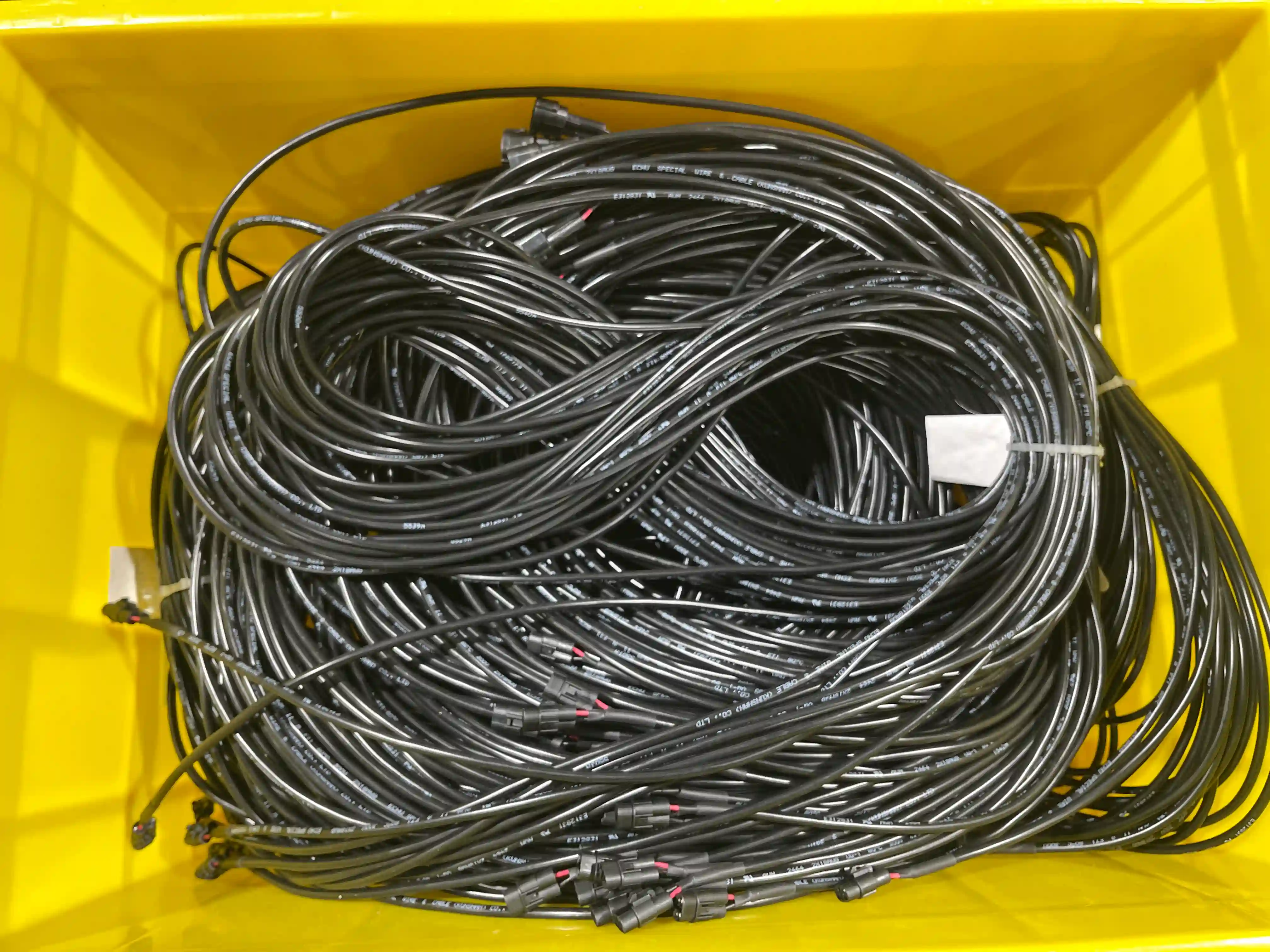
A cable gland looks simple: a threaded body, a seal, a nut, and sometimes a washer. In production, it is one of the most common failure points on panel-mounted cable assemblies. The gland must seal against the enclosure wall, grip the cable jacket, protect conductors from pull force, and sometimes bond a cable shield to the enclosure. If any one of those functions is underspecified, the assembly may pass continuity testing and still fail after washdown, vibration, or thermal cycling.
This guide explains how to select cable glands for custom cable assemblies and wire harnesses used in industrial controls, mining equipment, rail systems, marine enclosures, and outdoor machinery. It focuses on practical release details: cable OD range, thread family, IP rating, material, washer selection, EMC bonding, installation torque, and validation tests.
Useful OD margin from a seal range limit
Common 30 minute temporary immersion target
Preferred shield contact for EMC gland bonding
Common metric entry size for control panels
The 7 Factors That Decide Cable Gland Selection
The correct gland starts with the finished cable, not the enclosure hole. A drawing that says “M20 gland” is incomplete unless it also defines the cable OD, jacket material, sealing target, panel thickness, washer material, and pull requirement. For a supplier building a finished assembly, those details determine whether the gland becomes a controlled strain relief feature or just a threaded accessory.
“Cable gland selection should begin with measured jacket OD on production cable. A 0.3 mm OD change can move a small sensor lead from stable compression to a leak path, even when the wire gauge has not changed.”
Cable OD range
Use measured minimum and maximum jacket diameter, including supplier tolerance and ovality.
Ingress target
Define IP66, IP67, IP68, or IP69K by the real exposure: rain, immersion, pressure wash, or dust.
Thread and panel
Match thread family, panel cut-out, wall thickness, locknut access, and washer surface finish.
Material exposure
Check UV, oil, coolant, salt spray, cleaning chemicals, impact, and temperature range.
Mechanical retention
Specify pull force and continuity-after-pull checks for the finished assembly.
Shield bonding
Use EMC glands when the shield must terminate to a conductive enclosure at low impedance.
Serviceability
Decide whether the cable must be replaceable in the field or permanently overmoulded.
Thread Types: Metric, PG, NPT and When Each Fits
Most new Australian industrial projects use metric threads such as M12, M16, M20, M25, M32, and M40. Metric glands use a straight thread and normally rely on a sealing washer, O-ring, or flat gasket at the enclosure wall. This is predictable for sheet-metal cabinets and machined aluminium housings.
NPT is a tapered pipe thread often found on North American equipment, legacy junction boxes, and conduit systems. It seals differently, tightens differently, and should not be substituted for a metric opening. PG threads still appear on older European equipment, but they are rarely the best choice for new designs unless a replacement part must match an existing panel.
For custom assemblies, include both thread and cable OD on the drawing: “M20 x 1.5 gland, 6-12 mm seal range, nickel-plated brass, IP68, EPDM washer” is actionable. “Waterproof gland” is not.
IP Ratings: What the Gland Must Actually Survive
The IP Code describes resistance to dust and water ingress, but the rating only means something when the entire installed system is tested: gland body, washer, panel finish, cable jacket, and assembly torque. A gland rated IP68 on a smooth test plate can leak on a powder-coated panel if the washer is wrong or the hole has burrs.
Use IP66 for heavy rain and hose-down, IP67 for temporary immersion, IP68 for specified continuous or deeper immersion, and IP69K where high-pressure hot washdown is realistic. For mining, food equipment, marine hardware, and outdoor control boxes, match the test to the cleaning method and the real installed orientation.
“Do not buy an IP68 gland and assume the enclosure is IP68. The assembly only earns that rating after the cable jacket, washer, panel hole, and torque are validated together, usually with a 30 minute or longer water exposure test.”
Cable Gland Type Comparison
| Gland type | Best use | Typical rating | Main strength | Watch point |
|---|---|---|---|---|
| Nylon PA66 gland | Indoor panels, light industrial equipment, sensor leads | Commonly IP68 when correctly sized | Low cost, corrosion resistant, easy to install | Limited impact and UV performance unless material is specified |
| Nickel-plated brass gland | Machine wiring, mining controls, transport equipment | IP66 to IP68 depending on seal design | High thread strength and good mechanical retention | Needs correct washer material to avoid galvanic issues |
| Stainless steel gland | Marine, washdown, food equipment, chemical exposure | IP66, IP67, IP68, or IP69K by design | Best corrosion resistance and long service life | Higher cost and greater risk of over-tightening soft seals |
| EMC gland | VFD motors, shielded sensor cables, data and control cabinets | Usually IP66 to IP68 plus shield bonding | Provides 360-degree shield contact at panel entry | Poor braid preparation can reduce EMC performance sharply |
| Multi-hole gland | Several small leads entering one enclosure wall | IP65 to IP68 depending on insert fit | Reduces panel holes and simplifies enclosure layout | Every cable OD must match its insert bore, not just wire gauge |
| Ex-rated gland | Hazardous-area equipment requiring certified installation | Defined by explosion-protection certification and IP rating | Designed for regulated gas or dust environments | Must match the exact approval, cable type, and installation rules |
EMC Cable Glands for Shielded Cable Assemblies
EMC glands are used when a cable shield must bond directly to a conductive enclosure. They are common on shielded motor leads, VFD control wiring, encoders, servo feedback cables, Industrial Ethernet, and CAN bus cable assemblies. The goal is continuous, low-impedance contact around the braid or foil shield rather than a long pigtail.
The electromagnetic compatibility risk is not only the connector. A shielded cable can lose much of its benefit if the gland clamps the jacket but leaves the braid floating. For high-noise environments, specify the braid preparation length, clamp style, contact spring or cone, and whether the shield bonds at one end or both ends.
Production Validation Plan
Minimum release checks for a glanded cable assembly
- 1. Measure cable OD from at least 10 production cable samples and record min/max values.
- 2. Confirm thread engagement, washer compression, and locknut access on the real enclosure wall.
- 3. Apply specified gland torque, then perform axial pull testing on the finished assembly.
- 4. Run 100% continuity and pinout testing before and after pull-force checks.
- 5. Test insulation resistance where circuits exceed low-voltage signal levels or pass near wet zones.
- 6. Validate water or dust exposure to the target IP rating after thermal cycling when risk is high.
For quality systems, document the gland part number, washer material, panel thickness, torque value, cable OD, and inspection method in the control plan. This aligns with the process discipline expected under ISO 9001 quality management and reduces the chance that a buyer, installer, and harness supplier each make a different assumption.
“For a sealed panel-entry harness, I want continuity after pull, insulation resistance after water exposure, and a recorded gland torque. Those 3 checks catch most real-world gland installation failures.”
Common Cable Gland Mistakes
Sizing by AWG instead of jacket OD
Two 18 AWG cables can have very different outer diameters, especially with PUR, PVC, silicone, or shielded constructions.
Ignoring panel coating thickness
Powder coat, paint, burrs, and rough punched holes can stop a washer from sealing evenly.
Using nylon in harsh UV or impact zones
Outdoor machinery and mining equipment often justify brass or stainless steel despite the higher unit price.
Treating IP69K as universal waterproofing
IP69K targets high-pressure washdown; it does not automatically prove long-term immersion performance.
Leaving shield termination undefined
A shielded cable with no gland bonding plan can pass electrical test and still fail noise immunity in the cabinet.
Skipping assembly torque control
Hand-tight is not a process. Use torque values and visual inspection marks for repeatable production.
How a typical cable gland selection guide program runs with us
This is an illustrative description of a representative project type, not a specific customer engagement. As a contract assembler we do not publish customer-identifiable data.
Cable Gland Selection FAQ
What size cable gland do I need for a cable assembly?
Choose the gland by cable outer diameter, not conductor size. The cable OD should sit inside the manufacturer’s sealing range with at least 0.5 mm margin from either limit where possible. For example, an 8.0 mm cable is usually safer in a gland with a 6-10 mm seal range than one rated 8-12 mm.
Is IP68 always better than IP67 for cable glands?
No. IP67 means protection during temporary immersion, commonly 1 m for 30 minutes under the IP Code test framework. IP68 is defined by the manufacturer’s stated depth and time, so an IP68 claim is only useful when the exact test condition is shown on the drawing or datasheet.
Should I use metric or NPT cable gland threads?
Use metric threads such as M16, M20, M25, and M32 for most new industrial enclosures in Australia and Europe. Use NPT only when the equipment, conduit system, or legacy enclosure is already designed around tapered threads. Mixing M20 and 1/2 inch NPT can damage threads within 1 or 2 turns.
How tight should a cable gland be?
Use the manufacturer’s torque value whenever available. Small nylon glands may be in the 2-5 N·m range, while larger brass glands can exceed 8-12 N·m. Over-tightening can cut the seal or ovalise a soft jacket; under-tightening allows pull-out and water tracking.
When do I need an EMC cable gland?
Use an EMC gland when the cable shield must bond to a metal enclosure with low impedance, especially around VFD motors, encoders, servo drives, Ethernet, CAN bus, and noisy industrial control wiring. A 360-degree gland termination is usually more stable above 10 MHz than a long drain-wire pigtail.
Can a cable gland replace strain relief testing?
No. A gland is a strain relief method, but the finished cable assembly still needs validation. For production release, test pull retention, continuity after pull, insulation resistance, and sealing. Critical assemblies should add thermal cycling such as -20°C to 80°C before repeating electrical checks.
Related Cable Assembly Resources
Need a Glanded Cable Assembly Built to a Real IP Target?
Our team can review cable OD, panel entry, gland material, shield bonding, and validation requirements before production release. Share your drawing, enclosure details, and environmental exposure target, and we will help specify a buildable assembly.