
Precision Wiring Harness Manufacturer for Australian OEMs
Custom precision wiring harnesses for robotics, medical devices, automotive electronics, instrumentation, and compact industrial equipment where branch accuracy, connector orientation, and repeatable test evidence matter as much as the electrical design itself.
Quick answer
A precision harness controls datum-to-datum branch lengths, connector orientation, crimp geometry and label position against a drawing. Achievable tolerance depends on the branch type, routing method (fixture board or freely routed) and measurement method. Precision is confirmed on the drawing at quotation, not expressed as a universal number.
Start with engineering drawing review and agree the test plan. Certificates are held by the partner factory; see the Quality section and certificate pages and confirm the exact scope on request.
Why Precision Matters in a Wiring Harness
A harness can pass continuity and still fail the product. That usually happens when branch points drift, connector orientation changes, labels move, or fine-gauge terminations are inconsistent enough to create fit problems or intermittent faults in the field.
Precision wiring harness manufacturing is about controlling those details before they become expensive: measurement references, strip length, terminal setup, breakout geometry, shield handling, and the exact inspection criteria used to release the part. That is especially important in dense equipment where there is little tolerance for rework once the harness reaches assembly.
If your product relies on tight packaging, repeatable serviceability, or documented first-article approval, a generic wire harness process is usually not enough. You need a build that is engineered and inspected as a controlled component, not treated like loose wiring grouped together at the end of production.

What We Control on Precision Harness Programs
The objective is not complexity for its own sake. It is controlling the few variables that determine whether the approved sample and the repeat order behave the same way in your product.
Tight-Tolerance Branch Control
We define measurement points, breakout locations, and connector clocking around the installed assembly so the harness fits the product consistently instead of “close enough” on the bench.
Controlled Terminal Quality
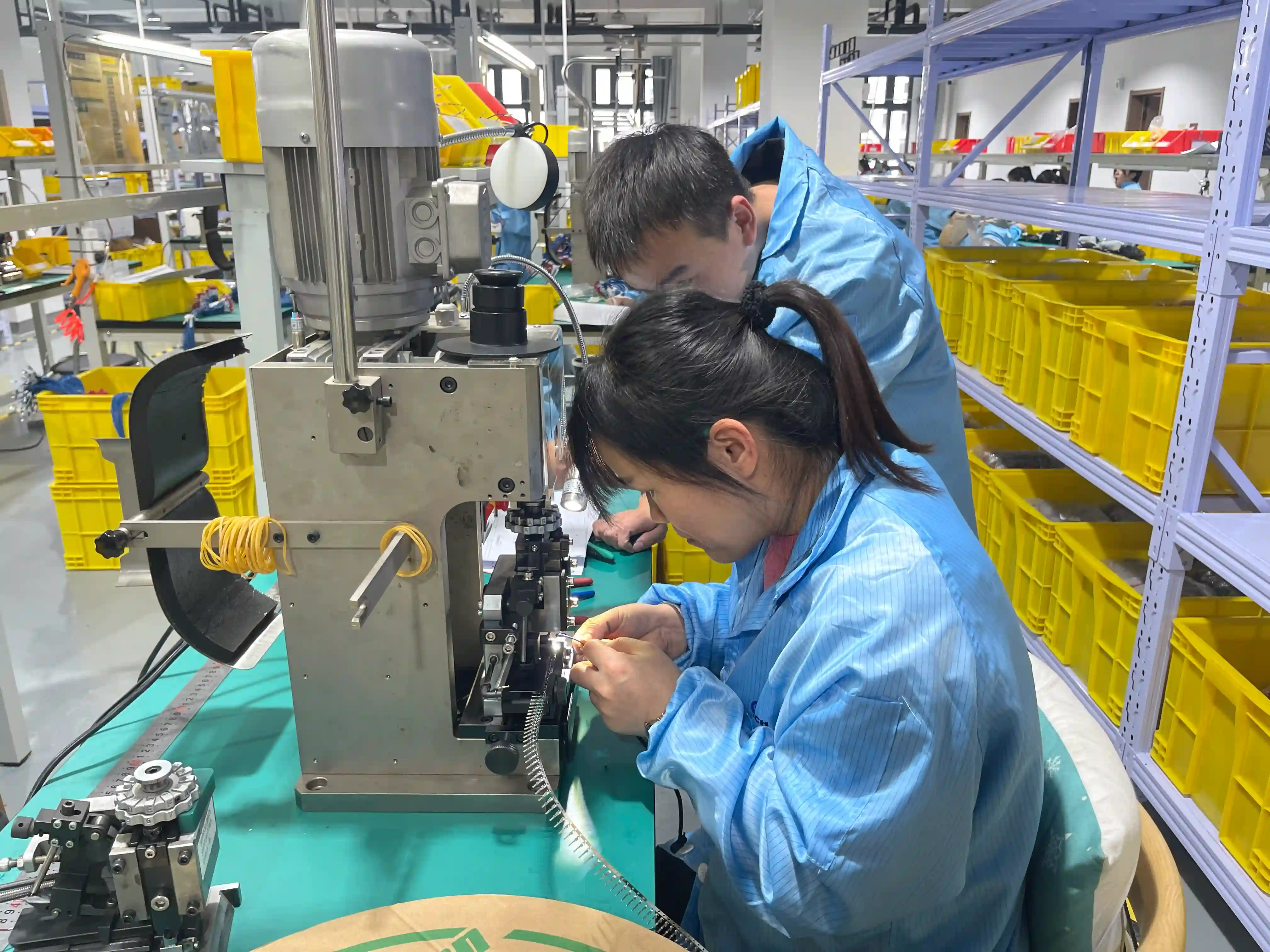
Precision harnesses depend on consistent strip length, conductor presentation, crimp setup, and cavity placement, especially on fine-gauge signal circuits and compact connector systems.
Documented First-Article Release
Sample approval, revision control, and first-article notes help the same harness move from prototype to repeat purchasing without hidden build assumptions.
Inspection That Matches the Risk
Visual checks alone are not enough on high-density harnesses. We define dimensional, electrical, and workmanship checkpoints around the circuits and features that actually matter.
Traceable Prototype-to-Production Supply
The approved BOM, labels, tooling choice, and test requirements are locked into controlled instructions so later builds stay interchangeable with the validated sample.
Built for High-Reliability Equipment
We support precision harnesses used in robotics, medical devices, automotive electronics, industrial controls, and instrumentation where repeatability is valued over commodity pricing alone.
Precision Harness Technical Scope
| Typical Products | Sensor harnesses, robotics looms, compact machine harnesses, medical internal harnesses, automotive sub-harnesses, and test-system interconnects |
| Precision Focus Areas | Branch length accuracy, connector orientation, cavity placement, label position, shield termination, and repeatable strain relief |
| Conductor Range | Fine-gauge signal wires through heavier power conductors, selected around the application rather than a fixed harness template |
| Connector Support | Molex, TE Connectivity, JST, Amphenol, Hirose, sealed automotive systems, and customer-specified connector families |
| Protection Options | Heat shrink, braid, sleeve, labels, boots, overmolding, shielding, and routing features matched to the product environment |
| Validation | Tested per the test plan agreed on the drawing; continuity and pinout checks are the baseline where the drawing calls for them. Additional checks, coverage and acceptance limits are agreed per drawing. |
| Quality Basis | Certificates are held by the partner factory. See the Quality section and its certificate pages; confirm the exact scope on request. Release evidence follows the agreed drawing and control plan. |
| Production Scale | Prototype, first-article, pilot and repeat-production quantities are confirmed per drawing at quotation. |
Useful Companion Pages
Tight-tolerance harness work usually benefits from an upstream drawing review, a defined test plan, and a clear understanding of DFM risks.
For buyer-side research, our guides on wire harness testing, crimp quality inspection, and RFQ best practices help define what should be documented before production release.
We also support market-specific precision programs in automotive, medical, and robotics applications where fit and repeatability are often audited closely.
Datum points and how branch length is measured
Measure between named reference points along a defined path. A connector mating face is the interface with its counterpart; a seating plane is the surface located against a stop; a cable-exit datum is the defined boundary where the cable leaves the housing or transition. On a fixture board, identify each pin or peg and say whether its centre or a contact edge defines the reference.
“Overall length” can mean tip-to-tip, mating-face-to-mating-face, a straight span or the length along a curved route. The drawing must name both datums, the path, the tolerance and the method. State whether the finished branch lies straight on a board without added tension, follows located pegs, or is measured under a specified tension with a defined load and direction. Include connector seating, support and clocking references so incoming inspection can reproduce the condition.
| Branch type | Dimension that can be controlled | What is not fully controlled | What to specify |
|---|---|---|---|
| Short fixed-length branch on fixture board | Datum-to-datum path and connector clocking against located supports | Final bend position after removal or installation | Mating / seating datums, peg layout, clocking reference and board measurement condition |
| Long flexible branch | Length along the defined supported path between named end datums | Free-hanging shape, sag and installed bend position | Path versus straight span, support spacing, straightening method and any specified tension |
| Branch with heat-shrink / overmold transition | Finished transition edge or moulded face relative to a connector datum | Bend origin in the flexible exit or shrink movement without a defined finishing condition | Finished-state datum, transition length, cooling / recovery condition and exit support |
| Branch with twisted / shielded pair | Finished branch path and exposed / untwisted length from a named exit | Individual conductor path from the outer cable length alone; relaxed twist shape | Finished cable condition, twist / shield termination boundaries, untwist limit and measuring path |
| Spliced breakout | Splice reference and branch exits located relative to board datums | Free branch angles or the hidden splice centre inferred from an irregular sleeve edge | Splice datum, breakout origin, branch exit directions and inspection stage before covering |
A short, located branch can support a more direct dimensional commitment than an unsupported flexible route, but both need an agreed method before quotation. The wire cutting and stripping tolerances guide explains upstream dimensions to include in that review.
Tolerance allocation: worst-case vs statistical stack
Allocate the finished branch tolerance across the operations that move its end datums. Avoid counting the same displacement in both cut length and terminal position. The following assumed example treats the contributors as separate, additive length errors with unit sensitivity.
Assumed example — not a production tolerance
Nominal finished datum-to-datum length: 250.00 mm. The entries below are assumed error allowances around that nominal, not physical segment lengths.
| Contributor | Assumed bilateral allowance |
|---|---|
| Cut length | ±0.40 mm |
| Strip / terminal position | ±0.30 mm |
| Connector seat | ±0.10 mm |
| Routing / lay-up | ±0.20 mm |
| Method | Calculation | Combined half-width |
|---|---|---|
| Worst-case: Σ |tᵢ| | 0.40 + 0.30 + 0.10 + 0.20 | ±1.00 mm |
| Root-sum-square: √(Σ tᵢ²) | √(0.40² + 0.30² + 0.10² + 0.20²) | ±0.55 mm |
Worst-case adds the allowed errors in the same direction. Use it where fit is critical or sample sizes are small and there is insufficient evidence for a statistical model. RSS assumes independent, centred, roughly normal contributors. To interpret these allowances statistically, assume each is the same multiple of its contributor sigma; RSS then represents that same multiple of the combined sigma. Drawing limits alone do not prove this assumption. Correlated errors, drift or biased seating invalidate a simple RSS estimate; it is not a guaranteed acceptance envelope.
Gauge repeatability before you trust the number
Repeatability asks how much readings change when the same operator repeats the measurement with the same setup. Reproducibility asks how much changes between operators using the agreed method. A gauge study separates these measurement effects from part variation; calibration alone does not do that.
A flexible harness can change shape under a tape or caliper, and jaw pressure or hand tension can move the apparent datum. A fixture-board gauge can locate connectors and support the branch along the specified path. Include removal and reseating in the study when they are part of routine inspection.
| Quantity | Value / calculation |
|---|---|
| Assumed drawing tolerance | ±1.00 mm |
| Full tolerance band: USL − LSL | 2 × 1.00 = 2.00 mm |
| Assumed combined gauge sigma | 0.04 mm |
| Gauge study width: 6 × sigma_gauge | 6 × 0.04 = 0.24 mm |
| %GRR = (6 × sigma_gauge) / tolerance band × 100 | 0.24 / 2.00 × 100 = 12.0% |
Published guidance: the commonly cited AIAG Measurement Systems Analysis (MSA) reading bands are under 10% generally acceptable, 10–30% potentially acceptable depending on the application, and over 30% generally not acceptable. Source: AIAG MSA guidance as explained in Minitab's “More on How to Interpret Gage R&R Output (Part 2)”. These are evaluation guidelines, not factory results or automatic approval criteria.
The assumed 12.0% falls in the conditional band. State the denominator: %Tolerance compares gauge variation with the specification band; %Study Variation compares it with study variation and answers a different question. Assess bias and stability as well as gauge R&R before using readings for acceptance or capability analysis.
Formula reference: Minitab, Statistical Quality Analysis, “Assessing Measurement System Variation — Percent tolerance”, using the combined repeatability and reproducibility standard deviation.
Process capability evidence: what Cp and Cpk tell you
Cp compares the specification width with process spread. Cpk also accounts for the mean's distance from the nearer limit. A centred process can therefore have the same Cp as an offset process while their Cpk and predicted rejection fractions differ.
Cp = (USL − LSL) / (6 × σ)
Cpk = min(USL − μ, μ − LSL) / (3 × σ)
Normal-model out-of-tolerance ppm = [Φ((LSL − μ) / σ) + 1 − Φ((USL − μ) / σ)] × 10⁶
USL and LSL are specification limits, μ is the process mean, σ is the process standard deviation estimated from appropriate within-process variation, and Φ is the standard normal cumulative distribution function. Assumed example: nominal 250.00 mm with ±1.00 mm tolerance gives LSL 249.00 mm and USL 251.00 mm. Means and sigmas below are assumed independently of the tolerance-stack and gauge examples; these are alternative process scenarios, not combined study data.
| Assumed case | Mean μ (mm) | Sigma σ (mm) | Cp | Cpk | Expected out-of-tolerance (ppm) |
|---|---|---|---|---|---|
| Centred | 250.00 | 0.25 | 1.33 | 1.33 | 63 |
| Offset | 250.40 | 0.25 | 1.33 | 0.80 | 8198 |
| Wider spread | 250.00 | 0.40 | 0.83 | 0.83 | 12419 |
Agree the customer-set Cpk target per program; 1.33 is a commonly used example, not a universal requirement. Capability needs a stable process, a suitable measurement system and enough representative samples to assess uncertainty. Request the sampling basis, stability evidence, distribution assessment and confidence bounds. Non-normal data needs an appropriate model. This page requests evidence and makes no factory Cp, Cpk or rejection-rate claim.
Definition reference: NIST/SEMATECH e-Handbook of Statistical Methods, “What is Process Capability?” and glossary entry “capable process”. The ppm calculation uses the stated normal distribution without an added mean-shift convention.
Records you can ask for on a precision harness
Request records that tie the measured feature to its drawing revision, measurement method and material lot. These are blank templates, not completed inspections or evidence of a factory study. Dashes are unfilled fields. Agree units, acceptance limits, sample selection and release responsibility before use.
| Drawing / revision / lot / sample | Datum-to-datum feature / nominal | Tolerance / limits | Condition / method | Measured | Gauge ID / calibration | Operator / date / disposition |
|---|---|---|---|---|---|---|
| — | — | — | — | — | — | — |
| Drawing / revision / lot / sample | Wire / terminal / applicator IDs | Crimp-height limit / measured | Pull-force limit / measured | Pull method / failure mode | Gauge IDs / calibration | Operator / date / disposition |
|---|---|---|---|---|---|---|
| — | — | — | — | — | — | — |
| Drawing / feature / tolerance band | Part / operator / trial IDs | Fixture / gauge ID / calibration | Condition / method / reading | Repeatability / reproducibility estimates | Combined gauge sigma / %GRR basis | Study file / review / disposition |
|---|---|---|---|---|---|---|
| — | — | — | — | — | — | — |
| Assembly / revision / lot | Wire / terminal / connector lots | Splice / sleeve / moulding material lots | Work instruction / tooling / fixture IDs | Inspection / test-plan revision | Record references / deviations | Release approval / date |
|---|---|---|---|---|---|---|
| — | — | — | — | — | — | — |
Use the first-article inspection guide to define deliverables and the wire harness manufacturing scope to align the build package. Crimp height and pull testing need the terminal system's specified limits and methods; a pull result alone does not establish crimp geometry or branch-length capability.
Typical Precision Wiring Harness Applications
These are the kinds of programs where dimensional discipline and traceable release criteria usually provide the most value.
Robotics and Motion Systems
Compact moving assemblies need exact branch geometry, strain control, and consistent connector orientation so maintenance and repeated motion do not expose routing errors.
Medical and Diagnostic Equipment
Internal harnesses in medical devices often combine space limits, traceability needs, fine-pitch terminations, and strict sample-to-production repeatability.
Automotive Electronics and EV Subsystems
Precision becomes important where harnesses must fit defined clips, pass exact branch points, or maintain repeatable terminal quality across sensor, controller, and body-electrical assemblies.
Industrial Controls and Instrumentation
PLC panels, sensor clusters, and compact machine assemblies benefit from cleaner routing, exact labels, and consistent pinout documentation that simplifies commissioning and service.
Test Equipment and Production Fixtures
Test harnesses need stable dimensions and reliable terminations because small build variation can create false failures, handling issues, or lost troubleshooting time.
Replacement and Supplier-Transfer Programs
Legacy imported harnesses and supplier transitions often need sample-based reverse engineering so the new part is not “similar” but actually interchangeable in the field.
Release Process for Repeatable Precision Builds
Requirement and Fit Review
We review the circuit count, connector family, measurement reference points, environment, and fit-critical features before defining how the harness will be controlled.
Build Definition
The team confirms wire, terminals, labels, sleeves, branch dimensions, orientation notes, and the exact inspection plan so operators are not left to interpret the drawing differently.
Prototype or First-Article Build
Initial samples are built to confirm fit, handling, connector engagement, and test performance before the part is released for repeat purchasing.
Controlled Production
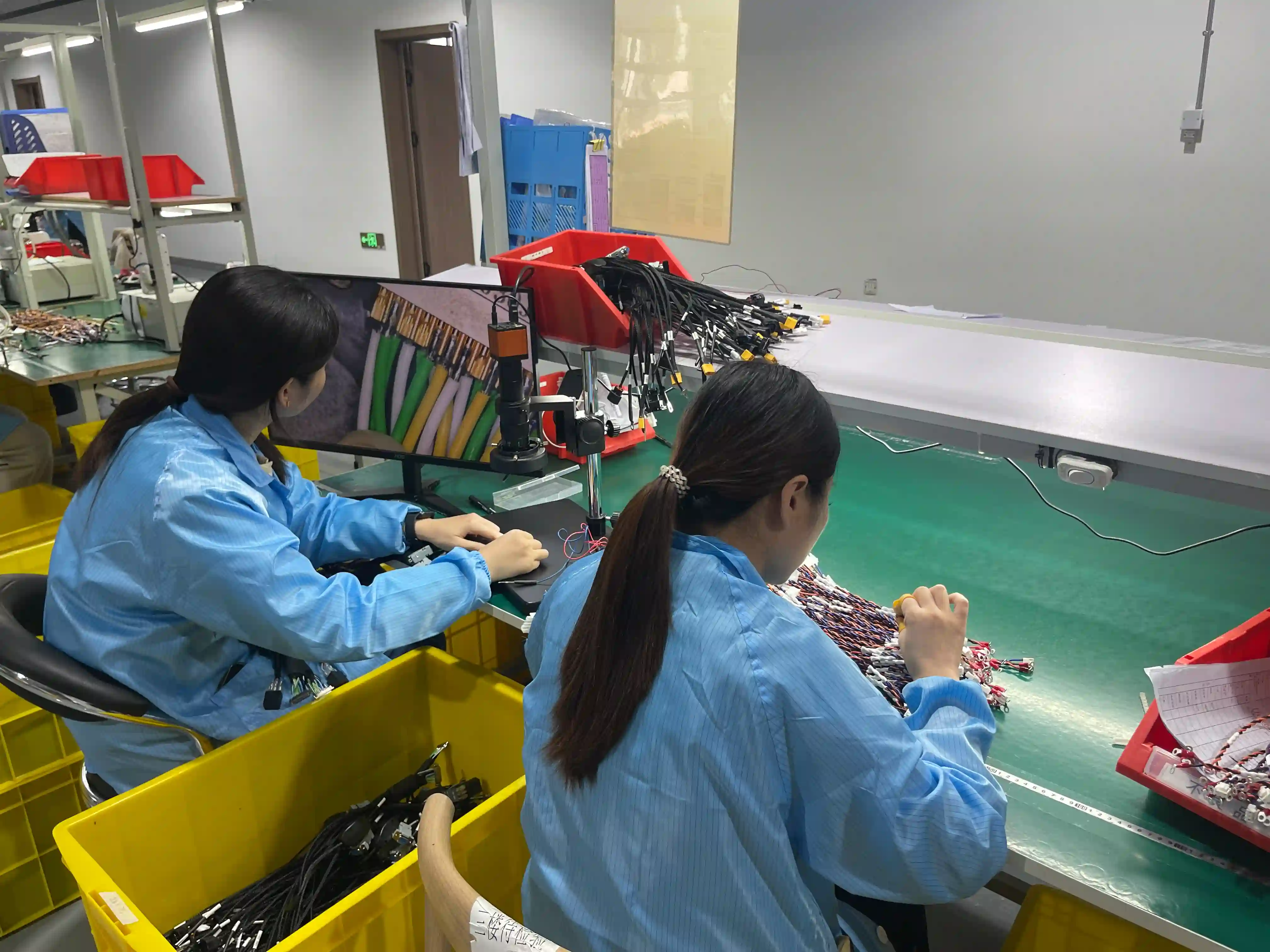
Assemblies are processed with approved tooling, work instructions, and in-process checks that hold the critical dimensions and workmanship points defined in the release package.
Electrical Test and Final Audit
Finished harnesses are verified against the agreed electrical and dimensional criteria, then packed and released with the documentation needed for incoming inspection or repeat ordering.
Precision Harness Release Checklist
Most repeatability problems come from vague drawings or incomplete release notes, not from the assembler lacking effort.
Define branch lengths and breakout measurements from clear reference points instead of freehand overall-length notes.
Lock connector orientation and cavity numbering into the drawing so operators and inspectors read the harness the same way.
Define mandatory and optional checks, coverage, sampling, acceptance limits and records in the test plan agreed on the drawing.
Confirm label text, placement, and readability before first article approval, especially on service and field-replacement assemblies.
Use public workmanship and quality references such as crimp termination fundamentals, IATF 16949 quality systems, and ISO 9000 quality management to keep inspection language stable and accessible.
Compare the approved sample against repeat builds under the same revision so a purchasing handoff does not quietly change the harness.
Define the precision harness release package
Achievable precision and required evidence are confirmed per drawing at quotation.
Frequently Asked Questions
Common questions from buyers comparing precision harness supply options.
Related Capability & Resource Links
Wire Harness Manufacturing
Broader custom wire harness capability for production-scale builds across Australian OEM sectors.
Engineering Drawing Review
Review BOMs, pinouts, tolerances, and test notes before releasing a precision harness.
Testing & Quality Control
See the electrical validation and inspection capability that supports high-reliability harness releases.
Wire Harness Crimp Quality Guide
Detailed resource on crimp inspection, pull testing, and process control for harness reliability.
Need a Precision Wiring Harness with Defined Acceptance Criteria?
Send your drawing, sample, or problem part. We will review the fit-critical details, confirm the test plan, and quote a precision harness build path from first article to repeat production.