
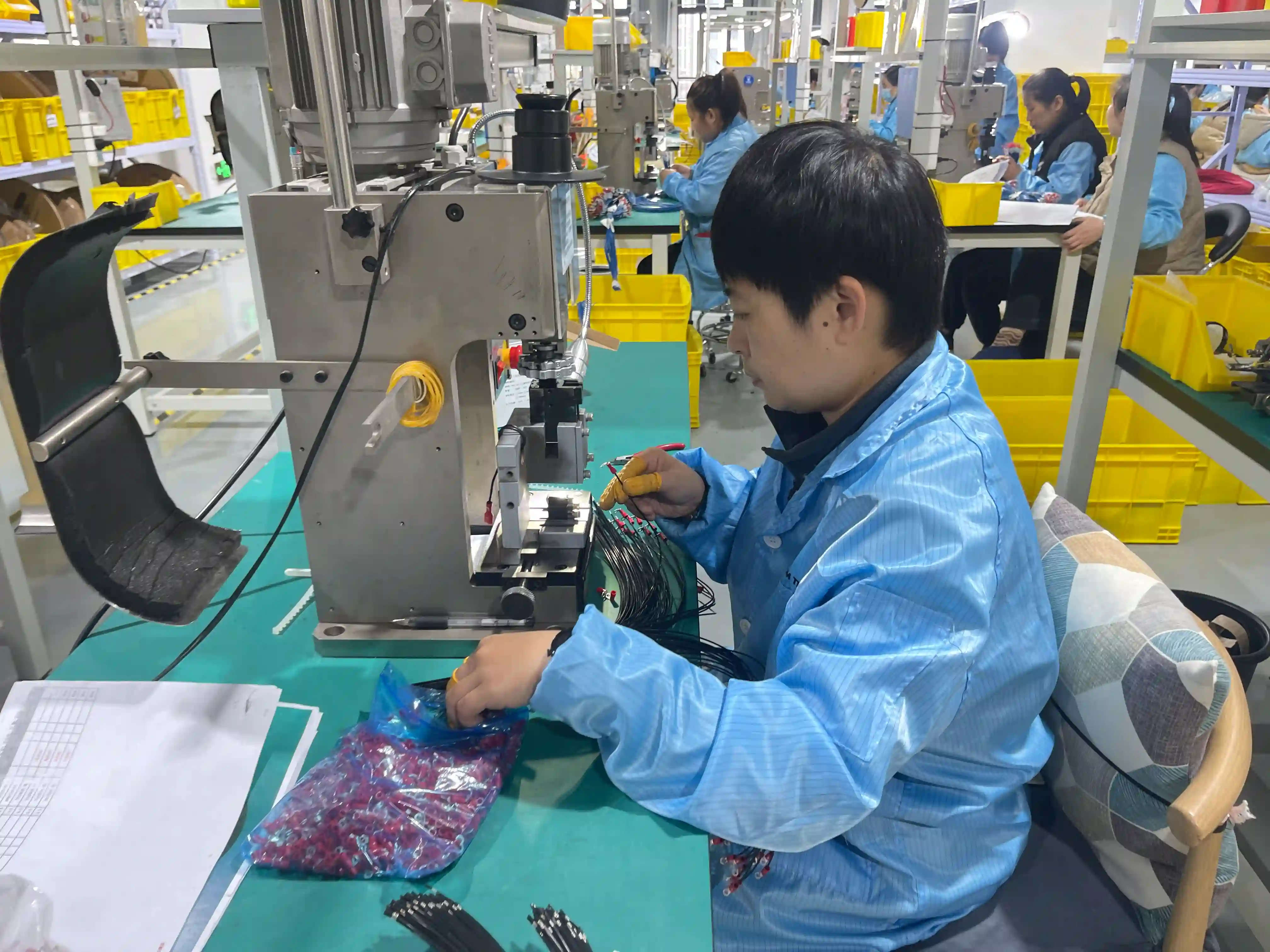
What a wire splice must do
A splice is not just a way to join copper. In a production harness, it has to carry current, survive vibration, fit within a branch breakout, pass inspection, and remain stable after years of thermal cycling. That is why the right question is not simply "which splice works" but "which splice is controllable for this conductor set, environment, and volume".
The main families used today are closed-barrel butt crimp splices, open-barrel parallel splices, lap-solder splices, solder sleeves, ultrasonic splices, and sealed repair splices. Each one solves a different manufacturing problem. A harness branch inside a protected enclosure needs a different joint from a service repair under a truck chassis or a high-current battery lead inside an EV pack.
Buyers often underestimate how much splice choice affects downstream operations. An oversized repair splice can block routing clips. A solder-heavy joint can create a stiff point that fails after a few hundred bend cycles. An unsealed splice in a wet location can pass end-of-line continuity, then fail after only one salt-spray season. That is why this guide ties splice type to actual use conditions, not just catalog descriptions.
If you are also evaluating terminal families, our wire harness terminal types guide explains where butt splices sit relative to ring, spade, ferrule, and pin terminations. For workmanship acceptance, the benchmark reference remains IPC guidance together with a documented customer specification.
A splice should add as little electrical loss as possible and remain stable through temperature rise.
The joint has to survive pull, bend, and vibration without letting strands break or back out.
A splice is only production-worthy if operators can repeat it with measured settings and clear acceptance criteria.
“If the splice changes the harness stiffness by more than the routing design expected, the failure may show up 200 mm away at the next clamp point. We review splice geometry and support length before we ever talk about price.”
— Custom Wire Assembly
The main types of wire splicing
1. Closed-barrel butt crimp splice
The classic butt splice joins two wire ends in line. Each conductor inserts from the opposite side into a metal barrel, and the barrel is compressed with a matched die. This is the default choice for repairs, low-to-medium volume production, and sealed field service work when combined with adhesive-lined heat shrink.
It is easy to source, easy to train, and compatible with manual ratchet tools or pneumatic bench presses. The tradeoff is package size. A butt splice is usually bulkier than a parallel splice or ultrasonic node, so it can be awkward inside dense branch junctions.
2. Open-barrel parallel crimp splice
Open-barrel splices are formed from stamped terminals and are common in automotive harness branches. Conductors lie parallel inside an open crimp shape rather than entering a round tube. This keeps the splice flatter and more compact, which helps when the branch must be taped or overwrapped immediately after termination.
This method is strongly tied to application tooling. It can be excellent for high-volume harness manufacturing, but only if the wire count, strand class, and tooling window are fixed and validated. It is rarely the best answer for ad hoc maintenance repairs.
3. Lap solder splice
A lap splice overlaps stripped conductors and bonds them with solder. It is still used in some high-reliability and legacy programs, especially where a drawing explicitly calls for a soldered join, but it demands tight workmanship control. The risk is solder wicking into the wire beyond the intended joint, creating a rigid section that can crack under repeated flex.
When solder is used, insulation support and strain relief are not optional. Many failures blamed on solder are really support failures. Teams that do this well also cross-check their process against our crimp vs solder terminations guide to decide whether the application truly needs solder at all.
4. Solder sleeve splice
A solder sleeve combines a preform solder ring, transparent sleeve, and usually meltable sealing adhesive in one component. Heat is applied with a controlled hot-air process. This makes the method attractive for controlled rework, screened cable drains, and harness repairs where consistent part identification is more important than high daily output.
The biggest mistake is treating solder sleeves like universal heat-shrink connectors. They still require compatible conductor sizes, controlled heat profiles, and post-process inspection for full wetting and seal recovery.
5. Ultrasonic splice
Ultrasonic splicing uses high-frequency mechanical vibration under clamping force to create a solid-state bond. No filler solder is added. For copper-to-copper branch joints, battery leads, and compact multi-wire nodes, it can deliver very low resistance with a smaller package than many crimped alternatives.
It also demands the most discipline. Tool wear, strip quality, conductor geometry, weld energy, and stack orientation all affect the result. That is why our dedicated ultrasonic wire splicing guide focuses heavily on validation instead of marketing claims.
6. Sealed repair splice
This is not a separate metallurgical process so much as a service-ready package. In practice it usually means a crimp butt splice with adhesive-lined insulation, dual-wall heat shrink, or a similar sealed repair kit. It is the correct choice when technicians need a portable, repeatable way to restore a damaged harness in the field.
For wet, dirty, or road-splash environments, a sealed repair splice often outperforms a nominally better electrical joint that lacks environmental protection. Water exclusion matters just as much as conductor resistance in mining, agriculture, and underbody vehicle harnesses.
Do not judge a splice by continuity alone
Almost every bad splice passes continuity on day one. The real test is what happens after 100 thermal cycles, washdown exposure, or 8 hours of engine vibration. If the application is exposed, specify sealing and strain support together, not as separate afterthoughts.
Wire splice comparison table
| Splice type | Best use | Main advantage | Main risk | Volume fit |
|---|---|---|---|---|
| Closed-barrel butt crimp | General production and repair of 2-wire inline joints | Simple tooling and broad availability | Bulky package in tight branch zones | Prototype to mid volume |
| Open-barrel parallel crimp | Automotive branch joints and taped harness trunks | Compact geometry and fast automation | Tooling window is narrow and program-specific | Mid to high volume |
| Lap solder splice | Legacy, drawing-controlled, or rework applications | Good conductivity with low hardware cost | Wicking can create brittle flex points | Low volume and repair |
| Solder sleeve | Documented repair kits and shield drain terminations | Part-controlled joining plus integrated sleeve | Heat profile errors cause incomplete wetting | Low volume and service work |
| Ultrasonic splice | High-current nodes and compact multi-wire branches | Very low resistance and small package | Process development and traceability burden | High volume |
| Sealed repair splice | Outdoor, underbody, mining, and washdown repairs | Environmental sealing with portable tooling | Poor prep can trap moisture or leave voids | Repair and low-volume service |
No single method wins every column. If the joint must be serviceable by a field technician, the best splice is usually the one that can be installed correctly with portable tools and verified visually. If the harness is built in thousands of units per month and the splice sits inside a taped branch, compact geometry and process speed start to dominate the decision.
For the underlying joining principles, even general references such as crimp joining and soldering are useful reminders that electrical performance and mechanical behaviour are always linked.
“On wet-zone repairs we treat seal recovery like a measurable feature, not a nice-to-have. If the adhesive ring does not flow fully around the insulation, the splice has not passed, even if the milliohm reading looks perfect.”
— Custom Wire Assembly
How to select the right splice by application
Start with conductor geometry. Are you joining two equal wires, combining one feed into multiple branches, or terminating a braided drain? The conductor stack is the first filter because many splice failures begin with poor fill ratio or unstable strand placement. In production crimping, the target is not just whether the copper fits, but whether the barrel fill and compression profile stay inside the validated window.
Next, map the environment. Under-dash automotive harnesses, cabinet wiring, and medical equipment leads usually face very different contamination and flex demands. In a protected indoor enclosure, a compact open-barrel splice can be ideal. In contrast, a mining or marine repair often needs a sealed joint plus secondary support, and teams should cross-check that decision against our wire harness environmental protection guide and IP rating comparison.
Volume is the third filter. Prototype teams and maintenance departments need methods that work with portable tools, short setup time, and broad part availability. High-volume automotive and appliance lines can justify application tooling, force monitoring, or ultrasonic process development because the repeatability savings show up across thousands of harnesses.
Finally, consider serviceability. If the joint may need to be opened, inspected, or replaced in the field, the best production splice is sometimes the wrong service splice. This is especially true on Australian mobile equipment, where downtime costs often exceed the part cost of a more robust repair kit. The splice decision should reflect total lifecycle cost, not just assembly takt time.
Best-fit situations
- Butt crimp splice for inline repair and low-volume production
- Open-barrel splice for compact branch joints under tape or braid
- Solder sleeve for documented rework and shield drain joins
- Ultrasonic for high-current and dense multi-wire nodes
- Sealed splice for splash, mud, washdown, and outdoor duty
Common misapplications
- Using solder on a flexing harness leg without strain relief
- Using an unsealed splice in wheel-well or mining washdown zones
- Treating ultrasonic splicing as a drop-in replacement without development trials
- Forcing too many conductors into a barrel to save a part number
- Validating only continuity instead of resistance, pull, and environmental performance
Inspection and validation rules that matter
A splice is production-ready only when the process can be inspected and repeated. For crimped splices, that usually means validated tooling, defined strip length, conductor insertion control, visual acceptance limits, and periodic pull-force verification. On critical programs, teams may also record crimp height or use force monitoring to detect tool drift.
For soldered and solder-sleeve joints, inspectors care about complete wetting, insulation clearance, seal recovery, and evidence that the wire was not overheated. For ultrasonic splices, validation expands to weld width, bundle compression, resistance stability, and parameter traceability. None of these checks can be guessed from a purchase order after the fact.
The best production teams integrate splice validation into the broader harness quality plan rather than treating it as an isolated station. That is why our wire harness testing guide and crimp quality inspection guide should sit alongside the splice drawing during release.
Five-point splice validation checklist
Visual acceptance: Verify strand capture, insulation position, seal recovery, and absence of nicked conductors.
Mechanical test: Pull or peel tests should match the conductor family and documented acceptance plan.
Electrical test: Use low-resistance measurement rather than simple continuity when splice resistance matters.
Environmental test: Add thermal cycling, vibration, and fluid exposure where the end use demands it.
Traceability: Lock down the exact wire, splice part, tool, and setup parameters used for release builds.
“A splice process is mature when a second operator on a different shift can repeat it and still hit the same pull-force and resistance window. If that cannot happen, the process is not ready for production release.”
— Custom Wire Assembly
How repair splicing differs from production splicing
Production splices optimise for repeatability, labour efficiency, and packaging. Repair splices optimise for access, portability, and risk reduction in uncontrolled environments. Confusing those objectives leads to poor decisions, especially when teams copy an OEM branch splice into a workshop without the original tooling or validation setup.
In field service, sealed butt splices are common because technicians can carry the parts and install them with portable crimp tools. In production, the same program may use open-barrel or ultrasonic branch splices that are flatter, cheaper at scale, and easier to wrap on a board. Both choices can be correct if they reflect the operating context.
If you are deciding whether a damaged harness should be repaired or replaced, our repair vs replacement guide breaks down when a splice is justified and when a complete harness change is the safer engineering decision.
How a typical types of wire splicing program runs with us
This is an illustrative description of a representative project type, not a specific customer engagement. As a contract assembler we do not publish customer-identifiable data.
Frequently asked questions
What is the most reliable type of wire splice for vibration?
For vibration-heavy harnesses, an IPC/WHMA-A-620 qualified crimp splice or an application-qualified ultrasonic splice is usually the safest choice. Both avoid the stiffness concentration of a long solder wick and can be validated with pull-force, milliohm resistance, and vibration testing.
When should I use a heat-shrink butt splice instead of an open splice?
Use adhesive-lined heat-shrink butt splices when the joint sits in moisture, splash, washdown, or outdoor service. They provide environmental sealing and strain support that a bare open splice does not, and many teams treat IP67-level sealing as the minimum target for exposed repairs. In automotive and mining service work, this is often the minimum acceptable field solution.
Are solder splices allowed in wire harness assemblies?
Yes, but only where the design, workmanship standard, and strain-relief method support them. IPC/WHMA-A-620 permits soldered splices, yet they require tight process control, proper insulation support, and careful management of solder wicking over more than a few millimetres beyond the intended joint area.
How many wires can be joined in one splice?
That depends on the splice family and tooling. Standard butt splices are usually two-wire joints, while parallel crimp or ultrasonic branch splices may consolidate 3 to 7 conductors in one compact node. The real limit is the validated conductor cross-section window, not just physical fit.
What tests should a production wire splice pass?
A production splice should pass visual inspection, conductor brush or insertion checks where applicable, pull-force or peel testing, low-resistance measurement, and program-specific environmental tests. Automotive and mobile equipment programs often add thermal cycling and vibration based on ISO 16750 profiles.
Can I use the same splice method for prototypes and field repairs?
Not always. Prototype and field repair work often favour sealed butt splices or controlled solder-sleeve repairs because they are portable and faster to deploy in low volumes. High-volume production harnesses usually shift to crimp or ultrasonic methods for repeatability, traceability, and lower unit cost, with release plans commonly adding IPC/WHMA-A-620 workmanship checks before volume ramp.
Need a splice recommendation that matches your harness build?
We help Australian OEMs choose the right crimp, ultrasonic, sealed repair, and overwrapped splice methods based on conductor size, routing density, ingress risk, and inspection requirements. Send your drawing, sample, or failure photo and we will recommend the lowest-risk production path.
Related reading
Ultrasonic Wire Splicing Guide
When ultrasonic joins beat crimped and soldered methods for compact, high-current nodes.
Crimp Quality Inspection Guide
Inspection methods, pull-force checks, and workmanship controls for repeatable crimp splices.
Repair vs Replacement Guide
Use this framework when deciding whether a damaged harness should be spliced or fully replaced.