
How Australian Robotics Companies Choose Wire Harness Partners in 2026
The definitive guide to evaluating wire harness suppliers for robotics applications. Learn about flex life requirements, EMI shielding, miniaturization trends, and partnership criteria that ensure reliable robotic systems.
Australia's Robotics Revolution: $5.6 Billion Industry by 2026
From collaborative robots in Brisbane manufacturing facilities to autonomous mining equipment in Western Australia, the Australian robotics sector is experiencing unprecedented growth. According to industry research, the Australian robotics sector has grown 340% since 2020, with wire harness failures being the #1 cause of unexpected downtime.
The challenge? Standard industrial cable assemblies fail catastrophically in robotics applications. Continuous flexing, high-frequency EMI, and extreme miniaturization demands require specialized wire harness partnerships.
The Robotics Industry in Australia: Why Wire Harnesses Matter
Australia's robotics ecosystem spans collaborative manufacturing robots, agricultural automation, mining equipment, medical robotics, and defense systems. Industry research indicates that 68% of robotic system failures in the first 3 years trace back to cable and connector issues.
Primary Robotics Applications in Australia
Industrial Manufacturing
6-axis articulated robots, SCARA robots, delta robots for pick-and-place, assembly line automation
Collaborative Robots (Cobots)
Human-robot collaboration, flexible manufacturing cells, adaptive automation systems
Mining & Resources
Autonomous haulage systems, remote drilling equipment, inspection robots, underground automation
Medical & Laboratory
Surgical robots, lab automation, pharmaceutical handling, sterilizable environments
Each application demands specialized wire harness design. The International Federation of Robotics reports that Australia installed 2,847 industrial robots in 2025 alone, with projections exceeding 4,000 units annually by 2027. Every robot requires multiple high-performance wire harnesses.
Unique Wire Harness Requirements for Robotics
Robotics cable assemblies operate under conditions that destroy standard industrial harnesses within weeks. Understanding these unique requirements is critical when evaluating potential manufacturing partners.
Continuous Flexing & Motion
Unlike static installations, robotics cables experience constant bending, twisting, and torsion. A typical 6-axis robot arm cycles through millions of movements annually, subjecting cables to extreme mechanical stress.
- • Ultra-flexible stranded conductors (1,000+ strands for 1mm² wire)
- • Special insulation materials (TPE, PUR, silicone) with high elasticity
- • Optimized lay length and conductor design for flex endurance
- • Proper strain relief and cable routing to minimize stress concentration
High-Speed Signal Integrity
Modern robots transmit real-time position data, high-resolution vision signals, and digital communication at speeds exceeding 100 Mbps. Any signal degradation causes positioning errors or system crashes.
- • Twisted pair construction with precise pitch control
- • Impedance matching (typically 100Ω or 120Ω differential)
- • Low capacitance cable designs for high-frequency performance
- • Signal cable separation from power lines (minimum 30mm recommended)
Space & Weight Constraints
Every gram of cable weight reduces robot payload capacity. Every millimeter of cable diameter limits routing options through narrow passages and joint assemblies.
- • Micro connectors with 1mm pitch replacing 2.5mm standards
- • Thin-wall insulation (0.15mm) reducing overall diameter 30%+
- • Hybrid cables combining power + signal + data in single assembly
- • Lightweight materials (aluminum conductors for non-flex sections)
Environmental Resistance
From cleanroom pharmaceutical environments to harsh mining conditions, robotics cables must withstand extreme temperature swings, chemical exposure, UV radiation, and moisture ingress.
- • Temperature range: -40°C to +105°C (extended applications to +125°C)
- • Oil and chemical resistant outer jackets (PUR, special PVC compounds)
- • IP65/IP67 rated connectors for washdown environments
- • UV-resistant materials for outdoor agricultural/mining robots

High-precision automated crimping essential for consistent robotics cable quality
Flex Life & Continuous Motion Considerations
Flex life is the primary failure mode for robotics wire harnesses. A cable that performs perfectly in static testing can fail within months under continuous flexing. Understanding flex life requirements and testing methodologies is essential for partner evaluation.
| Robot Type | Typical Cycles/Year | Required Flex Life | Cable Type Recommendation |
|---|---|---|---|
| 6-Axis Industrial Robot | 2-5 million | 10 million cycles | Ultra-flex PUR jacket, 1000+ strand |
| Collaborative Robot (Cobot) | 1-3 million | 5 million cycles | TPE insulation, fine strand copper |
| Delta/Pick-Place Robot | 5-10 million | 15+ million cycles | Specialized ultra-flex, helical construction |
| SCARA Robot | 2-4 million | 7 million cycles | PUR jacket, optimized lay length |
| Gantry/Linear Motion | 1-2 million | 3-5 million cycles | Energy chain rated cable |
Critical Question for Your Wire Harness Partner
"Do you have in-house flex testing equipment, and what is the maximum cycle count you can validate?"
Many manufacturers claim "high-flex" cables but only test to 100,000 or 500,000 cycles. Real robotics applications require validation to 1 million+ cycles minimum. At OurPCB, our flex test equipment validates cables beyond 5 million cycles, with accelerated life testing that simulates years of robot operation in weeks.
Design Practices That Extend Flex Life
- • Maintain minimum bend radius of 10x cable diameter
- • Use gradual curves, avoid sharp 90° bends
- • Implement proper strain relief at connection points
- • Route cables through center of rotation when possible
- • Use cable carriers/energy chains for linear motion
- • Avoid twisting combined with bending (use swivel connectors)
Common Flex Life Killers
- • Sharp bend radius less than 5x cable diameter
- • Cable ties too tight, creating stress points
- • Mixing standard and flex cables in same bundle
- • No strain relief at connectors (100% failure within 6 months)
- • Routing cables across sharp edges or corners
- • Combining torsion, bending, and tension simultaneously
EMI/RFI Shielding for Sensitive Robotics Electronics
Modern robots pack high-power servo motors, precision encoders, vision systems, and digital communication into tight spaces. Electromagnetic interference (EMI) and radio frequency interference (RFI) can cause positioning errors, communication dropouts, and sensor malfunctions. Effective shielding is non-negotiable.
Primary EMI Sources in Robotics
- • High-frequency servo motor PWM switching (4-20 kHz)
- • Regenerative braking current spikes
- • Variable frequency drives (VFDs) controlling motors
- • Wireless communication modules (WiFi, Bluetooth)
- • High-speed digital communication buses (EtherCAT, Profinet)
- • Nearby industrial equipment and welders
Effective Shielding Solutions
- • Braided shield: 85-95% coverage (servo, encoder cables)
- • Foil + braid combination: 95%+ coverage (high-sensitivity)
- • Twisted pair construction for differential signals
- • 360° shield termination at both ends
- • Individual pair shielding for critical signals
- • Proper grounding strategy (single-point vs. multi-point)
Shielding Requirements by Cable Function
| Cable Function | Shield Type | Coverage Required | Frequency Range |
|---|---|---|---|
| Power (servo motors) | Braided copper | 80-85% | Up to 100 MHz |
| Encoder signals | Foil + braid | 95%+ | Up to 500 MHz |
| Ethernet/fieldbus | Foil per pair + overall braid | 95%+ | Up to 1 GHz |
| Analog sensors (strain, temp) | Foil + drain wire | 90%+ | Up to 50 MHz |
| Vision/camera data | Triple shield (foil-braid-foil) | 98%+ | Up to 2 GHz |
Real-World Example: Melbourne Automotive Assembly Line
Challenge: A Melbourne automotive manufacturer experienced intermittent positioning errors on their 6-axis welding robots, causing quality issues and production delays. Standard troubleshooting found no mechanical or software faults.
Root Cause: Encoder cables with only 60% shield coverage were picking up EMI from adjacent servo motor power cables. During high-current motor acceleration, noise corrupted position feedback.
Solution: We redesigned the wire harness with:
- Individual twisted-shielded pairs for each encoder channel (95% coverage)
- Physical separation of power and signal cables (minimum 50mm)
- 360° shield termination using metal backshells
- Ferrite cores on power cables to suppress high-frequency noise
Result: Zero positioning errors over 8 months of operation. The client now specifies our shielding design for all new robot installations across their three Australian facilities.
2026 Miniaturization Trends in Robotics Wire Harnesses
The robotics industry is in a race to reduce size and weight while increasing capability. According to the Advanced Manufacturing Growth Centre, collaborative robots launching in 2026 target 50% weight reduction vs. 2023 models, driving unprecedented cable miniaturization.
Ultra-Thin Wall Insulation (0.15-0.20mm)
Advanced polymer compounds achieve UL/CSA ratings with insulation thickness reduced 40% vs. traditional designs. This allows 1mm² conductors in packages previously requiring 0.5mm² wire.
High-Density Micro Connectors (1mm Pitch)
2026 robotics designs increasingly adopt 1.0mm pitch connectors (vs. traditional 2.5mm), enabling 60% connector size reduction. 40-position connectors now fit in spaces previously housing 16 positions.
Hybrid Cable Assemblies
Combining power (up to 10A), signal, data, and even pneumatic/fluid lines in single jacket reduces total cable volume by 40-50% and simplifies routing through robot arms.
Aluminum Conductors for Semi-Static Sections
For cable sections experiencing minimal flexing (base-to-controller), aluminum conductors offer 60% weight reduction vs. copper while maintaining current capacity.
Questions to Ask Potential Partners About Miniaturization:
Partner Evaluation Criteria: What to Look For
Not all wire harness manufacturers can handle robotics applications. The failure rate, precision requirements, and engineering complexity demand specialized capabilities. Use these criteria to separate truly capable partners from those who claim robotics experience.
Proven Robotics Experience & References
Generic industrial cable experience does not translate to robotics capability. Demand specific evidence.
- • Minimum 3 customer references in robotics/automation sector
- • Case studies showing flex life validation (1M+ cycles)
- • Experience with specific robot brands (ABB, KUKA, Fanuc, Universal Robots, etc.)
- • Portfolio of completed robotics projects with photos/specifications
In-House Testing Capabilities
Outsourced testing creates delays and quality gaps. Partners must have comprehensive in-house test equipment.
- • Flex/bend testing machine (1M+ cycle capacity)
- • High-voltage dielectric tester
- • Pull force testing equipment
- • Cross-section analysis microscope
- • EMI/RFI shielding effectiveness tester
- • Environmental chambers (-40°C to +125°C)
- • Vision inspection systems
- • Network/signal integrity analyzers
Engineering Collaboration & DFM Support
Robotics wire harnesses require close collaboration between your mechanical team and the manufacturer's cable engineers.
- • Cable routing optimization recommendations
- • Bend radius calculations and validation
- • Design for Manufacturability (DFM) review
- • Material selection guidance (insulation, shielding, jacket)
- • Connector compatibility analysis
- • Cost reduction suggestions without compromising performance
Quality Certifications (IATF 16949 or Equivalent)
While IATF 16949 is automotive-specific, it demonstrates process control rigor essential for robotics.
Rapid Prototyping Capability (2-3 Week Samples)
Robotics development cycles are fast-paced. Long sample lead times slow product development and increase time-to-market.
Local Support with Manufacturing Scale
Australian robotics companies need the responsiveness of local support combined with the capacity and cost efficiency of established manufacturing.
- • Local office in Australia (Melbourne, Sydney, or Brisbane)
- • Engineering team accessible in Australian timezone
- • Manufacturing facility with 100,000+ monthly capacity
- • Proven logistics to Australia (customs, shipping, warehousing)
- • 24-48 hour response time for technical questions
Case Study: Queensland Agricultural Robotics Company
The Challenge
A Queensland-based company developing autonomous fruit-picking robots needed wire harnesses capable of withstanding outdoor UV exposure, temperature swings from 5°C to 45°C, constant flexing (8-12 hours daily operation), and dust/moisture ingress. Previous supplier's cables failed within 3 months of field testing.
Our Approach
- • Conducted detailed application analysis: flex frequency, bend radius, environmental exposure
- • Recommended UV-resistant PUR jacket with specialized additive package
- • Designed hybrid cable combining 24V power (10A), CAN bus, and USB 3.0 vision data
- • Implemented IP67-rated connectors with positive locking mechanisms
- • Validated flex life to 2 million cycles (equivalent to 3 years field operation)
- • Delivered first samples in 21 days despite 47-wire complexity
Results
- • Zero cable failures across 12 robots in field testing (18 months)
- • 35% weight reduction vs. previous design through hybrid cable approach
- • Reduced assembly time by 40% with pre-tested sub-assemblies
- • Client now scaling to production: 200 robots planned for 2026
- • Partnership expanded to include power distribution and sensor harnesses
"OurPCB understood our application immediately. They didn't just build to our specifications - they improved the design, reducing weight and cost while increasing reliability. Their Melbourne support made communication seamless during our fast-paced development."
- Engineering Director, Queensland Agricultural Robotics Firm
The Critical Importance of Collaboration & Communication
Robotics wire harnesses are not commodity products. They require ongoing engineering dialogue, design iteration, and problem-solving collaboration. The quality of communication with your manufacturing partner directly impacts product success.
Signs of Excellent Communication
- • Responds to technical questions within 24 hours
- • Asks detailed questions about your robot's motion profile
- • Proactively suggests design improvements
- • Provides regular project status updates without prompting
- • Assigns dedicated project engineer (not just sales contact)
- • Offers video calls to review complex design issues
- • Sends photos/videos of prototypes during assembly
- • Maintains detailed documentation of design changes
Communication Red Flags
- • Takes 3+ days to respond to emails
- • Provides only price quotes without technical discussion
- • Never questions your design (just builds to spec blindly)
- • Changes contact person frequently during project
- • Relies solely on sales team for technical communication
- • No visibility into production status
- • Defensive when asked about testing or certifications
- • Time zone challenges make real-time discussion impossible
OurPCB's Collaboration Model for Robotics Projects
Phase 1 - Initial Consultation: 30-60 minute video call with our robotics cable specialist to understand your application, motion profile, environmental conditions, and performance targets.
Phase 2 - Design Proposal: Within 3 business days, receive detailed proposal including cable construction, material specifications, connector recommendations, test plan, and pricing.
Phase 3 - Prototyping: Dedicated project engineer provides weekly updates. Photos/videos of assembly process. Design iteration based on your testing feedback.
Phase 4 - Validation: Complete test reports (flex testing, pull force, dielectric, environmental). Joint review session to approve for production.
Phase 5 - Production Support: Ongoing engineering support, design change management, quality monitoring, continuous improvement suggestions.
Frequently Asked Questions
What flex life should robotics wire harnesses achieve?
Industrial robotics applications typically require 5-10 million flex cycles minimum. Collaborative robots (cobots) need 3-5 million cycles. High-performance applications demand 10+ million cycles. Critical factors include wire construction (ultra-flexible stranded vs. standard), cable routing geometry, and bend radius management. Always validate with actual flex testing rather than relying on material datasheets alone.
How do I prevent EMI issues in robotic systems?
Effective EMI/RFI shielding requires multi-layer protection: braided shields with 85-95% coverage for servo and encoder cables, twisted pair construction for differential signal integrity, proper grounding at both ends using metal backshells, and physical separation of power and signal cables (minimum 30mm, ideally 50mm). Testing should validate shielding effectiveness above 1 GHz for modern high-speed robotics communication.
What makes a good robotics wire harness partner in Australia?
Look for proven experience in high-flex applications (verify with customer references), IATF 16949 or equivalent quality certification, in-house flex testing capabilities (minimum 1 million cycle testing), rapid prototyping capability (2-3 weeks), engineering collaboration on cable routing and design optimization, and local support with overseas manufacturing capacity for the best balance of responsiveness and cost efficiency.
How is robotics cable miniaturization trending in 2026?
2026 trends show 30-40% size reduction vs. 2020 designs through ultra-thin wall insulation (0.15-0.20mm thickness), high-density micro connectors (1mm pitch becoming standard for new designs), hybrid cable designs combining power, signal, and data in single assemblies, and selective use of aluminum conductors for semi-static sections. This enables more compact robot designs, increased payload capacity, and improved aesthetics for collaborative robots.
What testing should be performed on robotics wire harnesses?
Essential tests include: flex/bend cycle testing (minimum 1M cycles, ideally to failure point), pull force testing on crimped connections (4x working load minimum), high-voltage dielectric testing (1000V+ for 1 minute), continuity and resistance measurement, EMI shielding effectiveness (10 kHz to 1+ GHz), environmental testing (temperature cycling, UV exposure, moisture), and cross-section analysis of crimps. Demand test reports with actual data, not just pass/fail results.
How much do robotics wire harnesses cost?
Costs vary widely based on complexity, quantity, and specifications. Simple 6-wire cobot harnesses start around $25-45 per unit in volume (100+ pieces). Complex multi-axis industrial robot harnesses with 40+ wires, high-flex requirements, and specialized shielding range from $150-400+ per unit. Prototyping and NRE (non-recurring engineering) costs typically $500-2,000 for initial samples and testing. Request detailed breakdowns to understand where costs originate.
Why Australian Robotics Companies Choose OurPCB
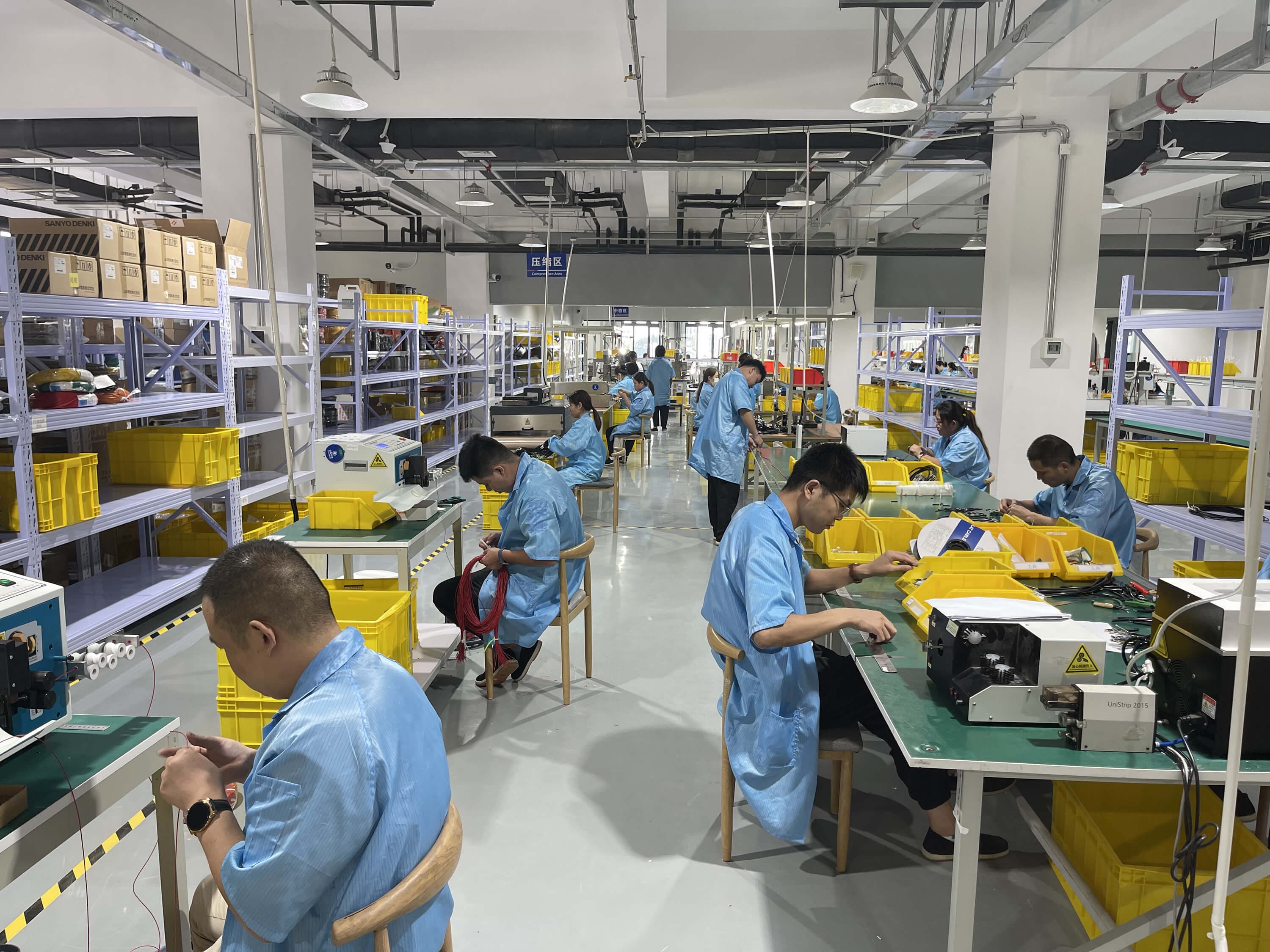
Since 2007, we've manufactured over 3.2 million high-flex cable assemblies for robotics, automation, and motion control applications worldwide. Here's what sets us apart for robotics projects:
Proven Flex Life Performance
- • In-house flex testing to 5+ million cycles
- • Specialized ultra-flex cable designs (1000+ strand conductors)
- • Experience with ABB, KUKA, Fanuc, Universal Robots platforms
- • Zero field failures on properly designed assemblies
EMI/RFI Expertise
- • Shielding effectiveness testing to 2 GHz
- • Experience with EtherCAT, Profinet, CANopen protocols
- • Proper grounding and termination techniques
- • Signal integrity validation for high-speed data
Miniaturization Capability
- • Micro connector crimping (1.0mm pitch capability)
- • Hybrid cable design and manufacturing
- • Ultra-thin wall insulation technologies
- • Weight optimization engineering support
Local Australian Support
- • Melbourne office: 1/30 Seaford Road, Seaford VIC 3198
- • Same timezone engineering support
- • Local phone: +61-3-9785-1090
- • Face-to-face design reviews available
Our Robotics Manufacturing Credentials
Ready to Discuss Your Robotics Wire Harness Project?
Get expert guidance on flex life requirements, EMI shielding, miniaturization options, and design optimization. Our Melbourne-based team responds within 24 hours with detailed technical proposals.
Related Articles
Prototype to Production
Scale your robotics wire harness design efficiently.
Silicone vs PVC vs XLPE
Flexible cable materials for continuous motion.
Molex vs TE vs JST
Connector selection for robotics applications.