
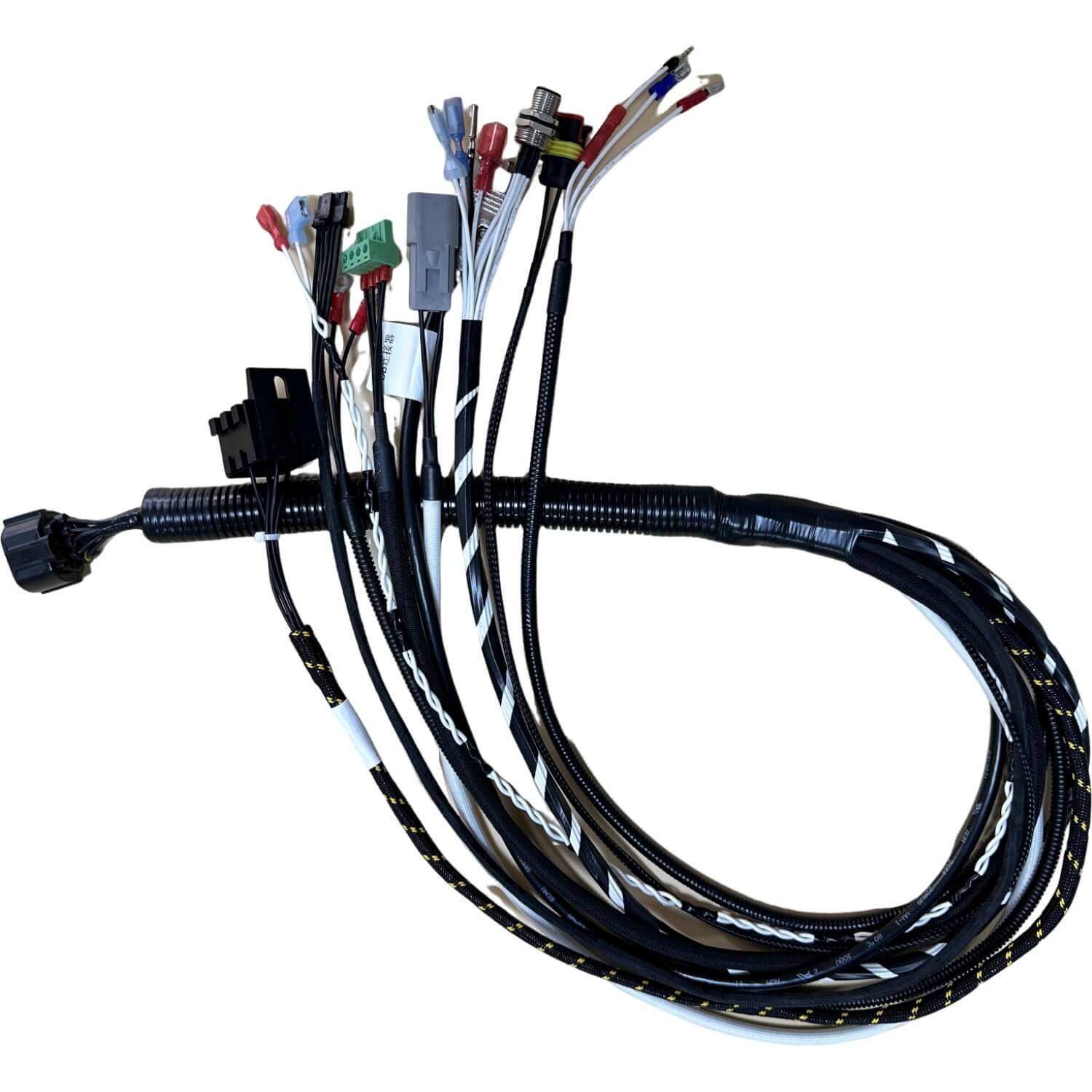
RF connectors join coaxial cables to antennas, radios, test equipment, and other devices that transmit or receive radio-frequency signals. Pick the wrong one and you lose signal power, introduce interference, or create a connection that fails within weeks in an outdoor environment.
This guide covers the 12 most common RF connector families, their specifications, and the practical selection criteria that determine which connector belongs on your cable assembly. Engineers working across Australian telecommunications, defence, mining, and industrial markets will find specific guidance for harsh-environment and compliance requirements.
Major RF connector families covered
Frequency range across all connector types
Typical SMA mating cycles before degradation
Signal loss per adapter in an RF chain
"RF connector selection is one of the few decisions where a $2 part can destroy the performance of a $20,000 system. We have seen mining communication failures, dropped 5G backhaul links, and failed EMC tests traced to a single mismatched or under-torqued connector."
Hommer Zhao
Engineering Director, Custom Wire Assembly
What Are RF Connectors and Why Do They Matter?
An RF (radio frequency) connector provides a mechanically stable, electrically shielded junction between two coaxial conductors. Unlike standard electrical connectors that carry DC or low-frequency AC, RF connectors must maintain a controlled impedance across the entire signal path to prevent reflections that degrade signal quality.
Every RF connector has a characteristic impedance — either 50 ohm or 75 ohm — that must match the cable and system impedance. A mismatch creates a standing wave that reflects energy back toward the transmitter, reducing the power delivered to the antenna or receiver. Engineers measure this mismatch as VSWR (voltage standing wave ratio) or return loss in decibels.
50 Ohm vs 75 Ohm: The Two Impedance Standards
- 50 ohm — Used for RF transmission, wireless communications, radar, test equipment, and most industrial applications. Optimised for power handling.
- 75 ohm — Used for video, CATV, broadcast, and satellite TV distribution. Optimised for low signal attenuation. F-type and BNC (75 ohm variant) are the most common.
RF connectors evolved from military programs in the 1940s and 1950s. The BNC appeared in 1951, developed by Paul Neill and Carl Concelman at Bell Labs. The N-type connector, named after Paul Neill, predates it slightly. SMA connectors arrived in the 1960s for microwave-frequency work. Each generation pushed the usable frequency range higher while making the connector smaller. For cable assemblies that carry both RF and power signals, engineers should verify the power conductors with a voltage drop calculator to ensure both signal and power paths meet system requirements.
How RF Connectors Work: Coupling Mechanisms Explained
The coupling mechanism determines how quickly you can connect and disconnect, how well the connector resists vibration, and how repeatable the electrical performance is across mating cycles.
Threaded (SMA, N-Type, TNC)
A nut threads onto the mating connector body, creating a mechanically secure junction. Threaded connectors offer the highest reliability in vibration environments and the most repeatable VSWR performance.
Trade-off: Slower to connect; requires a wrench for proper torque.
Bayonet (BNC)
A quarter-turn twist-lock mechanism. Two pins on the plug engage slots on the jack, locking with a spring-loaded detent. Fast to connect and disconnect — under 2 seconds.
Trade-off: Less vibration resistance than threaded; limited to lower frequencies.
Push-On / Snap-On (SMB, MCX, MMCX)
A spring-loaded snap fit that engages when pushed together. No rotation required. Suited for high-density board-mount applications where space is limited.
Trade-off: Lower retention force; can disconnect under vibration or cable pull.
Slide-Lock (QMA, QN)
A push-and-slide mechanism that combines the speed of push-on with better retention than bayonet. Tool-free field installation in under 3 seconds.
Trade-off: Higher cost; fewer source options than SMA or N-type.
RF Connector Types: Complete Reference Guide
Each connector family occupies a specific niche defined by frequency range, size, power handling, and coupling mechanism. Below are the 12 connector families most relevant to Australian cable assembly applications.
1. BNC (Bayonet Neill-Concelman)
The workhorse of test labs and video systems. The bayonet mechanism allows fast connection changes during testing. Available in both 50-ohm (RF) and 75-ohm (video) versions — they look identical, so check the part number before ordering.
Common cables: RG-58, RG-59, RG-174. Mating cycles: ~500. Applications: oscilloscopes, CCTV, two-way radio, network analysers.
2. SMA (SubMiniature Version A)
The most widely used RF connector for microwave-frequency work. Its compact 1/4-36 UNS thread provides reliable performance to 18 GHz (some variants reach 26.5 GHz). SMA dominates in wireless infrastructure, IoT devices, and RF test setups.
Common cables: RG-174, RG-316, LMR-195. Mating cycles: ~500. Torque: 3–5 in-lbs (brass), 7–10 in-lbs (stainless).
3. RP-SMA (Reverse Polarity SMA)
Identical outer dimensions to SMA, but the centre contact is reversed: the plug has a socket, the jack has a pin. Created to comply with FCC Part 15 rules that discourage end-users from attaching high-gain antennas to consumer Wi-Fi equipment.
Common mistake: SMA and RP-SMA threads mate, but no electrical connection is made. Forcing them together damages the centre pin. Always verify polarity before purchasing cables or adapters.
4. N-Type
A medium-sized, rugged connector with high power handling (up to 300W at 1 GHz). Popular for base station antennas, telecommunications infrastructure, and outdoor installations. The 5/8-24 UNEF thread provides strong mechanical retention.
Common cables: RG-213, LMR-400, RG-214. Torque: 12–15 in-lbs. Power handling: up to 300W at 1 GHz.
5. TNC (Threaded Neill-Concelman)
A threaded variant of BNC that replaces the bayonet with a 7/16-28 UNEF thread for improved vibration resistance. TNC is the go-to choice for mobile radio, cellular base stations, and aerospace applications where vibration would cause a BNC to work loose.
Common cables: RG-58, RG-142, RG-400. Mating cycles: ~500.
6. F-Type
The most common 75-ohm connector. Uses the coaxial cable's own centre conductor as the contact pin, reducing cost. Found on nearly every cable TV, satellite, and NBN HFC connection in Australia.
Common cables: RG-6, RG-11. Applications: CATV, satellite TV, NBN HFC, antenna distribution.
7. UHF (PL-259 / SO-239)
A legacy connector still common in HF and VHF amateur radio. The name "UHF" is misleading — it was designed in the 1930s when frequencies above 30 MHz were considered ultra-high. Its non-constant impedance makes it unsuitable for precision RF work above 300 MHz.
Common cables: RG-8, RG-213, RG-58 (with adapter). Applications: ham radio, CB radio, marine VHF.
8. 7/16 DIN
A high-power, low-PIM connector built for cellular base stations and 5G infrastructure. The large contact surfaces and air-gap design minimise passive intermodulation, which can degrade network capacity in multi-carrier environments.
Power handling: up to 2 kW. PIM: < −160 dBc. Applications: mobile base stations, in-building DAS, broadcast.
9. FAKRA
An automotive-specific connector defined by the FAKRA standard (USCAR-17). Colour-coded plastic housings prevent cross-connection: blue for GPS, black for cellular, violet for GSM, white for satellite radio. Used in every modern vehicle for antenna connections. Learn more about automotive connectors in our connector selection guide.
Applications: automotive GPS, cellular, V2X, infotainment, ADAS radar.
10. MCX & MMCX (Micro Coaxial)
30% smaller than SMA. MCX uses a straight snap-on coupling; MMCX adds a rotating interface for applications where the cable needs to pivot. Both are common on GPS modules, wireless cards, and IoT boards.
Mating cycles: ~500 (MCX), ~500 (MMCX). Common cables: RG-174, RG-316.
11. U.FL / IPEX (Ultra-Miniature)
The smallest common RF connector — only 3 mm in diameter. Designed for internal PCB-to-antenna connections in laptops, phones, and IoT modules. Not intended for external cable assemblies.
Low cycle count: U.FL connectors are rated for only 30 mating cycles. They are designed for factory assembly, not field service. Repeated reconnection will destroy the contact.
12. QMA (Quick-Lock SMA Alternative)
Same electrical performance as SMA but with a tool-free slide-lock coupling that connects in under 2 seconds. Developed by Huber+Suhner for base station installations where technicians need to connect dozens of cables at height.
Mating cycles: 1,000+. Applications: 5G small cells, DAS, rooftop equipment.
RF Connector Specifications Comparison Table
| Connector | Impedance | Frequency | Coupling | Mating Cycles | Power (1 GHz) |
|---|---|---|---|---|---|
| BNC | 50/75Ω | DC–4 GHz | Bayonet | 500 | 80W |
| SMA | 50Ω | DC–18 GHz | Threaded | 500 | 100W |
| RP-SMA | 50Ω | DC–18 GHz | Threaded | 500 | 100W |
| N-Type | 50/75Ω | DC–18 GHz | Threaded | 500 | 300W |
| TNC | 50Ω | DC–12 GHz | Threaded | 500 | 100W |
| F-Type | 75Ω | DC–3 GHz | Threaded | 500 | N/A |
| UHF (PL-259) | ~50Ω | DC–300 MHz | Threaded | 500 | 500W |
| 7/16 DIN | 50Ω | DC–7.5 GHz | Threaded | 500 | 2,000W |
| FAKRA | 50Ω | DC–6 GHz | Snap-on | 10 | 20W |
| MCX/MMCX | 50Ω | DC–6 GHz | Snap-on | 500 | 50W |
| U.FL/IPEX | 50Ω | DC–6 GHz | Snap-on | 30 | N/A |
| QMA | 50Ω | DC–18 GHz | Slide-lock | 1,000+ | 100W |
Power ratings are approximate and vary by manufacturer. Always consult the connector datasheet for exact values at your operating frequency.
"The specification table gets engineers 80% of the way. The remaining 20% comes down to environmental factors that the datasheet does not cover — salt spray exposure in Cairns, red dust infiltration at a Pilbara mine site, or the UV degradation that bakes cable jackets in the Northern Territory."
Hommer Zhao
Engineering Director, Custom Wire Assembly
How to Select the Right RF Connector for Your Application
Follow these seven steps to narrow down from 12 connector families to the one that fits your requirements.
Define your frequency range
Your operating frequency eliminates most options immediately. Working at 15 GHz? UHF, BNC, and F-type are all ruled out. Only SMA, N-type (precision), QMA, and precision connectors remain.
Match impedance to the system
RF and wireless systems use 50 ohm. Video and CATV use 75 ohm. Mixing impedances creates reflections that degrade signal quality. There is no adapter that converts between impedances without loss.
Evaluate power handling
High-power transmitters (broadcast, radar, base stations) need connectors rated above the peak power level. At high altitudes, derate for reduced air pressure. N-type handles 300W; 7/16 DIN handles 2 kW.
Assess environmental exposure
Outdoor installations need weatherproof or IP-rated connectors. Salt spray, UV, extreme temperatures, and vibration each narrow the field. See the waterproofing section below.
Check size and form factor constraints
Board-mount applications demand MCX, MMCX, or U.FL. Panel-mount installations suit BNC or N-type. Rack-mount equipment often uses SMA or TNC.
Consider mating cycle requirements
Test fixtures that connect and disconnect 50 times per day need connectors with high cycle ratings. U.FL (30 cycles) is wrong for this role; QMA (1,000+ cycles) is purpose-built for it.
Factor in total cost of ownership
Cheap connectors cause expensive failures. A $3 SMA that fails at a remote mine site can cost $15,000 in truck rolls and downtime. Specify quality brands (Amphenol, TE Connectivity, Rosenberger) for production assemblies.
SMA vs RP-SMA: Understanding Reverse Polarity
SMA and RP-SMA cause more ordering errors than any other RF connector pair. The confusion is understandable — they are mechanically identical from the outside.
| Feature | SMA | RP-SMA |
|---|---|---|
| Plug centre contact | Pin (male) | Socket (female) |
| Jack centre contact | Socket (female) | Pin (male) |
| Outer thread | 1/4-36 UNS | 1/4-36 UNS (same) |
| Will they mate? | Threads engage, but no electrical contact is made | |
| Primary use | RF test, infrastructure, military | Wi-Fi routers, consumer wireless |
How to identify them visually: Look at the plug (the part with external threads). If you see a pin sticking out from the centre, it is standard SMA. If the centre has a hole (socket), it is RP-SMA. The jack (part with internal threads) is the mirror image.
50 Ohm vs 75 Ohm: What You Need to Know
The 50-ohm standard was a compromise between maximum power handling (at 30 ohm) and minimum signal loss (at 77 ohm) for air-dielectric coaxial cable. It became the standard for RF transmission systems where both power and signal quality matter.
The 75-ohm standard was optimised for minimum attenuation, making it ideal for long cable runs in video and CATV distribution where signal loss matters more than power transfer.
50 Ohm Applications
- Cellular base stations & 5G
- Two-way radio & land mobile
- Wi-Fi access points
- GPS & navigation systems
- Test & measurement equipment
- Radar & defence systems
75 Ohm Applications
- Cable TV (CATV) distribution
- Satellite TV (Foxtel, etc.)
- NBN HFC connections
- Broadcast video infrastructure
- CCTV analogue systems
- Antenna distribution systems
Waterproofing and IP Ratings for Outdoor RF Installations
Standard RF connectors are not sealed. Moisture wicks into the cable-connector junction through capillary action, corrodes the centre pin, and degrades VSWR over weeks or months. In coastal Australian locations (Darwin, Cairns, Sydney harbourside), salt spray accelerates corrosion within days of exposure. For comprehensive environmental protection strategies, see our environmental protection guide.
| IP Rating | Protection Level | RF Application |
|---|---|---|
| IP65 | Dust-tight, water jets | Sheltered outdoor antenna mounts |
| IP67 | Dust-tight, immersion to 1m | Rooftop antennas, tower-mount equipment |
| IP68 | Dust-tight, continuous immersion | Underground, subsea, flood-prone areas |
| IP69K | High-pressure wash, steam | Mining washdown areas, food processing |
Weatherproofing Best Practices
- Use self-amalgamating tape over the connector junction — it fuses to itself creating a watertight seal
- Create a drip loop below the connector so water runs away from the junction
- Apply dielectric grease to the threads before mating to prevent galvanic corrosion between dissimilar metals
- Use weatherproof boots designed for the connector type when available
Torque Specifications and Proper RF Connector Tightening
RF connector torque is not optional. Under-torquing causes intermittent contact, increased VSWR, and passive intermodulation. Over-torquing cracks the dielectric insulator, deforms the centre pin, and strips threads. Both conditions lead to field failures that are expensive to diagnose at a remote tower site.
| Connector | Material | Torque (in-lbs) | Torque (Nm) |
|---|---|---|---|
| SMA | Brass | 3–5 | 0.34–0.56 |
| SMA | Stainless steel | 7–10 | 0.79–1.13 |
| TNC | All | 12–15 | 1.36–1.70 |
| N-Type | All | 12–15 | 1.36–1.70 |
| 7/16 DIN | All | 22–25 | 2.49–2.82 |
Finger-Tight Is Not Enough
Finger tightening produces roughly 1–2 in-lbs of torque — well below the minimum for any threaded RF connector. For bench testing, finger-tight may work temporarily. For production assemblies, permanent installations, and any outdoor connection, use a calibrated torque wrench.
RF Adapters: When to Use Them and When to Avoid Them
RF adapters bridge between different connector types — SMA-to-N, BNC-to-SMA, N-to-7/16 DIN. They are useful for temporary connections in test setups but problematic in permanent installations.
When Adapters Make Sense
- • Temporary test bench connections
- • Bridging legacy equipment to modern systems
- • Prototype evaluation before ordering custom cables
- • One-off lab measurements
When to Avoid Adapters
- • Permanent outdoor installations
- • Any connection requiring more than one adapter in series
- • High-power transmit paths (>50W)
- • Low-PIM environments (telecom base stations)
Each adapter adds 0.1–0.5 dB of insertion loss and introduces two additional connector interfaces that can degrade VSWR. Stacking two or three adapters can add over 1 dB of loss — a 20% reduction in signal power. For production deployments, order custom cable assemblies with the correct connectors on each end.
"I tell every customer the same thing: adapters are for prototyping, not for production. A custom RF cable assembly with the right connectors on each end costs $15–$30 more than an adapter chain, and it eliminates a failure point that could cost you $10,000 in downtime and truck rolls."
Hommer Zhao
Engineering Director, Custom Wire Assembly
RF Connector Applications in Australian Industries
Australia's geography and industries create specific demands on RF cable assemblies that generic selection guides overlook.
Mining & Resources
Underground and open-pit mines use leaky feeder systems, two-way radio repeaters, and proximity detection systems that rely on RF cable assemblies. Connectors face red dust infiltration, extreme heat (50°C+ surface temperature), vibration from heavy machinery, and washdown procedures. N-type with IP67 boots is the baseline. For mining-grade assemblies, IP69K-rated connectors withstand high-pressure washdown.
Recommended connectors: N-type (IP67), TNC, 7/16 DIN for base stations.
Telecommunications & 5G
Australian carriers (Telstra, Optus, TPG) are deploying 5G across metro, suburban, and regional areas. Base station jumper cables use 7/16 DIN or 4.3-10 connectors for low-PIM performance. Small cells on street furniture use QMA or SMA. ACMA licensing requires connector quality that maintains signal integrity across the licensed spectrum.
Recommended connectors: 7/16 DIN, 4.3-10, QMA, N-type.
Defence & Aerospace
Australian Defence Force (ADF) projects follow MIL-STD-348 connector specifications and AS/NZS requirements. RF cable assemblies for shipboard radar, tactical radios, and electronic warfare systems need connectors rated for vibration, temperature cycling (-55°C to +125°C), and salt fog exposure per MIL-STD-810. For more on defence requirements, see our MIL-SPEC wire harness guide.
Recommended connectors: TNC (MIL-spec), N-type, SMA (stainless steel), specialised mil-circular.
Marine & Offshore
Navigation radar, AIS transceivers, VHF radio, and satellite communication antennas on vessels require RF connectors that resist salt spray corrosion. Stainless steel or nickel-plated connectors with O-ring seals are mandatory. For marine cable assembly guidance, see our marine cable assembly guide.
Recommended connectors: N-type (stainless, IP68), TNC, UHF (PL-259 for VHF radio).
Frequently Asked Questions About RF Connectors
What is the difference between SMA and RP-SMA connectors?
SMA uses a standard pin-and-socket centre contact. RP-SMA reverses only the centre contact: the plug has a socket, the jack has a pin. The outer threads are identical, so they will thread together but make no electrical connection. SMA is used for RF infrastructure and test equipment. RP-SMA is used for consumer Wi-Fi equipment. Always check the centre contact before ordering.
Can I use a 75-ohm connector in a 50-ohm RF system?
Technically possible, but it creates an impedance mismatch that reflects signal energy. A 75-ohm connector in a 50-ohm system produces a return loss of about 14 dB (VSWR 1.5:1). For video distribution where some mismatch is tolerable, this may work. For wireless communications, radar, or precision measurement, always match impedances.
How many times can I connect and disconnect an SMA connector?
Standard SMA connectors are rated for roughly 500 mating cycles at correct torque. After exceeding this, thread wear and centre contact degradation increase VSWR. For high-cycle applications (test benches, field service), use QMA (1,000+ cycles) or precision 3.5 mm connectors.
Do I need waterproof connectors for outdoor antennas?
Yes. Standard RF connectors admit moisture through capillary action, leading to corrosion and VSWR degradation within weeks. Use IP67 or IP68 rated connectors with O-ring seals for permanent outdoor installations. At minimum, apply self-amalgamating tape over the connection and create a drip loop below the connector.
What torque should I use for an N-type RF connector?
N-type connectors require 12–15 in-lbs (1.36–1.70 Nm). Under-torquing causes intermittent connections and passive intermodulation. Over-torquing can crack the dielectric or deform the centre pin. Use a calibrated torque wrench for all production and permanent installations.
How much signal loss does an RF adapter add?
Each adapter adds 0.1–0.5 dB of insertion loss, varying by connector type and frequency. Stacking multiple adapters compounds loss and degrades VSWR. For production systems, eliminate adapters by ordering custom cable assemblies with the correct connectors pre-terminated on each end.
References & Further Reading
Related Articles
Cable Assembly Connector Selection Guide
How to choose the right connector for power, signal, and data cable assemblies.
EMC/EMI Shielding Best Practices
Shielding, grounding, and filtering techniques for electromagnetic compatibility.
Telecommunications Cable Assembly Guide
Complete guide to data centre and telecom cable assembly design and manufacturing.