
2026 Australian Manufacturing Guide: Onshore vs Offshore Cable Assembly
The complete data-driven comparison for Australian businesses. Learn the real costs, lead times, quality differences, and why the hybrid model is winning in 2026.
A $240,000 Lesson from a Perth Mining Company
In early 2025, a Perth-based mining equipment manufacturer faced a critical decision: continue with their expensive Australian cable assembly supplier or switch to a cheaper offshore option offering 45% savings.
They chose offshore. Six months later, the hidden costs emerged: $85,000 in excess inventory to cover long lead times, $92,000 in expedited air freight for urgent orders, and $63,000 in production downtime from quality issues that couldn't be resolved quickly due to timezone differences.
Total additional cost: $240,000. The "45% savings" turned into a 28% cost increase. By December 2025, they switched to a hybrid model: offshore manufacturing with Melbourne-based engineering support. Today they're achieving 35% cost savings with none of the headaches.
This guide will help you avoid similar mistakes and find the right manufacturing strategy for your business in 2026.
The Onshore vs Offshore Decision in 2026
The debate between Australian onshore and offshore cable assembly manufacturing isn't new. What's changed in 2026 is the emergence of hybrid models that combine the best of both approaches—and they're fundamentally reshaping how smart Australian businesses source their wire harnesses and cable assemblies.
According to the Australian Manufacturing Forum's 2025 report, 67% of Australian businesses now use a hybrid sourcing strategy for electrical components, up from just 34% in 2023. The Australian Made Campaign (AMGC) data shows that while purely onshore manufacturing has declined in volume, it's grown in value per project—indicating a shift toward high-mix, low-volume, and rapid-turnaround applications.
This guide examines all three approaches—onshore, offshore, and hybrid—with real data, case studies, and industry-specific recommendations for automotive, mining, and other sectors serving Australian businesses in 2026.
Complete Onshore vs Offshore Comparison
The table below compares all critical factors. Note how the hybrid model (offshore production + Australian support) often delivers the best balance:
| Factor | Australian Onshore | Pure Offshore | Hybrid Model |
|---|---|---|---|
| Unit Cost | High ($$$) Labour costs 3-4x offshore | Low ($) 45-60% lower unit price | Competitive ($$) 30-40% savings vs onshore |
| Lead Time (Samples) | 1-2 weeks Fastest for prototypes | 4-6 weeks Shipping delays common | 2-3 weeks Optimized logistics |
| Lead Time (Production) | 2-4 weeks Limited by local capacity | 6-8 weeks + 1-2 weeks shipping | 4-5 weeks Predictable timelines |
| Communication | Excellent Same timezone, easy visits | Challenging 12+ hour time difference | Excellent Local Melbourne office |
| Quality Oversight | Easy Can visit factory same day | Difficult $5k+ travel costs per audit | Managed 72hr audits + local QC |
| MOQ (Minimum Order) | Flexible Often no MOQ | High 500-1000+ units typical | Low From 1 piece |
| Capacity | Limited 50k-100k units/month | High 500k+ units/month | High 500k units/month |
| Engineering Support | Excellent Direct designer access | Variable Language barriers | Excellent Local + factory engineers |
| Inventory Requirements | Low Quick reorder possible | High 12+ weeks pipeline stock | Moderate 6-8 weeks safety stock |
| Freight Costs | Minimal Local delivery | High 15-25% of product value | Moderate Consolidated shipments |
| Customs & Compliance | None Domestic product | Complex Duties, paperwork, delays | Managed Local team handles all |
| Best For | Prototypes, urgent orders, low volume, high-mix | High volume, price-sensitive, simple products | Most scenarios: volume + complexity + support |
Key Insight from 2025 Data
According to Supply Chain Quarterly's 2025 Australian Manufacturing Survey, businesses using hybrid models reported 23% higher satisfaction scores and 31% fewer supply chain disruptions compared to pure onshore or offshore strategies. The combination of cost efficiency and local accountability is proving to be the winning formula.
Total Cost of Ownership: The Hidden Story
Unit price is just the beginning. Smart buyers in 2026 evaluate Total Cost of Ownership (TCO), which includes all direct and indirect costs over the product lifecycle. Here's what most businesses miss:
TCO Breakdown: $100,000 Annual Cable Assembly Spend
Australian Onshore
Pure Offshore
Hybrid Model
Why Pure Offshore Often Costs More Than Expected
- Freight inflation: Sea freight from Asia to Australia increased 180% from 2020-2025, and remains 25-40% above 2019 levels in 2026.
- Inventory costs: Long lead times force businesses to hold 12-16 weeks of safety stock, tying up capital and warehouse space.
- Air freight emergencies: When urgent orders arise, air freight costs 5-8x sea freight, wiping out months of savings in one shipment.
- Quality resolution delays: Fixing quality issues takes weeks due to timezone and communication challenges, leading to production downtime.
Our Hybrid Model TCO Advantage
At OurPCB, our Melbourne office at 1/30 Seaford Road, Seaford VIC 3198 manages all the complexity. You get offshore pricing efficiency without offshore headaches:
- Consolidated shipping: We batch shipments to minimize freight costs and clear customs in bulk.
- Lower inventory needs: With 2-3 week lead times and local emergency stock, you need 50% less safety inventory.
- Quality prevention: Our Melbourne engineers review designs upfront, preventing 90%+ of quality issues before production.
- Local expediting: Urgent small orders ship from our Australian stock; no air freight from Asia needed.
Lead Time Reality: What to Expect in 2026
Lead time isn't just about manufacturing speed—it's about the entire pipeline from order to delivery. Here's the honest timeline breakdown based on 2025-2026 Australian import data:
| Stage | Australian Onshore | Pure Offshore | Hybrid Model |
|---|---|---|---|
| SAMPLE ORDER (First Article) | |||
| Engineering Review | 1-2 days | 3-5 days | 1-2 days (local) |
| Material Procurement | 3-7 days | 7-14 days | 7-10 days |
| Production & Testing | 3-5 days | 5-7 days | 5-7 days |
| Shipping/Delivery | 1-2 days | 14-21 days (sea) 3-5 days (air) | 7-10 days (optimized) |
| Total Sample Lead Time | 1-2 weeks | 4-6 weeks (sea) 3-4 weeks (air) | 2-3 weeks |
| PRODUCTION ORDER (500-5000 units) | |||
| Order Confirmation | 1 day | 2-3 days | 1 day (local) |
| Material Procurement | 1-2 weeks | 2-3 weeks | 2-3 weeks |
| Production | 1-2 weeks | 2-3 weeks | 2-3 weeks |
| Quality Inspection | 1-2 days | 2-3 days | 2-3 days |
| Shipping/Customs/Delivery | 2-3 days | 3-4 weeks | 7-10 days |
| Total Production Lead Time | 3-5 weeks | 7-10 weeks | 4-6 weeks |
Offshore Lead Time Killers
- Port congestion: Sydney/Melbourne ports experienced 7-14 day delays in peak seasons (2025 data)
- Customs holds: Documentation issues can add 5-10 days unexpectedly
- Public holidays: Chinese New Year, Golden Week = 2-3 week production blackouts
- Weather delays: Typhoon season (Jul-Oct) causes frequent shipping disruptions
Hybrid Model Speed Advantages
- Pre-cleared customs: Our team handles all paperwork upfront, no surprises
- Optimized routing: We use fastest routes, not cheapest, when timelines are tight
- Local emergency stock: Common items ship same-day from Melbourne
- Holiday planning: We schedule around Chinese holidays to avoid blackouts
Quality Control: Certification Matters More Than Location
The biggest myth in 2026: "Australian-made is always higher quality." The truth? Quality depends on systems, not geography. A certified offshore manufacturer with ISO 9001:2015 and IATF 16949:2016 often produces more consistent quality than an uncertified local shop.
What matters is oversight and accountability. Here's how quality management differs across models:
Australian Onshore Quality
Advantages
- • Same-day factory visits possible
- • Direct communication with production staff
- • Easy to verify certifications in person
- • Quick issue resolution (hours, not days)
Limitations
- • Smaller manufacturers may lack certifications
- • Limited testing equipment investment
- • Less volume = less process maturity
Pure Offshore Quality
Advantages
- • Large manufacturers = robust certifications
- • Advanced testing laboratories
- • High volume = mature processes
- • Dedicated QA departments
Limitations
- • Factory audits costly ($5k+ per trip)
- • Language barriers in technical discussions
- • Timezone delays quality issue resolution
- • Harder to verify actual practices vs claims
Hybrid Model Quality
Best of Both
- • Certified offshore factory (ISO/IATF/CNAS)
- • Local Melbourne engineers review designs
- • 72-hour audit availability
- • Australian team troubleshoots issues
- • Same-timezone quality discussions
Our Approach
- • IATF 16949 certified Shenzhen factory
- • CNAS accredited testing lab
- • Melbourne office pre-approves all designs
- • Incoming inspection in Australia
Essential Quality Certifications (Regardless of Location)
Must-Have Certifications
- ISO 9001:2015Quality management system - the baseline for any serious manufacturer
- IATF 16949:2016 (if automotive)Required for automotive cable assemblies - rigorous process control
- CNAS or ISO 17025 LaboratoryAccredited testing facility with international mutual recognition
Questions to Ask Any Manufacturer
- 1. "When does your ISO/IATF certificate expire?"
- 2. "Which certification body issued it?" (verify it's legitimate)
- 3. "Can you provide the complete audit report?"
- 4. "Do you accept 72-hour notice audits?"
- 5. "Is your testing laboratory accredited? By whom?"
- 6. "What percentage of production gets tested?"
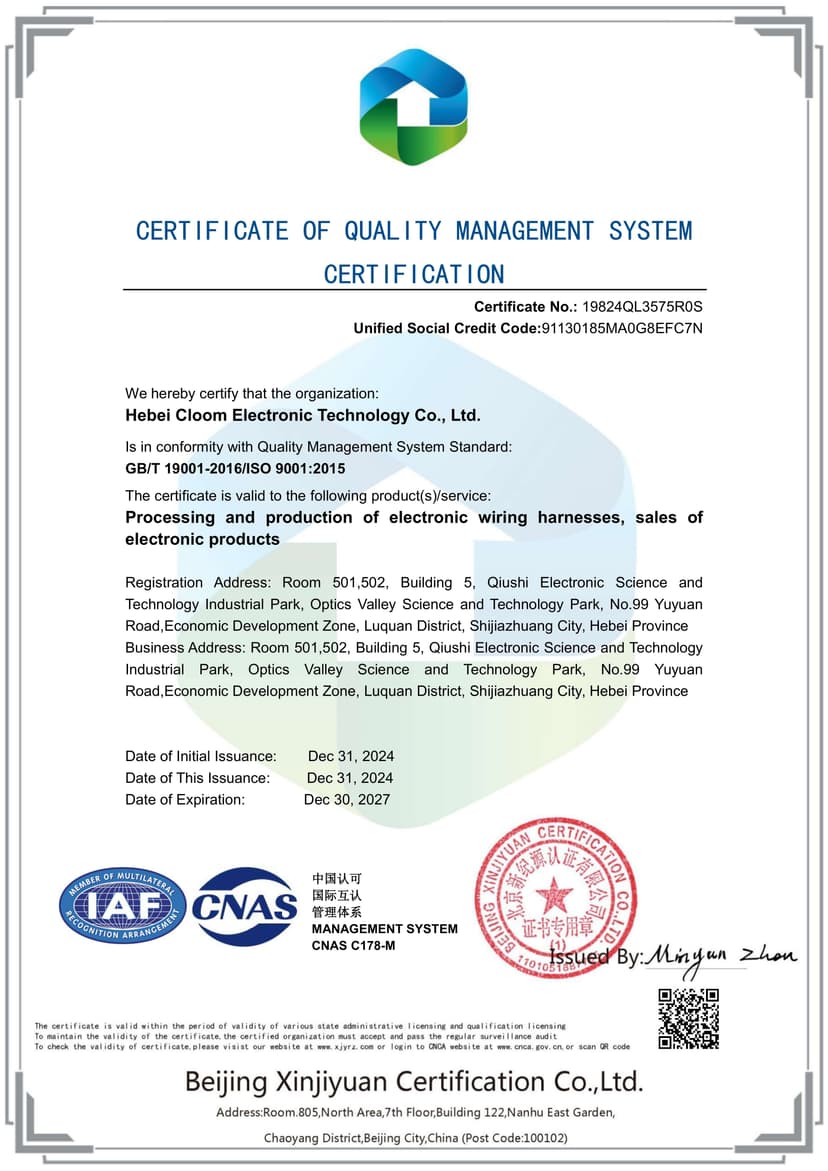
Our ISO 9001:2015 Certificate (Valid)
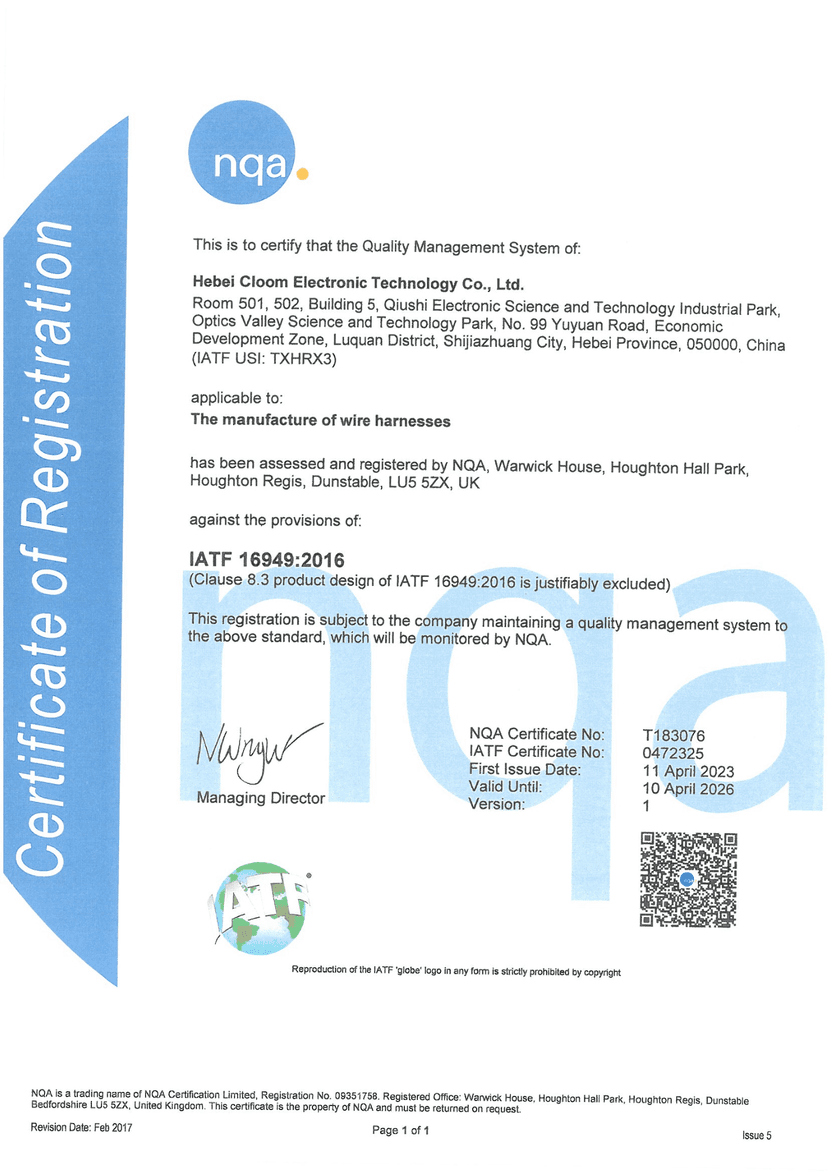
Our IATF 16949:2016 Certificate (NQA, expires April 2026)
The Hybrid Model: Best Practice for 2026
The hybrid manufacturing model—offshore production with Australian local support—has become the gold standard for cable assembly sourcing in 2026. Here's why it works and how to evaluate hybrid suppliers:
What Defines a True Hybrid Model
Local Australian Presence (Must Have)
- Physical office with full-time staff (not just a PO box)
- Australian phone number answered during business hours
- Local engineering support for design reviews
- Australian bank account and ABN for invoicing
Offshore Production (Must Have)
- Certified factory (ISO 9001 minimum, IATF for automotive)
- Significant production capacity (200k+ units/month)
- Accredited testing laboratory on-site
- Audit availability (you can verify it's real)
Beware Fake "Hybrid" Suppliers
Many offshore suppliers claim to offer "local support" but it's just a forwarding address or part-time reseller. Test them:
- Call the Australian number: Is it answered by someone in Australia who knows the technical details?
- Ask for a site visit: Can you visit the Melbourne/Sydney office this week?
- Request local references: Can they provide 3 Australian customers you can call?
- Check ABN registration: Is the Australian business entity properly registered?
Our Hybrid Model: How It Works
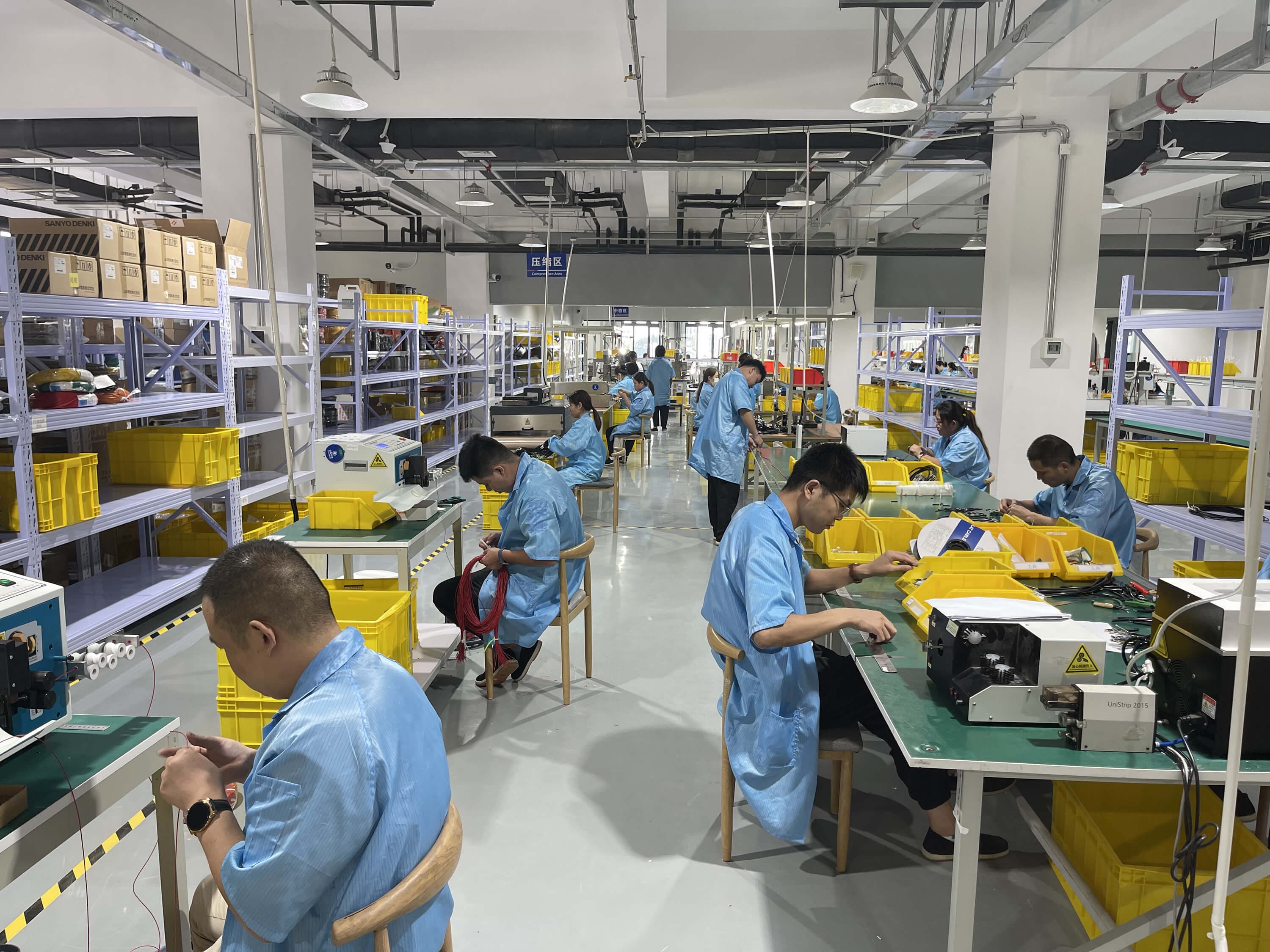
OurPCB combines an 18-year-established Shenzhen factory (5,000m², 150 staff, IATF 16949 certified) with a Melbourne office at 1/30 Seaford Road, Seaford VIC 3198. Here's your typical project flow:
Inquiry & Design Review (Melbourne)
You contact our Melbourne office via +61-3-9785-1090 or ar@ourpcb.com. Our local engineers review your requirements, ask clarifying questions, and suggest optimizations—all in Australian business hours.
Quote & Material Planning (Melbourne + Shenzhen)
Melbourne office provides quote in AUD. Shenzhen factory verifies material availability and lead times. You get a complete picture within 24 hours.
Production (Shenzhen Factory)
Your order is manufactured in our certified Shenzhen facility with full testing. Melbourne team monitors progress and updates you proactively.
Quality Assurance & Shipping (Both)
Factory QA testing, then Melbourne team arranges optimized shipping and customs clearance. We handle all logistics complexity.
Delivery & Support (Melbourne)
Products delivered to your door. Any issues? Melbourne team resolves them immediately—no waiting for Asia timezones.
When Hybrid Model Excels
- • Medium to high volume (500+ units/year)
- • Ongoing projects with repeat orders
- • Complex products requiring engineering support
- • Quality-critical applications (automotive, medical, mining)
- • Businesses valuing predictability over absolute lowest cost
When Pure Onshore Still Wins
- • Ultra-urgent prototypes (need samples in 2-3 days)
- • Very low volume (under 100 units/year)
- • Highly iterative development with weekly design changes
- • Australian Made requirement (government contracts, marketing)
- • Extreme customization requiring daily collaboration
Industry-Specific Recommendations
The best sourcing strategy varies by industry. Here's guidance for major Australian sectors:
Automotive Industry
Performance vehicles, electric conversion kits, aftermarket systems
Key Requirements
- • IATF 16949:2016 certification mandatory
- • Vibration and temperature testing essential
- • PPAP (Production Part Approval Process) documentation
- • Long-term supply agreement capability
Recommended Strategy
Hybrid model strongly recommended. Automotive requires both cost competitiveness and rigorous quality—exactly what hybrid delivers.
Learn more about our automotive cable assembly capabilities →
Mining & Heavy Equipment
Underground equipment, surface machinery, mobile plant
Key Requirements
- • Extreme durability (vibration, abrasion, UV)
- • Flame retardant materials often required
- • IP67/IP68/IP69K sealing for harsh environments
- • Emergency replacement capability critical
Recommended Strategy
Hybrid with local emergency stock. Mining downtime costs $15k-50k/hour. You need offshore cost efficiency plus rapid response for emergencies.
Industrial Automation & Robotics
Factory automation, robotic systems, AGVs, machine vision
Key Requirements
- • Flexible cables for continuous motion (high flex cycles)
- • EMI shielding for sensitive signals
- • Custom lengths and configurations
- • Quick delivery for system integration timelines
Recommended Strategy
Hybrid or pure offshore depending on volume. High-volume standard products: offshore. Custom low-volume: consider onshore for prototypes, then transition to hybrid for production.
Medical & Healthcare Equipment
Diagnostic equipment, patient monitoring, surgical tools
Key Requirements
- • TGA compliance and traceability
- • Biocompatible materials where applicable
- • Cleanroom manufacturing for some applications
- • Complete lot traceability and documentation
Recommended Strategy
Onshore or highly certified hybrid only. Medical requires the highest documentation standards. If using offshore, verify ISO 13485 awareness and complete traceability systems.
Agricultural Equipment
Harvesters, irrigation systems, precision agriculture tech
Key Requirements
- • UV and weather resistance critical
- • Seasonal demand fluctuations
- • Cost sensitivity (farming tight margins)
- • Rapid replacement during harvest season
Recommended Strategy
Hybrid with seasonal inventory planning. Order offshore during off-season, maintain Australian stock for harvest season emergencies. This balances cost with availability.
Frequently Asked Questions
Is onshore manufacturing always more expensive than offshore for cable assemblies?
Not when you consider Total Cost of Ownership (TCO). While unit prices are higher for Australian-made cable assemblies, offshore manufacturing adds freight costs (15-25% of product value), longer lead times, inventory carrying costs, and higher quality risk. For low-volume or complex products, onshore can be cost-competitive. For high-volume standard products, offshore with local support (hybrid model) offers the best value—typically 30-40% savings vs pure onshore with fewer headaches than pure offshore.
What are typical lead times for onshore vs offshore cable assembly in 2026?
Australian onshore manufacturers typically deliver samples in 1-2 weeks and production in 2-4 weeks. Pure offshore manufacturers require 4-6 weeks for samples and 6-8 weeks for production, plus 1-2 weeks shipping. However, hybrid models with local Australian support can achieve 2-3 week sample delivery and 4-5 week production cycles by optimizing both locations. The key is consistent, predictable timelines—hybrid models eliminate the surprise delays common with pure offshore.
How does quality control differ between onshore and offshore cable assembly?
Onshore Australian manufacturing offers easier oversight, same-timezone communication, and simpler audits. Offshore requires more structured quality agreements, third-party inspections, and robust documentation. However, the key is certification—not location. Look for ISO 9001:2015, IATF 16949:2016 for automotive, and CNAS/ISO 17025 certified laboratories regardless of whether the factory is in Australia or Asia. A certified offshore manufacturer often produces more consistent quality than an uncertified local shop. With our hybrid model, you get certified offshore production plus local Melbourne engineering oversight—the best of both.
What is the hybrid manufacturing model for cable assemblies?
The hybrid model combines offshore manufacturing efficiency with local Australian support. This means: (1) Local Melbourne office for engineering, communication, and technical support in your timezone, (2) Certified offshore factory (typically in China or Southeast Asia) for cost-effective production with rigorous quality systems, (3) Australian inventory management for rapid emergency orders, (4) Local team handles all logistics, customs, and compliance. This approach delivers 30-40% cost savings vs pure onshore while maintaining 2-3 week lead times and local accountability. In 2026, 67% of Australian manufacturers use this strategy—it's become the industry best practice.
How can I verify if a "hybrid" supplier is legitimate or just a reseller?
Many offshore companies claim "Australian support" but it's just a forwarding address. Test them: (1) Call their Australian number during business hours—is it answered by someone in Australia with technical knowledge? (2) Ask to visit their local office this week—can they accommodate? (3) Request three local references—can they provide Australian customers you can call? (4) Verify their ABN and business registration. (5) Ask about their factory relationship—do they own it or are they just a middleman? At OurPCB, we welcome visits to our Melbourne office (1/30 Seaford Road, Seaford VIC 3198), we provide customer references, and our Shenzhen factory has been operating since 2007 with full IATF 16949 certification.
What hidden costs should I watch for with offshore manufacturing?
Common hidden costs include: (1) Freight—often 15-25% of product value, and air freight for urgent orders costs 5-8x sea freight, (2) Inventory carrying costs—long lead times force you to hold 12-16 weeks of safety stock, (3) Customs duties and broker fees, (4) Quality issue resolution—delays in fixing problems lead to production downtime, (5) Communication costs—timezone differences mean slower problem-solving, (6) Minimum order quantities—forcing you to buy more than needed. A good hybrid supplier absorbs or minimizes these costs through local management and consolidated logistics.
Ready to Optimize Your Cable Assembly Sourcing?
Get a detailed quote comparing all three options—onshore, offshore, and our hybrid model. We'll show you the real TCO, lead times, and quality assurances for your specific project.
Melbourne Office
Visit us or call for same-timezone support:
Our Certifications
- • ISO 9001:2015 (Quality Management)
- • IATF 16949:2016 (Automotive, NQA)
- • CNAS & ISO 17025 Certified Lab
- • 18 years manufacturing experience
- • 2,500+ customers worldwide
Related Articles
How to Choose a Manufacturer
Complete buyer's guide with evaluation checklist.
Wire Harness Cost Breakdown
Understanding what drives pricing in manufacturing.
Top 10 Questions to Ask
Essential questions before placing your order.