
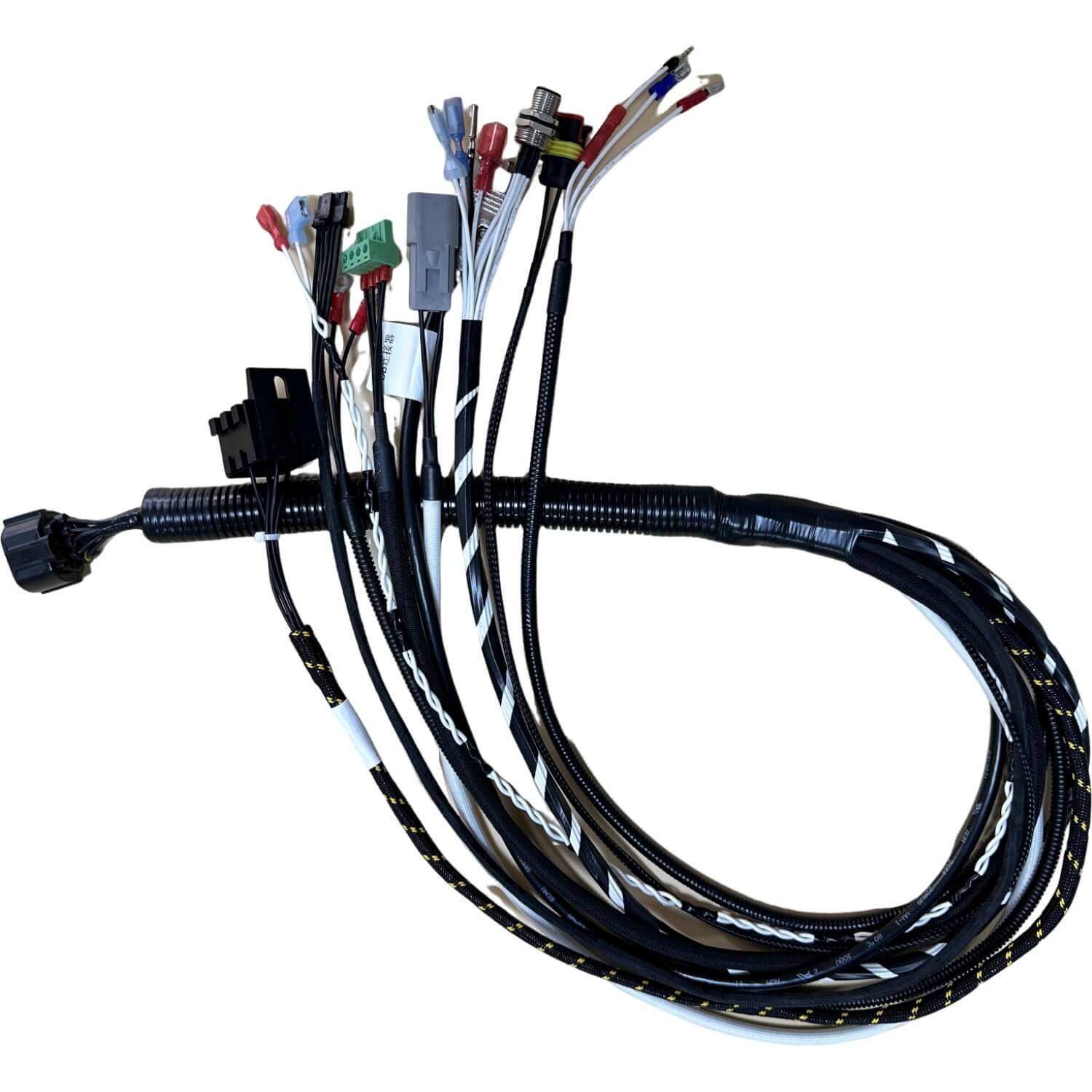
Up to 90% of cable assembly failures occur at the connector junction — the exact point where the flexible cable meets the rigid connector housing. Strain relief is the engineering solution that prevents these failures by distributing mechanical stress over a longer transition zone. This guide covers everything you need to design, select, and specify strain relief for cable assemblies used in Australian industrial, medical, mining, and defence applications.
Cable failures occur at connector junctions
UL 817 pull force test requirement
Flex cycles for robotic applications
Optimal hardness range for strain relief
What Is Cable Strain Relief and Why Does It Matter?
Strain relief is any mechanical feature that transfers pulling, bending, and twisting forces away from the electrical termination point. Without it, every tug on a cable concentrates stress on the solder joints, crimp connections, or pin contacts inside the connector — eventually causing intermittent faults or complete open circuits.
The root cause is a stiffness mismatch. A flexible cable meets a rigid connector housing, creating a "hard point" where all bending stress concentrates. Copper conductors are ductile, but repeated bending beyond their fatigue limit causes work hardening and eventual fracture. Strain relief solves this by creating a gradual stiffness transition from the rigid connector to the flexible cable.
With Proper Strain Relief
- •Bending stress distributed over 30–80 mm transition zone
- •Pull forces transferred to cable jacket, not conductors
- •Flex life extended from hundreds to tens of thousands of cycles
- •IP-rated environmental sealing at the cable entry
- •Meets UL 817, IPC/WHMA-A-620, and MIL-STD requirements
Without Strain Relief
- •All stress concentrates at a single 2–3 mm junction point
- •Conductors fatigue and fracture within months of service
- •Intermittent faults that are difficult to diagnose
- •Jacket cracking exposes conductors to moisture and dust
- •Field failures, warranty claims, and safety hazards
"In 18 years of cable assembly manufacturing, I've seen the same pattern repeatedly: an engineer designs a beautiful cable assembly, specifies every wire gauge and connector correctly, and then treats strain relief as an afterthought. That missing detail is what brings the assembly back for warranty repair six months later. Strain relief is not cosmetic — it is structural."
Types of Strain Relief for Cable Assemblies
Each strain relief method offers a different balance of protection, cost, repairability, and environmental sealing. The right choice depends on your production volume, operating environment, and serviceability requirements.
| Type | Protection Level | IP Rating | Unit Cost | Field Repairable | Best For |
|---|---|---|---|---|---|
| Overmoulded (injection) | Excellent | IP67–IP68 | $$$ | No | High volume, harsh environments |
| Cable gland / cord grip | Very good | IP66–IP68 | $$ | Yes | Panel entry, industrial equipment |
| Heat-shrink boot | Good | IP54–IP67 | $ | Partial | Low volume, prototyping, repairs |
| Mechanical clamp / backshell | Very good | Varies | $$ | Yes | MIL-spec, aerospace, defence |
| Metal spring relief | Good | None | $ | Yes | Test leads, instrument cables |
| Rubber grommet | Moderate | IP54 | $ | Yes | Panel pass-through, vibration damping |
1. Overmoulded Strain Relief
Overmoulding uses injection-moulded thermoplastic (typically TPU or TPE) to encapsulate the cable-to-connector junction. The mould creates a tapered boot that transitions smoothly from the rigid connector to the flexible cable. This is the gold standard for strain relief — it provides the highest pull force resistance, best flex life, and reliable IP67/IP68 sealing.
The drawback is tooling cost. A custom mould costs AUD $2,000–$8,000, making overmoulding economical only at volumes above 500–1,000 units. The cable cannot be field-serviced — if the connector fails, the entire assembly must be replaced.
2. Cable Glands and Cord Grips
Cable glands use a compression seal (typically nylon or stainless steel body with an elastomeric insert) to clamp around the cable jacket at a panel or enclosure entry point. They provide both strain relief and IP-rated sealing in a single component. Standards like EN 50262 define thread sizes, clamping ranges, and IP ratings for cable glands.
Cable glands are field-replaceable and available off-the-shelf in metric (M12–M63) and PG thread sizes. They are the default choice for industrial control panels, switchgear, and any application requiring cable entry into an enclosure.
3. Heat-Shrink Boots and Transitions
Heat-shrink strain relief boots are pre-formed polyolefin or elastomeric tubes that shrink around the connector-to-cable transition when heated. They provide moderate strain relief by stiffening the transition zone, and adhesive-lined versions add moisture sealing up to IP67.
Heat shrink is ideal for low-volume production, prototyping, and field repairs. However, it does not provide the same pull force resistance as overmoulding or cable glands, and the tapered profile is limited to standard boot shapes. Companies like TE Connectivity offer extensive ranges of moulded heat-shrink shapes for common connector families.
4. Mechanical Clamps and Backshells
Backshells are aluminium or composite housings that bolt onto the rear of a connector and clamp the cable bundle. They are standard in aerospace and defence applications using MIL-DTL-38999, MIL-DTL-5015, and Deutsch series connectors. Backshells provide EMI shielding continuity in addition to strain relief.
For non-military applications, simple two-piece cable clamps with a saddle provide effective strain relief in control cabinets and junction boxes. The key is sizing — the clamp must grip the cable jacket firmly without crushing it.
Calculating Minimum Bend Radius
Bend radius is the single most important parameter in strain relief design. If a cable is bent tighter than its minimum bend radius, the outer conductors stretch beyond their elastic limit and begin to fatigue. Strain relief must enforce a bend radius at or above the cable manufacturer's specification.
Bend Radius Formulas
Static installation (cable is fixed after installation):
Rmin = 5 × Cable OD
Example: 8 mm OD cable → 40 mm minimum bend radius
Dynamic / continuous flex (cable moves during operation):
Rmin = 10 × Cable OD
Example: 8 mm OD cable → 80 mm minimum bend radius
| Cable Type | Typical OD | Static Rmin (5×) | Dynamic Rmin (10×) |
|---|---|---|---|
| Sensor cable (M12) | 5 mm | 25 mm | 50 mm |
| 7-core control cable | 10 mm | 50 mm | 100 mm |
| Multi-pair data cable | 14 mm | 70 mm | 140 mm |
| Power cable (4 AWG) | 20 mm | 100 mm | 200 mm |
| Robot arm harness | 25 mm | 125 mm | 250 mm |
Important: Always Check the Datasheet
The 5× and 10× rules are industry guidelines from the NEC and IPC standards. However, your cable manufacturer's datasheet always takes precedence — some high-flex cables are rated for tighter radii, while some coaxial and fibre-optic cables require larger ratios. Check the datasheet first and use the formulas as a fallback when manufacturer data is unavailable.
Material Selection for Strain Relief
The strain relief material must create a gradual stiffness transition. If the strain relief is too rigid, it simply moves the hard point to the end of the boot. If it is too soft, it provides no real protection. The target Shore A hardness range is 70–90, sitting between the flexible cable jacket (typically Shore A 50–70) and the rigid connector housing (Shore D 60+).
| Material | Shore Hardness | Temp Range | Chemical Resistance | UV Resistance | Best For |
|---|---|---|---|---|---|
| TPU (polyurethane) | Shore A 75–95 | -40 °C to +80 °C | Good | Moderate | Overmoulding, high abrasion |
| TPE (thermoplastic elastomer) | Shore A 60–85 | -50 °C to +100 °C | Moderate | Good | General overmoulding, soft-touch |
| Nylon (PA6/PA66) | Shore D 70–80 | -40 °C to +120 °C | Good | Poor (needs UV stabiliser) | Cable glands, rigid boots |
| Silicone | Shore A 40–70 | -60 °C to +200 °C | Excellent | Excellent | Medical, high-temp, food-grade |
| PVC | Shore A 65–85 | -20 °C to +70 °C | Moderate | Poor | Low-cost, indoor applications |
| Stainless steel (spring) | N/A | -200 °C to +300 °C | Excellent | Excellent | Instrument cables, test leads |
Material-to-Jacket Compatibility
For overmoulded strain relief, the mould material must bond chemically or mechanically to the cable jacket. TPU bonds well to PUR and PVC jackets. TPE bonds to TPE-jacketed cables. Silicone bonds to silicone jackets. Mismatched materials create a weak interface that fails under pull testing. Always request material compatibility data from your moulder before committing to a material combination.
How to Choose: Decision Framework
Use this decision matrix to narrow down the right strain relief method for your application. Score each factor for your project and the highest-scoring method is your recommended starting point.
| Decision Factor | Overmoulding | Cable Gland | Heat-Shrink Boot | Clamp / Backshell |
|---|---|---|---|---|
| Volume > 1,000 units | ★★★ | ★★ | ★ | ★★ |
| Volume < 100 units | ★ | ★★★ | ★★★ | ★★★ |
| IP67+ sealing required | ★★★ | ★★★ | ★★ | ★ |
| Field-replaceable cable | ★ | ★★★ | ★★ | ★★★ |
| Continuous flex / robotics | ★★★ | ★ | ★ | ★★ |
| EMI shielding continuity | ★★ | ★★ | ★ | ★★★ |
| Aesthetic appearance | ★★★ | ★★ | ★★ | ★ |
★★★ = Excellent fit | ★★ = Adequate | ★ = Poor fit for this requirement
"For Australian mining and outdoor applications, I always recommend overmoulded TPU strain relief rated to IP68. The combination of UV exposure, dust, vibration, and temperature cycling in Australian conditions is more demanding than most engineers expect. A cable gland that works fine in a European factory will loosen and leak within 12 months on a Pilbara mine site."
Industry-Specific Strain Relief Requirements
⛏️ Mining & Resources
- •IP68/IP69K rating for high-pressure washdown
- •UV-stabilised materials for outdoor exposure
- •Impact and abrasion resistance per AS/NZS mining standards
- •Temperature range: -20 °C to +80 °C typical
🏥 Medical Devices
- •Biocompatible materials (ISO 10993) for patient-contact cables
- •Autoclave-compatible silicone for sterilisable assemblies
- •IEC 60601-1 safety compliance per medical cable standards
- •Smooth, non-porous finish for cleanability
🛡️ Defence & Aerospace
- •MIL-DTL-38999 backshells with EMI shielding
- •Redundant strain relief per SAE AS50881
- •IPC/WHMA-A-620 Class 3 workmanship
- •Wide temperature range: -55 °C to +125 °C
🤖 Robotics & Automation
- •50,000+ flex cycles at minimum per robotic harness standards
- •Multi-axis bending and torsion resistance
- •Segmented boot design for controlled flex zones
- •Oil and coolant resistant materials
7 Common Strain Relief Mistakes
1. Using zip ties as strain relief
Zip ties create a sharp stress concentration that cuts into the cable jacket over time. Under vibration, the tie loosens or migrates, providing zero protection. Use a proper boot, gland, or clamp instead.
2. Heat shrink without a flex transition
Applying heat shrink tubing over the connector junction stiffens the area but does not eliminate the hard point — it merely shifts it to the end of the heat shrink. Use a tapered boot shape that provides a gradual stiffness transition.
3. Wrong cable gland size
An oversized gland that is overtightened crushes the cable jacket, damaging insulation. An undersized gland cannot seal properly. Match the gland clamping range to your exact cable OD and verify IP rating after installation.
4. Mismatched overmould material
If the overmould material does not bond to the cable jacket, the interface becomes the new failure point. TPU on a silicone jacket, or PVC on a PUR jacket, will delaminate under pull testing. Always verify material compatibility.
5. Ignoring UV exposure
Standard nylon and PVC strain relief components degrade rapidly under Australian UV conditions, becoming brittle within 12–24 months. Specify UV-stabilised grades or use inherently UV-resistant materials like silicone or UV-stabilised TPU for outdoor applications.
6. Skipping strain relief on "low-risk" assemblies
Even an assembly that "just sits on a shelf" experiences stress during installation, maintenance, and accidental tugs. Every cable assembly connected to equipment should have at minimum a basic boot or grommet at each termination.
7. Jamming multiple cables under one clamp
Clamping multiple cables together prevents individual cables from flexing independently, creates uneven pressure distribution, and can crush smaller cables. Use individual clamps or properly sized multi-cable saddles with appropriate spacing.
Testing and Validation Standards
Proper strain relief must be validated through standardised testing. The two primary tests are the pull force test and the flex endurance test. These tests are defined in UL 817, IPC/WHMA-A-620, and IEC 60601-1 (for medical devices).
Pull Force Test (UL 817)
- Apply 13.5 kg (30 lb) axial force for 60 seconds
- No conductor displacement or jacket slippage
- No visible damage to strain relief component
- Electrical continuity maintained post-test
Flex Endurance Test
- Bend cable ±90° at rated bend radius
- Cycle count per application class (1,000–50,000+)
- Monitor conductor resistance throughout test
- Failure = resistance increase exceeding 20%
| Standard | Scope | Key Strain Relief Requirement |
|---|---|---|
| UL 817 | Cord sets and power supply cords | 30 lb pull force for 60 seconds, no displacement |
| IPC/WHMA-A-620 | Cable and wire harness assemblies | Class 1/2/3 acceptance criteria, redundant relief for Class 3 |
| IEC 60529 | Ingress protection (IP code) | IP rating verification for cable glands and sealed boots |
| IEC 60601-1 | Medical electrical equipment | Strain relief per patient safety and risk classification |
| SAE AS50881 | Aerospace vehicle wiring | Potted/moulded strain relief with redundancy requirements |
| AS/NZS 3000 | Australian wiring rules | Cable support and protection at termination points |
Specifying Strain Relief in Your Cable Assembly RFQ
When sending an RFQ to a cable assembly manufacturer, include these strain relief specifications to ensure accurate quoting and correct production:
Strain Relief Specification Checklist
"When reviewing a customer's cable assembly drawing, the first thing I check is strain relief. If it is missing or underspecified, we flag it immediately. A well-specified strain relief saves more in warranty and field service costs than it ever adds to the BOM. We offer free DFM review on every RFQ — take advantage of it."
Frequently Asked Questions
What is the minimum bend radius for a cable assembly?
For static installations, use 5× the cable outer diameter (OD). For dynamic or continuous-flex applications, use 10× the cable OD. For example, a 10 mm OD cable has a 50 mm static bend radius and a 100 mm dynamic bend radius. Always check the cable manufacturer's datasheet, as some cables have different requirements.
Can I use zip ties as cable strain relief?
No. Zip ties create a concentrated stress point that cuts into the cable jacket over time, accelerating failure rather than preventing it. They also loosen under vibration. Use proper strain relief methods such as overmoulding, cable glands, or purpose-built boots.
What is the difference between a cable gland and a strain relief boot?
A cable gland uses mechanical compression to clamp the cable at a panel entry point and typically provides IP-rated sealing. A strain relief boot is a moulded or heat-shrink component that tapers from the connector body to the cable jacket, distributing bending stress. Cable glands excel at panel mounting; boots are better for free-hanging cables.
What Shore hardness should strain relief material be?
Target Shore A 70–90. This range sits between the cable jacket stiffness (Shore A 50–70) and the connector housing rigidity (Shore D 60+). Softer materials provide more flexibility but less protection, while harder materials create a secondary hard point.
How do I test strain relief on a cable assembly?
The primary test per UL 817 is a pull force test: apply 13.5 kg (30 lb) of axial force for 60 seconds and verify no conductor displacement. For flex applications, perform a bend test at ±90° for the required cycle count. Monitor conductor resistance — a rise exceeding 20% indicates failure.
When should I choose overmoulding over a cable gland?
Choose overmoulding for high-volume production (1,000+ units), when IP67/IP68 sealing is required, or when aesthetics matter (medical, consumer). Choose cable glands when the cable must be field-replaceable, when you need panel entry, or for low-volume production where tooling cost is a concern.
Sources & References
Need Strain Relief Engineering Support?
Our engineering team provides free DFM review on every cable assembly RFQ. We'll recommend the optimal strain relief method for your application, environment, and production volume — and quote it within 48 hours.