

The connector is the most vulnerable point in any cable assembly. It is where electrical contact meets mechanical stress, where sealing meets repeated mating, and where a single wrong specification can turn a reliable harness into a warranty liability. Selecting the right connector requires balancing seven interrelated criteria — environment, current, pin count, mating cycles, size, cost, and lead time — against the specific demands of your application. This guide walks you through each criterion with practical data, comparison tables, and recommendations tailored to Australian industry sectors including mining, defence, medical, and industrial automation.
Cable assembly field failures caused by connector issues
Highest protection rating for mining and washdown connectors
Mating cycles for high-durability test connectors
Temperature range of mil-spec circular connectors
Why Connector Selection Matters
A cable assembly is only as reliable as its weakest connection point. The connector interface is where conductors transition from protected cable to exposed contact pins, where environmental sealing is tested with every mate-unmate cycle, and where mechanical loads concentrate during installation and service.
Choosing a connector that is marginally adequate for your application is worse than choosing one that is clearly wrong. A clearly wrong connector gets caught during design review. A marginally adequate connector passes prototype testing but fails 18 months into field deployment when cumulative vibration, corrosion, and thermal cycling degrade the contact interface below acceptable thresholds.
The cost difference between a connector that meets minimum requirements and one that provides genuine design margin is typically 10–30%. The cost of a single field failure — including equipment downtime, technician dispatch, warranty repair, and reputation damage — can exceed the connector cost by 100× or more. In Australian mining and defence applications, where equipment operates in extreme conditions far from service centres, connector over-specification is not waste — it is insurance.
Right Connector = Reliable Assembly
- •Environmental sealing exceeds worst-case field conditions
- •Current capacity derated for maximum operating temperature
- •Mating cycle rating exceeds expected service life connections
- •Proven vibration resistance for the installation location
- •Field-serviceable without specialist tools
Wrong Connector = Field Failures
- •Ingress protection barely meets nominal conditions
- •Current rating used at full capacity with no thermal margin
- •Mating cycles exhausted before equipment reaches service interval
- •Locking mechanism loosens under operational vibration
- •Proprietary contacts requiring specialist tooling for field repair
"In 18 years of building cable assemblies, I have seen more field failures caused by connector selection than by any other single factor — including crimping quality, wire gauge errors, or routing problems. The connector is where the assembly meets the real world. Get that interface wrong, and nothing else you do right will save you."
7 Critical Connector Selection Criteria
Every connector selection decision comes down to the same seven factors. Evaluate them in this order — environment first, cost last — to avoid the common mistake of selecting on price and then discovering the connector cannot survive the application.
| # | Criterion | Key Specifications | Common Pitfall |
|---|---|---|---|
| 1 | Operating Environment | IP rating, temperature range, UV resistance, chemical compatibility | Specifying IP rating for connector body only, not mated pair |
| 2 | Current & Voltage Rating | Per-pin current at max temp, voltage rating, dielectric withstand | Using rated current at 25°C when actual operating temp is 85°C |
| 3 | Pin Count & Configuration | Power pins, signal pins, coax, fibre, hybrid layouts | No spare pins for future expansion or diagnostic access |
| 4 | Mating Cycles | Rated insertions, contact plating (tin, gold, silver) | Specifying gold contacts for permanent connections (wasted cost) |
| 5 | Mechanical Requirements | Vibration (g-force), shock, retention force, cable strain relief | Push-pull connector in high-vibration location without secondary lock |
| 6 | Size & Weight | Panel cutout, behind-panel depth, cable OD compatibility | Connector fits the panel but cable bend radius causes fouling |
| 7 | Cost & Availability | Unit price, MOQ, lead time, second-source options | Single-source connector with 16-week lead time and no alternative |
Design Margin Rule of Thumb
For Australian mining and defence applications, apply minimum 30% design margin on current rating, specify IP rating one grade above the minimum environmental requirement, and select connectors with at least 2× the expected mating cycle count. This margin accounts for dust accumulation, temperature extremes in outback locations, and field technicians who may not follow ideal mating procedures.
Need Help Selecting the Right Connector?
Our engineering team reviews your application requirements and recommends the optimal connector — free of charge.
Connector Types Compared
Connectors broadly fall into six categories. Each has strengths and trade-offs that make it suited to specific cable assembly applications. The table below compares the major types across the criteria that matter most in Australian industrial and OEM harness design.
| Connector Type | Best For | IP Rating | Typical Current | Mating Cycles | Cost Level |
|---|---|---|---|---|---|
| Circular (MIL-DTL-38999, MIL-DTL-5015) | Defence, aerospace, harsh environments | IP67–IP68 | 5–150 A | 500–5,000 | High |
| Deutsch DT/DTM/DTP | Automotive, mining, heavy equipment | IP67–IP69K | 7.5–25 A per pin | 100+ | Medium |
| M12 / M8 (IEC 61076) | Industrial automation, sensors, Ethernet | IP67–IP68 | 2–16 A | 100–500 | Medium |
| D-Sub (DB9, DB15, DB25) | Legacy serial, industrial control panels | IP20 (unhoused) | 3–5 A | 200–500 | Low |
| Terminal Blocks (Phoenix, Weidmuller) | Panel wiring, DIN rail, switchgear | IP20 (open) | 10–125 A | N/A (screw/spring) | Low |
| Rectangular (Molex, TE, JST) | PCB-to-wire, internal harness, consumer | IP20–IP44 | 1–20 A | 30–1,000 | Low |
Circular vs Rectangular: When to Use Each
The circular-vs-rectangular decision is the most common connector selection dilemma. The answer depends primarily on the environment and serviceability requirements.
Choose Circular When:
- Connector exposed to dust, water, or chemicals
- High vibration environment (vehicles, machines)
- Field service personnel need to disconnect/reconnect
- Mixed power and signal in one interface
- Temperature extremes (<-20°C or >85°C)
Choose Rectangular When:
- Internal connection inside an enclosure
- High pin density required in compact space
- PCB board-to-wire or board-to-board connection
- Cost is a primary constraint
- Protected indoor environment (IP20 sufficient)
IP Ratings for Connectors: What You Actually Need
IP (Ingress Protection) ratings are defined by IEC 60529 and consist of two digits: the first for solid particle protection (0–6), the second for liquid protection (0–9K). For connector selection in Australian applications, the liquid protection digit is usually the critical constraint.
| IP Rating | Solid Protection | Liquid Protection | Typical Application |
|---|---|---|---|
| IP20 | Fingers >12 mm | None | Indoor control panels, DIN rail |
| IP44 | Objects >1 mm | Splashing water | Indoor industrial, light splashing |
| IP65 | Dust-tight | Low-pressure water jets | Outdoor general, food processing |
| IP67 | Dust-tight | Immersion to 1 m / 30 min | Automotive, agricultural, marine deck |
| IP68 | Dust-tight | Continuous submersion (manufacturer-specified depth) | Subsea, underground mining, marine hull |
| IP69K | Dust-tight | High-pressure hot steam jet (80°C, 80 bar) | Mining washdown, food-grade equipment |
IP Rating — Mated vs Unmated
A connector's IP rating applies to the mated pair — both halves connected and locked. The unmated (open) connector half may have a much lower IP rating unless it includes a protective cap. Always check the datasheet for both mated and unmated ratings, and specify protective caps or dummy plugs for connectors that may remain unmated during field service.
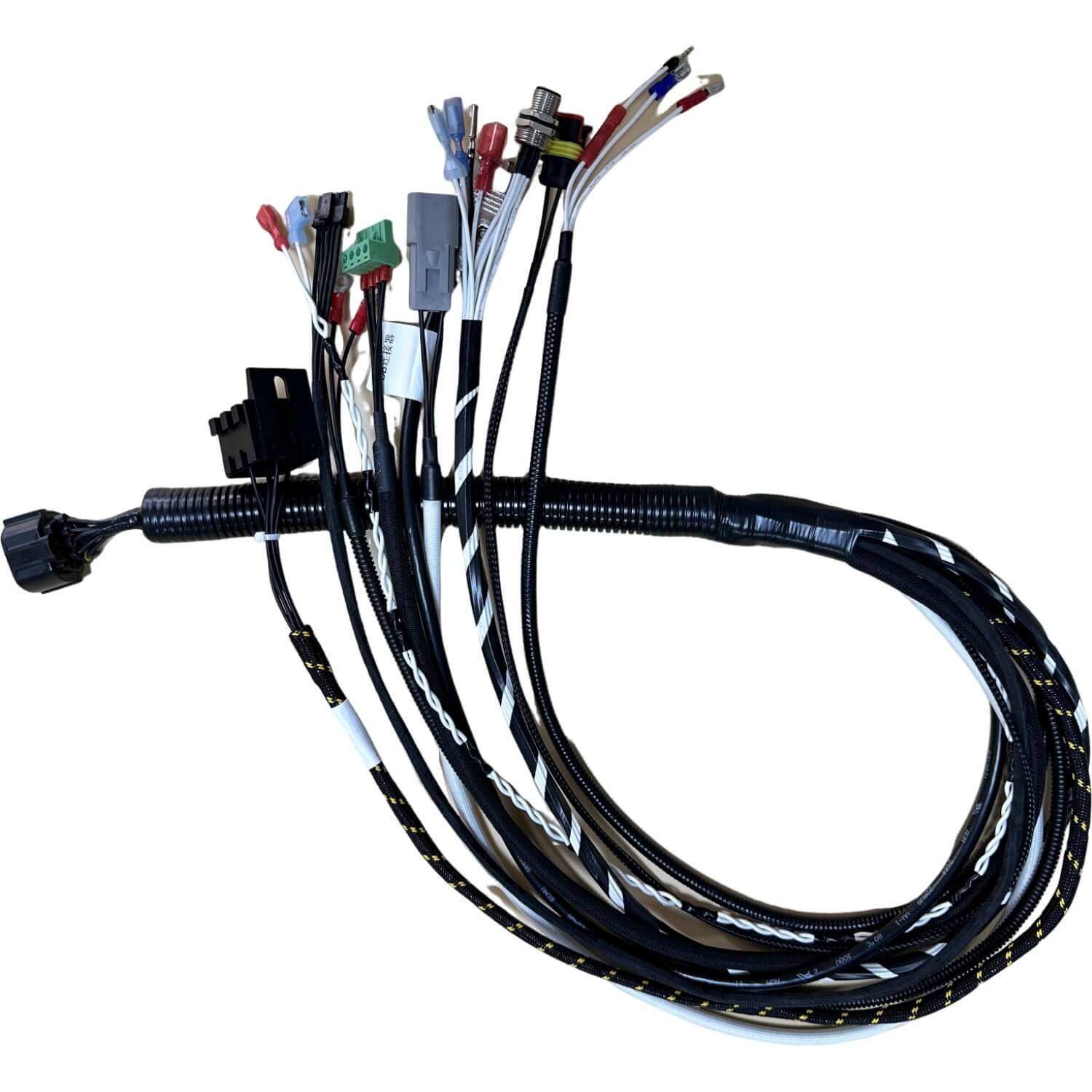
"Australian mining customers learned the IP rating lesson the hard way. We had a major dragline OEM specify IP65 connectors for cable assemblies mounted on the boom — technically correct for 'outdoor use.' Within six months, red dust had penetrated every unsealed mating face. They switched to Deutsch DTP with IP69K-rated sealing boots. The cost per connector went up by $8. The field failure rate dropped to zero. That is the economics of proper connector selection."
Industry-Specific Connector Recommendations
Different Australian industry sectors have distinct connector requirements driven by regulatory standards, environmental conditions, and reliability expectations. The following recommendations are based on our experience supplying cable assemblies to these sectors.
Mining & Heavy Equipment
Recommended Connectors
- • Deutsch DT/DTP — standard for mobile mining equipment
- • Amphenol ATHD — high-power (up to 100 A per pin)
- • TE Deutsch HD30/HDP20 — heavy-duty multi-pin
- • Souriau UTS — miniature sealed circular
Key Requirements
- • IP67 minimum, IP69K preferred for washdown zones
- • -40°C to +125°C temperature range
- • Vibration resistance per MIL-STD-810
- • UV-resistant housings (outdoor permanent installation)
Medical Devices
Recommended Connectors
- • LEMO B/K series — push-pull, autoclavable
- • Fischer MiniMax — high-density miniature
- • ODU MEDI-SNAP — plastic, sterilisable
- • Hirose DF-series — board-to-wire, compact
Key Requirements
- • Biocompatible housing materials (USP Class VI)
- • Autoclave resistance (134°C steam, 2 bar)
- • IEC 60601-1 creepage/clearance compliance
- • Touch-proof design for patient safety
Defence & Aerospace
Recommended Connectors
- • MIL-DTL-38999 Series III — tri-start bayonet, EMI shielded
- • MIL-DTL-5015 — legacy heavy-duty circular
- • MIL-DTL-83723 — miniature circular
- • Amphenol D38999 — AUKUS-qualified QPL sources
Key Requirements
- • QPL (Qualified Products List) sourcing mandatory
- • EMI/RFI shielding (360° shell-to-shell bonding)
- • MIL-STD-810 vibration, shock, salt spray testing
- • Full ITAR/DFARS compliance for AUKUS programs
Industrial Automation & Robotics
Recommended Connectors
- • M12 (A/B/D/X-coded) — sensors, industrial Ethernet
- • M8 — compact sensor connections
- • Han series (Harting) — heavy-duty rectangular
- • SPEEDCON (Phoenix Contact) — fast-locking M12
Key Requirements
- • IP67 minimum for plant floor installations
- • Cat5e/Cat6A Ethernet capability (X-coded M12)
- • 10+ million flex cycles for robotic drag chain cables
- • Colour-coded keying to prevent cross-connection
8 Common Connector Selection Mistakes
These are the mistakes we see most frequently in connector specifications from Australian OEMs and system integrators. Each one leads to either field failures, supply chain disruptions, or unnecessary cost.
1. Specifying IP rating without checking mated condition
Many IP67 connectors are only IP67 when fully mated with the correct cable clamp torqued to specification. Check the unmated rating and specify protective caps.
2. Using current rating at 25°C for high-temperature applications
A connector rated at 20 A at 25°C may only safely carry 12–14 A at 85°C. Always derate per the manufacturer's temperature curve.
3. No spare pins for future requirements
Adding one sensor or diagnostic signal to a fully populated connector means redesigning the entire cable assembly. Specify at least 15–20% spare pins.
4. Single-source connector with no cross-reference
Supply chain disruptions in 2021–2023 taught hard lessons. Always identify at least one cross-compatible alternative from a second manufacturer.
5. Gold contacts for permanent connections
Gold plating is designed for connectors that will be mated/unmated many times. For permanent installations (mated once and locked), tin-plated contacts at half the cost provide equal or better long-term reliability.
6. Ignoring cable-to-connector strain relief
The cable entry point is where most connector failures start. Without proper strain relief — backshell, cable clamp, or overmould — cable weight and vibration load transfer directly to solder cups or crimp barrels.
7. Mixing metric and imperial thread standards
An M12 connector will physically thread onto a 1/2" NPT panel hole but will never seal correctly. Verify thread specification on both connector and panel mount.
8. Not testing with the actual cable
The connector datasheet specifies a cable OD range. If your cable is at the edge of that range, the cable clamp or gland may not seal properly. Always prototype with the actual production cable.
"The three questions I ask every customer before recommending a connector: Where will it live? How hot will it get? And how often will someone disconnect it? Those three answers eliminate 80% of the options and point directly to the right connector family. Everything else — pin count, wire gauge, cost — is secondary to getting the environment, temperature, and service frequency right."
Quick Connector Decision Matrix
Use this decision matrix to rapidly narrow your connector options based on the primary application constraint. Start with your most restrictive requirement (usually environment or current) and follow the recommendation.
| If You Need... | Start With... | Key Brands |
|---|---|---|
| IP69K sealed, high vibration | Deutsch DT/DTP or Amphenol AT | TE Connectivity, Amphenol |
| MIL-spec, EMI shielded | MIL-DTL-38999 Series III | Amphenol, ITT Cannon, Souriau |
| Industrial Ethernet (IP67) | M12 X-coded (Cat6A) | Phoenix Contact, Binder, Harting |
| Compact sensor signals | M8 or M12 A-coded | Binder, Lumberg, Turck |
| Medical, autoclavable | LEMO B-series push-pull | LEMO, Fischer, ODU |
| High power (>60 A per pin) | Amphenol ATHD or Anderson SB | Amphenol, Anderson, Rema |
| Low-cost PCB-to-wire | Molex Micro-Fit, JST VH/XH | Molex, JST, TE |
| Heavy-duty panel interface | Harting Han series modular | Harting, Phoenix Contact, Weidmuller |
Connector Contact Plating: Tin vs Gold vs Silver
Contact plating determines how many mating cycles the connector can endure, its resistance to corrosion, and the contact resistance over time. Choosing the right plating is a direct cost-versus-reliability trade-off.
| Property | Tin (Sn) | Gold (Au) | Silver (Ag) |
|---|---|---|---|
| Mating cycles | 10–50 | 500–10,000 | 100–500 |
| Relative cost | 1× | 3–8× | 1.5–3× |
| Best for | Permanent connections, power | Signal, data, frequent mating | High current, RF, high-temp |
| Corrosion resistance | Moderate (oxide forms but is conductive) | Excellent (noble metal, no oxide) | Good (tarnishes but conductivity maintained) |
| Contact resistance | <5 mΩ (new) | <1 mΩ (stable over life) | <1 mΩ (new) |
| Max temperature | 150°C | 200°C | 250°C+ |
Critical Rule: Never Mix Tin and Gold Contacts
Mating a tin-plated pin with a gold-plated socket (or vice versa) causes rapid wear of the gold layer and accelerated corrosion at the dissimilar metal interface. Both mating halves must use the same contact plating. This is a frequently violated rule in field repairs where replacement contacts are sourced without checking plating compatibility.
Frequently Asked Questions
What is the most important factor when selecting a connector?
The operating environment is the most critical factor. A connector must survive the worst-case combination of temperature, moisture, vibration, dust, and chemical exposure. Start with IP rating and temperature range to narrow options, then evaluate current capacity, pin count, and mating cycles. Choosing a connector that barely meets environmental requirements is the leading cause of field failures.
What IP rating do I need for outdoor cable assemblies in Australia?
For general outdoor use, IP65 is the minimum. For mining and heavy industrial washdown, IP67 or IP68 is standard. Mining equipment exposed to high-pressure cleaning requires IP69K. Always specify the IP rating for the mated pair, not just the connector body — and specify protective caps for any unmated connector halves.
How do I calculate the current rating I need for a connector?
Start with maximum continuous circuit current, then apply a 20–30% derating factor. Check the manufacturer's datasheet for per-pin current at your operating temperature — current capacity drops as temperature rises. For multi-pin connectors carrying power and signal on the same housing, verify that adjacent pin heating doesn't cause cumulative derating beyond limits.
When should I use circular vs rectangular connectors?
Circular connectors are the better choice for harsh environments — their 360-degree sealing achieves higher IP ratings, and bayonet or threaded coupling resists vibration. Rectangular connectors win when you need high pin density in compact spaces, such as control panel interfaces or PCB-to-wire connections. For field-serviceable equipment exposed to dust, moisture, or vibration, circular connectors are almost always the right choice.
What is the difference between Deutsch DT, DTM, and DTP series?
DT connectors accept 14–20 AWG wire (13 A continuous per pin). DTM connectors are the miniature version for 20–24 AWG wire (7.5 A per pin). DTP connectors are the power version for 10–14 AWG wire (25 A per pin). All three share IP67 environmental sealing and are widely used in Australian mining and automotive applications.
How many mating cycles should I specify?
For permanent installations (connected once during assembly), 50–100 cycles is sufficient. For equipment serviced quarterly, specify 500+ cycles. For test fixtures or frequently swapped modules, specify 5,000–10,000+ cycles. Higher mating cycle ratings typically mean gold-plated contacts, which adds cost but ensures long-term contact reliability.
Sources & References
- IEC 60529: Degrees of Protection Provided by Enclosures (IP Code) — International Electrotechnical Commission
- Deutsch DT/DTM/DTP Connector Family Technical Overview — TE Connectivity
- IPC/WHMA-A-620E Requirements and Acceptance for Cable and Wire Harness Assemblies — IPC
- Pull-Force Testing Crimped Wires — Assembly Magazine
- Pull-Test Standards and Methods for Wire Terminal Connections — Mecmesin
Need Cable Assemblies with the Right Connectors?
Our engineering team helps you select the optimal connector for your application — from mining-grade Deutsch to medical-grade LEMO. Free DFM review and connector recommendation included with every quote.